
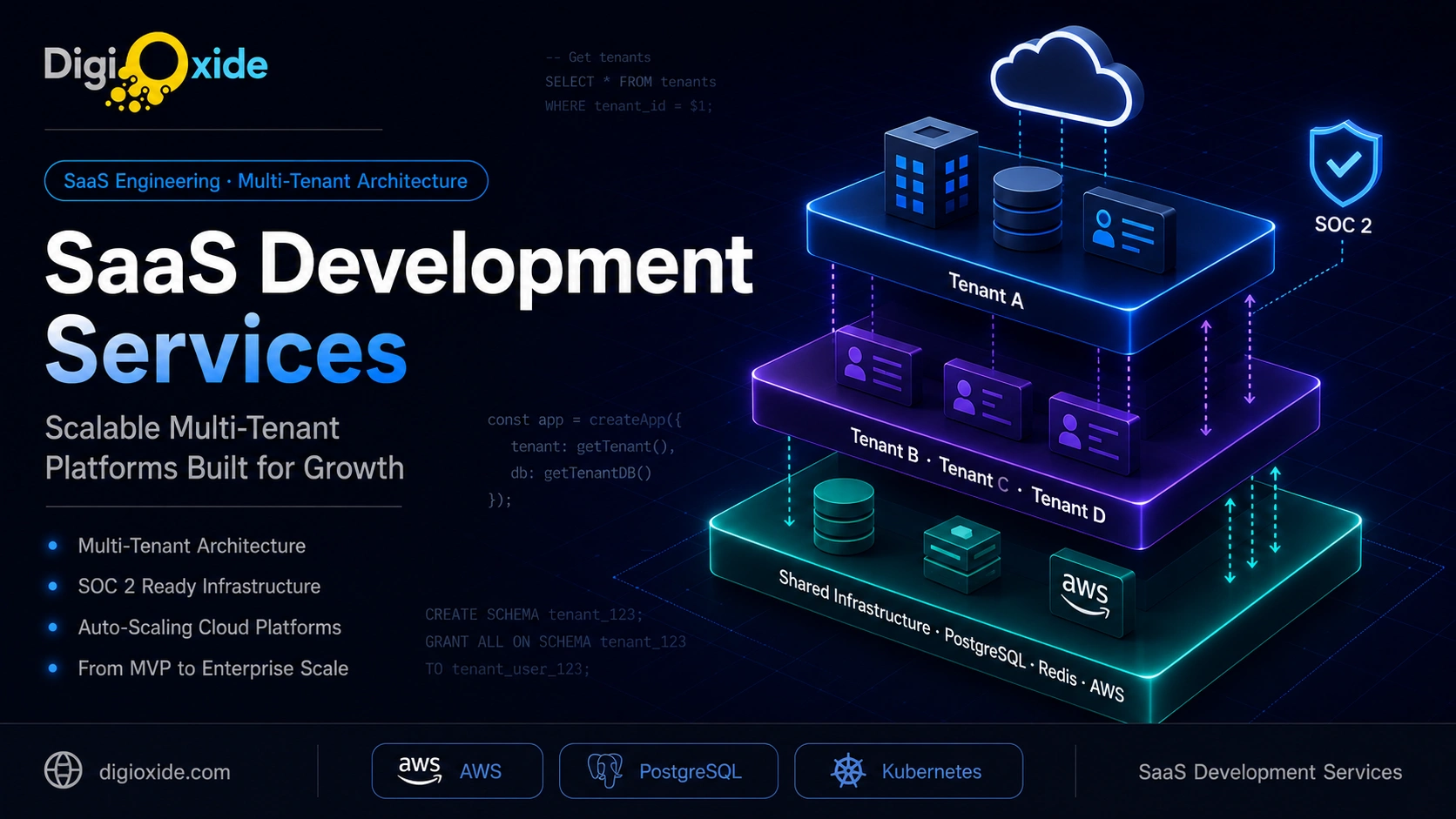
SaaS Development Services: Building Scalable Multi-Tenant Platforms

SaaS development services take a product from concept to a secure, scalable, multi-tenant cloud platform serving thousands of customers from one shared application. At Digioxide Technologies Private Limited, we have spent years helping product companies, enterprises, and funded startups architect SaaS platforms that scale cleanly from the first 50 tenants to 5,000 or more without a costly rewrite. The right architecture choice in the first two weeks of a project usually decides the unit economics for the next five years.
The three core multi-tenant architecture models are shared database with shared schema (lowest cost, weakest isolation), shared database with separate schemas (hybrid, moderate isolation), and separate database per tenant (highest isolation, highest cost). Most production SaaS platforms we build at Digioxide use a hybrid: a shared-schema base for the standard tier and a separate-database premium tier for enterprise and regulated customers. The hardest problems are operational discipline, not architecture diagrams: tenant-aware queries, per-tenant observability, automated provisioning, noisy neighbor protection, and an offboarding flow that satisfies GDPR and India’s DPDP Act. SaaS development costs range from USD 40,000 for a focused MVP to USD 900,000+ for an enterprise-grade platform.
If you are starting a SaaS product or scaling one that is straining under growth, talk to our team about what your architecture should look like. The conversation costs nothing and often saves months of rework.
What Are SaaS Development Services?
SaaS development services are specialist engineering services for designing, building, and scaling cloud software delivered over the internet on a subscription model. A complete engagement covers product strategy, multi-tenant architecture, cloud setup, security, billing wiring, observability, and continuous post-launch engineering, so the product is ready for paying customers and able to scale without a rewrite.
A serious SaaS development engagement is not just “build a web app on AWS.” At Digioxide, our SaaS development engagements typically include:
- Product discovery, feature prioritization, and pricing model design
- Tenant model definition (what a tenant is, how users map to tenants)
- Multi-tenant architecture and tenant isolation strategy
- Backend, frontend, and API engineering
- Cloud infrastructure on AWS, Azure, or Google Cloud
- Authentication, authorization, SSO, SCIM, and tenant-aware data access
- Subscription billing, metering, dunning, and revenue recognition
- DevOps, CI/CD, infrastructure-as-code, and feature flags
- Observability (logs, metrics, traces) with per-tenant filtering
- Compliance posture: SOC 2 Type II, ISO 27001, HIPAA, PCI DSS, GDPR, India’s DPDP Act
- Performance engineering, load testing, and scale planning
- Post-launch support, scaling, and ongoing product engineering
If you are early stage, a focused team can take you from validated idea to first paying customer in 12 to 20 weeks. Mature products need a different mix: more platform engineering, more security and compliance, less greenfield coding. The work shifts from “ship features” to “build infrastructure that lets features ship safely.”
Digioxide engages on both ends of that spectrum. We have built MVPs for funded founders racing to a product-market fit milestone, and we have stabilized mature SaaS platforms whose original architecture could no longer carry the load. The right engagement model depends on where you are, and we shape the team around that, not the other way around.
What Is a Multi-Tenant SaaS Platform?
A multi-tenant SaaS platform is a single running application instance that serves multiple independent customers (tenants) simultaneously, with each tenant’s data, users, and configurations logically isolated. From the customer’s perspective, the application should feel dedicated and secure. Behind the scenes, infrastructure is shared. This shared infrastructure model is what makes modern SaaS economically viable.
The classic analogy is a residential building. The building is the SaaS application. Each apartment is a tenant environment. Tenants share the building structure, plumbing, electricity, and security system, but each has a private, locked apartment that no other tenant can enter. Updates to the building benefit everyone instantly. The cost of maintaining the building is divided across all tenants.
Multi-tenancy is the model behind Slack, Notion, Shopify, Salesforce, HubSpot, Zendesk, GitHub, and the overwhelming majority of B2B and B2C SaaS. It is the default model in 2026 because the unit economics work: each new customer adds revenue without adding much marginal infrastructure cost, new customers can be provisioned in seconds rather than days, and product updates ship once to everyone instead of being deployed individually across hundreds of instances.
But multi-tenancy is not “shared hosting.” It is an intentional design pattern that touches every layer of the stack: API gateway, application logic, data access layer, caching, queues, background workers, search, analytics, and observability. Every layer has to be tenant-aware from day one. A SaaS product retrofitted from single-tenant to multi-tenant later is months of expensive engineering work that should have been done at the start. This is one of the most common reasons clients come to Digioxide for an architectural reset, and it is also the rework we work hardest to help new clients avoid.
Why Companies Build Multi-Tenant Instead of Single-Tenant
Consider the alternative: single-tenant architecture, where each customer gets a dedicated application instance, dedicated database, and dedicated infrastructure. The argument for single-tenant is straightforward: maximum data isolation, maximum customization per customer, and a clean answer to security questionnaires. The argument against it is also straightforward: it does not scale.
With 10 customers, single-tenant is manageable. With 100 customers, the operations team is full-time on patching and provisioning. With 1,000 customers, single-tenant is structurally impossible to operate, no matter how big the team is.
The trade-offs:
| Factor | Multi-Tenant | Single-Tenant |
|---|---|---|
| Cost per customer | Low (shared infrastructure) | High (dedicated infrastructure) |
| Time to provision a new customer | Seconds | Hours to days |
| Data isolation | Logical (via tenant_id, RLS, or schema) | Physical (separate database) |
| Customization per customer | Limited and configurable | High and deep |
| Compliance friction | Higher upfront design, lower ongoing | Lower upfront, repeated per tenant |
| Update deployment | Once, to everyone | Once per tenant, often manually |
| Operational overhead at scale | Lower per customer | Much higher per customer |
| Best-fit buyer | SMB, mid-market, most B2B | Regulated enterprise, defense, healthcare |
| Total cost of ownership | Up to 40% lower than equivalent single-tenant | Higher, scales linearly with customers |
For most modern B2B and B2C SaaS, multi-tenant is the right default. Single-tenant is the right choice only when a specific enterprise contract or compliance posture requires physical data isolation, and even then, the smart move is usually to offer single-tenant as a premium tier on top of a multi-tenant base.
The Three Multi-Tenant Architecture Models, Explained Properly
Choosing the right multi-tenant isolation model is the single most consequential architectural decision in any SaaS build. It determines cost, performance, security posture, operational complexity, and the kinds of customers you can credibly serve. At Digioxide, this is the first design conversation we have with a client, and the answer is never “the same for everyone.”
Model 1: Shared Database, Shared Schema
This is the simplest, cheapest, and most common starting point. All tenants live inside the same database, share the same tables, and every relevant row carries a tenant_id column. Every query must filter by tenant_id, either through application code, a repository layer that enforces it automatically, or database-level controls like PostgreSQL Row-Level Security (RLS).
The analogy: A large apartment building where everyone uses the same laundry room but each person has their own clearly marked hamper. Efficient, cheap, requires strict rules.
What’s compelling:
- Lowest infrastructure cost: one database to provision, monitor, back up, and tune
- Easiest schema migrations: one change applies to everyone instantly
- Easiest horizontal scaling: adding read replicas benefits every tenant at once
- Simplest operations: one set of dashboards, one set of alerts, one runbook
- Fastest time-to-market: most frameworks (Rails, Laravel, Django, Spring Boot, NestJS) assume this model
- Strong baseline efficiency: many small tenants can share resources well
What’s hard:
- A missing
WHERE tenant_id = Xclause is a data leak. A single forgotten filter in one query can expose one tenant’s data to another. This is the most common source of cross-tenant breaches we encounter in audit work. - Application-level enforcement requires discipline. RLS policies in Postgres help, but they have to be tested continuously, not just at setup.
- Susceptible to noisy neighbor effects. One tenant running a heavy query can saturate the database and slow down every other customer.
- Per-tenant operations are awkward. Restoring just one tenant from backup, or implementing per-tenant data residency, is significantly harder than in other models.
- Limited customization. Tenant-specific schema extensions are difficult; feature differentiation has to live in feature flags and configuration.
Who should use it: Early-stage SaaS products and MVPs, high-volume B2C and SMB B2B with thousands of similar tenants, products with a uniform data model. This is the model we recommend for most Digioxide clients starting fresh; it gets you from zero to scale fastest. Most products that will eventually evolve into hybrid architectures should start here.
Model 2: Shared Database, Separate Schemas
All tenants share the same database server, but each tenant gets their own schema. Queries no longer need a tenant_id row filter; instead, the application sets the schema search path based on the tenant context.
The analogy: A co-working space where everyone shares the building, the cafeteria, and the elevator, but each company has its own locked office suite.
What’s compelling:
- Stronger logical isolation than shared schema, since data is physically separated at the schema level
- Per-tenant backup and restore is operationally cleaner
- More flexibility for tenant-specific schema extensions
- Easier compliance reporting per tenant
- Better support for white-label or vertical SaaS
What’s hard:
- Schema migrations become a coordination problem. A single migration now has to run across N schemas. At 500 tenants, this can take hours and creates real risk. Migration tooling that handles parallel execution and resumable failures is essential, which is why Digioxide ships every Model 2 build with a custom migration runner built into the CI/CD pipeline.
- Connection pooling complexity. PostgreSQL has a practical ceiling before connection management becomes painful past a few thousand schemas.
- You still share the underlying database engine. Noisy neighbor persists at the CPU, memory, and I/O level.
- Operational tooling has to know about schemas.
Who should use it: Mid-market B2B SaaS with 100 to 2,000 tenants, products where tenants need meaningfully different data structures, vertical SaaS serving regulated SMBs.
Model 3: Separate Database per Tenant (Silo Model)
Each tenant gets a dedicated database instance, sometimes even a dedicated database cluster. Maximum isolation at the data tier. One tenant’s runaway query cannot affect another.
The analogy: Each tenant has their own separate building, with their own dedicated infrastructure.
What’s compelling:
- Strongest possible tenant isolation. Eliminates noisy neighbor entirely at the data tier.
- Non-negotiable for many regulated industries: HIPAA, PCI DSS, SOC 2 Type II, banking, defense, government
- Per-tenant performance tuning. A high-value enterprise tenant can get more memory, faster storage, or read replicas
- Backup, restore, and migration per tenant are trivial
- Geographic data residency is a configuration decision, not a re-architecture
- Compliance audits are dramatically cleaner
What’s hard:
- Infrastructure cost scales linearly with tenant count
- Automation is mandatory. Manual provisioning at any scale is impossible.
- Cross-tenant analytics require a separate data warehouse
- Slower feature rollouts if migration automation is not mature
- Cloud cost can spiral
Who should use it: Enterprise SaaS with high-value, low-volume customers, regulated industries, products with strict data residency requirements, and premium tiers within a hybrid architecture.
The Three Models, Side by Side
| Criterion | Shared DB, Shared Schema | Shared DB, Separate Schemas | Separate DB per Tenant |
|---|---|---|---|
| Tenant isolation | Application logic | Schema level | Physical database |
| Infrastructure cost | Lowest | Moderate | Highest |
| Operational complexity | Lowest | Moderate | Highest |
| Cross-tenant data leak risk | Highest (app logic) | Moderate | Lowest |
| Noisy neighbor risk | High | Moderate | None |
| Customization per tenant | Limited (config only) | Some (schema extensions) | High (DB-specific) |
| Per-tenant backup | Hard | Easy | Trivial |
| Schema migration speed | Fastest | Moderate (N times) | Slowest, but parallelizable |
| Data residency support | Hard | Hard | Trivial |
| Compliance posture | Weakest | Moderate | Strongest |
| Onboarding speed | Instant | Fast | Slower (provisioning) |
| Best fit | Startups, SMB, B2C | Mid-market B2B | Enterprise, regulated |
The Hybrid Model: What Most Mature SaaS Actually Uses
Most production SaaS platforms past Series A use a hybrid architecture. Standard-tier tenants share a database. Enterprise tenants who pay a premium and demand contractual data isolation get their own database. The hybrid model lets you serve the broad market efficiently while still winning enterprise deals that require dedicated infrastructure.
This is the most common architecture Digioxide ships in 2026. We build the shared-schema base first, ensure every query is tenant-aware, and design the path to a dedicated-database tier from day one, so when a client signs their first enterprise deal, moving that customer to dedicated infrastructure is a configuration decision, not a code rewrite.
The Noisy Neighbor Problem and Why It Will Find You
If we had to name the single most underestimated challenge in multi-tenant SaaS, it would be the noisy neighbor problem. It does not announce itself during development. It shows up in production, usually at the worst possible moment.
The noisy neighbor problem occurs when one tenant’s activities overload shared resources, whether CPU, database capacity, network bandwidth, or message queue capacity, and the performance for every other tenant on the same infrastructure degrades. Here is what it looks like in practice.
Tenant A, a large enterprise customer, runs a quarterly report aggregating three years of data across millions of rows. Their query saturates the database CPU. Meanwhile, Tenant B, a paying SMB doing nothing unusual, suddenly sees basic page loads time out. They file a support ticket. Your SLA is broken. You have no immediate fix because the problem is structural.
This pattern recurs constantly. A bulk import. A backfill job. A poorly indexed search. An AI feature that runs vector queries on every interaction. Each is a potential noisy neighbor. At Digioxide, every multi-tenant build we ship includes noisy-neighbor mitigation as a first-class design concern, not an afterthought.
How to Mitigate Noisy Neighbor Before It Finds You
- Per-tenant connection pooling. Use PgBouncer or a similar pooler with per-tenant pool limits.
- Query timeout enforcement at the application layer. Set aggressive statement timeouts per tenant tier.
- Dedicated worker queues for premium tenants. Do not let enterprise and free-tier tenants share the same background job queue.
- Rate limiting and quota enforcement. Every tenant has documented limits: API calls per minute, query budget per hour, storage caps, export size limits.
- Read replicas for analytics workloads. Route reporting and analytical queries to read replicas.
- Tenant-aware resource quotas in Kubernetes. If you run on K8s, use resource requests and limits per tenant context.
- Move heavy tenants to dedicated infrastructure. The hybrid model lets you graduate them without changing the application.
- Schedule heavy operations. For exports, imports, and analytics, encourage or enforce off-peak scheduling.
For any enterprise tenant with contractual performance SLAs, the only complete answer is dedicated infrastructure. Shared infrastructure cannot guarantee resource availability under adversarial workloads.
A 7-Step Roadmap to Build a Scalable Multi-Tenant SaaS Platform
Here is the sequence Digioxide follows on most SaaS engagements, refined over many client projects across SMB, mid-market, and enterprise tiers.
Step 1: Design the Core Architecture Layer
Resist the temptation to start with 30 microservices. For 99% of early-stage SaaS products, a well-architected modular monolith is the right starting point. Monoliths are simpler to develop, easier to deploy, faster to debug, and they comfortably handle millions of requests per day when designed properly.
The right starting architecture for most products:
- A modular monolith for the core application (one deployable unit, strict internal module boundaries)
- A managed PostgreSQL database (Amazon RDS, Google Cloud SQL, Azure Database for PostgreSQL)
- Redis for caching, sessions, and lightweight queues
- A managed object store (S3 or equivalent) for files
- Containerized deployment on Kubernetes (EKS, GKE, AKS) or a simpler PaaS to start
- A CI/CD pipeline that deploys on every merge to main
- Infrastructure-as-code from day one (Terraform or Pulumi)
This stack will take a SaaS product comfortably from zero to a few thousand tenants. Extract microservices later when you have concrete bottlenecks and a team mature enough to operate distributed systems. Digioxide engineers have shipped both monolith-first and microservices-first architectures, and the lesson we keep relearning is the same: ship the monolith well first, extract services later when the pain is specific and measurable.
Step 2: Choose the Right Tenant Isolation Model
Pick one of the three models (or the hybrid) as your default. Document the rule for when a customer moves to a stronger tier. Make this decision deliberately with product, sales, and security input. Sales will tell you what enterprise buyers ask for in their security questionnaires. Security will tell you what compliance posture you need. Product will tell you which tier you actually want to win.
Step 3: Build Tenant-Aware Authentication and Authorization
Most SaaS products use an organization-based authentication model. Each tenant is an organization. Users belong to one or more organizations. A single user may be an admin in Tenant A and a viewer in Tenant B. The tenant context for any given request is determined at sign-in, not inferred later.
Components:
- Identity provider. Auth0, Clerk, AWS Cognito, Azure Entra ID, or a self-hosted Keycloak.
- Token-based session. A JWT or session cookie carrying the user’s identity and current tenant context.
- Role-Based Access Control (RBAC). Roles like Admin, Editor, Viewer, scoped per tenant.
- Permission checks that always include tenant ID.
- Enterprise readiness. SSO via SAML 2.0 and OIDC, SCIM for user provisioning.
The most important principle: tenant context is established at the authentication layer and propagated through every downstream service call. Context that gets lost mid-stack is a data isolation failure waiting to happen.
Step 4: Design Data Isolation
Whichever isolation model you chose, implement it consistently:
- Every relevant table has a
tenant_idcolumn (shared-schema) or is in a tenant-scoped schema - Row-Level Security policies enforce tenant scoping at the database level
- A repository layer or ORM scope automatically applies the tenant filter
- Background jobs carry tenant context in their payload, not derived from environment or session
- Caches are tenant-scoped with tenant ID in the cache key
- Logs, metrics, and traces are tagged with
tenant_id - Per-tenant encryption keys via a KMS for regulated workloads
Step 5: Enable Scalability and Performance Tuning
Build scalability into both infrastructure and software from the start:
- Auto-scaling infrastructure (Kubernetes HPA, Auto Scaling Groups, serverless concurrency)
- Load balancing and tenant-aware routing for cache locality
- Caching strategy (Redis or Memcached for hot data, CDN for static assets)
- Database performance: index every column you filter on (especially
tenant_id), partition large tables, use read replicas - Asynchronous everything heavy (email, exports, webhooks, AI inference)
Continuously monitor application performance metrics broken down by tenant. This is how you spot a specific tenant’s experience degrading before they file a ticket.
Step 6: Add Observability and Governance for All Tenants
With your SaaS expanding to dozens or hundreds of tenants, observability becomes a survival requirement. Tag every metric, log, and trace with a tenant ID. Build dashboards filterable by tenant. “Is the app slow today?” should be answerable per tenant in under a minute.
Other practices Digioxide builds in by default: distributed tracing via OpenTelemetry, centralized logging, tenant analytics dashboards for internal teams, FinOps and chargeback tracking, and immutable audit trails attributing every action to a user and tenant.
Step 7: Pilot, Load Test, and Roll Out Incrementally
Validate the system with real customers before opening the floodgates. Onboard a handful of pilot tenants. Run realistic load tests with mixed tenant profiles. Roll out incrementally. Keep a documented rollback plan.
Adding AI to a SaaS Platform: The Architectural Shift
If AI features are on the roadmap (and in 2026, they almost always are), the architecture decisions you make at the start will dictate how much rework you have to do to get there. A SaaS platform built with AI in mind from day one has a structural advantage over one bolting AI on later.
A modern AI-powered SaaS needs different architecture decisions than a traditional CRUD app:
- A dedicated inference layer that scales independently from your application servers
- A vector database (pgvector inside Postgres, Pinecone, Weaviate, or Qdrant) for semantic search and RAG
- A prompt management system so prompts can be versioned, A/B tested, and improved without redeploying code
- Token-based usage metering that flows into your billing system, because AI workloads can be expensive per-request
- Per-tenant budget controls so one tenant cannot accidentally burn through your inference budget
- Audit trails for AI decisions, increasingly required by emerging regulation
- Streaming response support for chat and copilot patterns
- Caching strategies (semantic cache, prompt cache) to control cost
- Fallback patterns when an LLM provider has an outage
Digioxide’s AI-powered SaaS engagements have shipped semantic search, copilots, RAG systems, AI agents, and AI-driven recommendation engines into production multi-tenant platforms. The pattern that consistently works: plan the AI architecture into the foundation, even if the first version of the product only has one AI feature. The marginal cost of designing the foundation correctly is small. The cost of retrofitting it later is significant.
Security and Compliance: What Enterprise Buyers Actually Ask
Enterprise procurement teams send security questionnaires that run hundreds of questions long. The platform has to answer them with evidence, not promises. Building security and compliance posture late is three to five times more expensive than building it in.
The control framework that satisfies most enterprise buyers in 2026:
- Data isolation. Document your model and how a bad query cannot return another tenant’s data.
- Encryption. At rest (AES-256 minimum), in transit (TLS 1.2+, TLS 1.3 preferred). Rotate keys. Use a KMS.
- Access controls. RBAC, least privilege, just-in-time access for production. SSO and MFA required for the platform team.
- Audit logs. Every action attributable to a user and tenant, immutable, retained for compliance.
- Backups and recovery. Defined RPO and RTO, tested restores quarterly.
- Vulnerability management. Dependency scanning, container image scanning, regular penetration tests.
- Incident response. Documented runbook, on-call rotation, 24-hour notification policy.
- Compliance. SOC 2 Type II as baseline for B2B SaaS. HIPAA, PCI DSS, ISO 27001, GDPR, DPDP Act depending on buyers.
Digioxide’s compliance engagements typically run alongside core development. We have helped clients reach SOC 2 Type II readiness in 6 to 9 months, HIPAA-aware operating posture in similar timeframes, and ISO 27001 in 9 to 12 months. The investment pays for itself the first time it lets the client win an enterprise deal that would otherwise have been blocked at procurement.
IBM’s 2024 data breach report found the average cost of a multi-tenancy-related breach reached USD 4.4 million. The cost of building robust security upfront is a small fraction of one breach.
The Pitfalls That Cost Multi-Tenant SaaS the Most
After many SaaS builds, the failure patterns repeat. Here are the pitfalls Digioxide consistently helps clients avoid (and rescue from when they have already hit them).
Pitfall 1: Not automating tenant provisioning from day one
Manual setup is fine for 10 customers. At 100, it is a bottleneck. At 500, it is a liability. Build the automation before you need it.
Pitfall 2: Designing schema migrations for a single-tenant world
In multi-tenant with separate schemas or databases, a migration is a coordination problem. Build migration tooling that handles parallel execution and resumable failures before the volume makes it urgent.
Pitfall 3: Treating the audit trail as optional
Without an audit trail, when a customer says “this data disappeared,” you are guessing. Audit trails are also the evidence that satisfies SOC 2.
Pitfall 4: Hardcoding tenant limits in application code
Rate limits, storage quotas, API budgets belong in tenant configuration records in the database, not constants in your codebase.
Pitfall 5: Ignoring data residency from the start
GDPR, HIPAA, India’s DPDP Act, and a growing list of regional laws require data residency. Design tenant routing to support regional deployments from day one.
Pitfall 6: No tenant-level observability
When a customer reports “the app is slow,” support should be able to filter dashboards to that one tenant in under a minute.
Pitfall 7: Skimping on background job infrastructure
SaaS is full of async work. Use a mature job system with dead-letter queues, retry policies, and observability.
Pitfall 8: Treating one customer’s bug as the whole product’s bug
With feature flags, you can isolate a fix to the affected tenant and ship safely.
How Much Does SaaS Development Cost?
Realistic ranges from credible engineering teams in 2026:
- MVP (10 to 16 weeks). USD 40,000 to USD 120,000.
- Production-ready V1 (16 to 28 weeks). USD 120,000 to USD 350,000.
- Enterprise-tier platform with SOC 2 Type II readiness (28 to 52 weeks). USD 350,000 to USD 900,000+.
- Ongoing engineering after launch. 60% to 80% of build cost per year.
Cost drivers: integrations, regulated industries, mobile clients, multi-region deployment, AI features, white-label or vertical SaaS.
Digioxide structures engagements in three common shapes: fixed-scope MVP delivery for founders racing to product-market fit, dedicated team retainers for ongoing product engineering, and project-based architectural rescue for SaaS platforms that have outgrown their original design. Each engagement starts with a discovery week to map your specific situation, which we offer at no cost for serious projects.
Anyone quoting a flat USD 15,000 to USD 25,000 for a “scalable multi-tenant SaaS platform” is either misunderstanding the scope or planning to deliver something significantly less than the term implies. The hard work in SaaS is not the first 80%; it is the last 20% that takes the product from “demo” to “production-grade.”
When to Hire a SaaS Development Partner
A specialist partner is worth bringing in when one of these is true:
- You have product-market fit signals but not the in-house engineering bench to scale safely
- You are entering a regulated market and need SOC 2, HIPAA, or similar readiness without learning it from scratch
- Your current product was built fast and is breaking under load. You need an architecture reset without halting feature work.
- You are an internal IT or innovation team being asked to build a SaaS product, and your default stack is not optimized for multi-tenant cloud delivery
- You need senior engineers immediately and cannot wait six to nine months to hire them in-house
The right partner brings opinionated defaults, a delivery process built around SaaS specifically, and a track record of moving products from idea to production. They should know when to push back on the customer’s request, which is the single best signal of senior engineering judgment.
A focused team like Digioxide running a SaaS development engagement typically delivers more in 16 weeks than a fresh in-house team builds in 6 to 9 months, because the architectural and operational decisions are already made and battle-tested. We bring the playbook so your team can focus on the parts only you can do: customer development, pricing, positioning, and the business itself.
If you are considering an engagement, the right first conversation is a discovery call: 45 minutes, no commitment, where we map your current state and lay out the two or three architecture paths that fit. That conversation is the most leveraged hour you can spend at the start of a SaaS build, whether you end up working with us or not.
Frequently Asked Questions
What is multi-tenancy in SaaS?
Multi-tenancy is an architecture where a single instance of a SaaS application serves many customer accounts (tenants), with each customer’s data logically isolated. It is the dominant model for modern SaaS because it lowers cost per customer dramatically, lets new customers be provisioned in seconds, and ships product updates to everyone simultaneously. Multi-tenancy can lower total cost of ownership by up to 40% compared to single-tenant deployments.
How long does Digioxide take to build a multi-tenant SaaS platform?
A focused MVP takes 10 to 16 weeks with our team. A production-ready V1 with billing, SSO, basic compliance controls, and a meaningful feature set usually lands in 16 to 28 weeks. An enterprise-grade platform with full SOC 2 Type II readiness, hybrid architecture, and mobile clients takes 9 to 14 months. Timelines depend more on scope discipline and decision velocity than on team size, and we make scope conversations explicit at the start of every engagement.
Which is better, multi-tenant or single-tenant SaaS?
Multi-tenant is better for almost every B2B and B2C SaaS. Single-tenant is the right answer only when a specific enterprise buyer’s contract or compliance posture explicitly requires physical data isolation. The best pattern is usually a hybrid: a multi-tenant base with a single-tenant or dedicated-database premium tier.
What is the best database for multi-tenant SaaS?
PostgreSQL is the most common choice in 2026 because of its row-level security, strong JSON support, mature replication, and broad ecosystem. Digioxide ships most multi-tenant builds on Postgres. MySQL/MariaDB are also valid. For specific subsystems with high write throughput, teams sometimes add a NoSQL layer.
How do you scale a multi-tenant SaaS to thousands of customers?
Three habits do most of the work. First, design every query around tenant_id and enforce it through a repository layer plus database-level row security. Second, set per-tenant resource quotas. Third, invest in tenant-level observability. Add read replicas, caching, partitioning, and async job queues as load grows.
Can Digioxide migrate an existing single-tenant application to multi-tenant?
Yes, and we have done this for several clients. The migration usually means introducing tenant_id across the data model, adding tenant-aware authentication, refactoring background jobs, building tenant-aware caching, and executing a careful cutover plan that runs both architectures side by side. Budget 3 to 6 months for a real application. We can also build the new multi-tenant architecture in parallel with feature delivery on the existing system.
What is the noisy neighbor problem in multi-tenant SaaS?
The noisy neighbor problem is when one tenant’s heavy resource usage saturates shared infrastructure and degrades performance for every other tenant. Mitigations include per-tenant connection pools, query timeouts, dedicated worker queues, rate limits, read replicas for analytics, and moving heavy tenants to dedicated infrastructure. Digioxide bakes noisy-neighbor mitigation into every multi-tenant build from day one.
What is a white-label multi-tenant SaaS?
A white-label multi-tenant SaaS is a platform where each tenant can configure branding, custom domains, and UI themes so the application appears to be their own product. The architecture is still multi-tenant under the hood. The discipline is building configuration over customization: feature flags, theme configurations, tenant-scoped settings.
How much does it cost to add multi-tenancy to an existing SaaS product?
For a small product, USD 30,000 to USD 80,000 of focused engineering. For a mid-sized product with significant data, USD 80,000 to USD 250,000. For a complex enterprise codebase, USD 250,000+ and 4 to 9 months. We scope this precisely after a discovery week.
How do I start a SaaS development project with Digioxide?
The first step is a discovery call where we map your current state, your goals, and the architectural paths that fit. From there we typically run a paid discovery week to produce a delivery plan with milestones, costs, and risks, after which you decide whether to proceed. The discovery output is yours regardless. Get in touch through our contact page to set up the conversation.
