
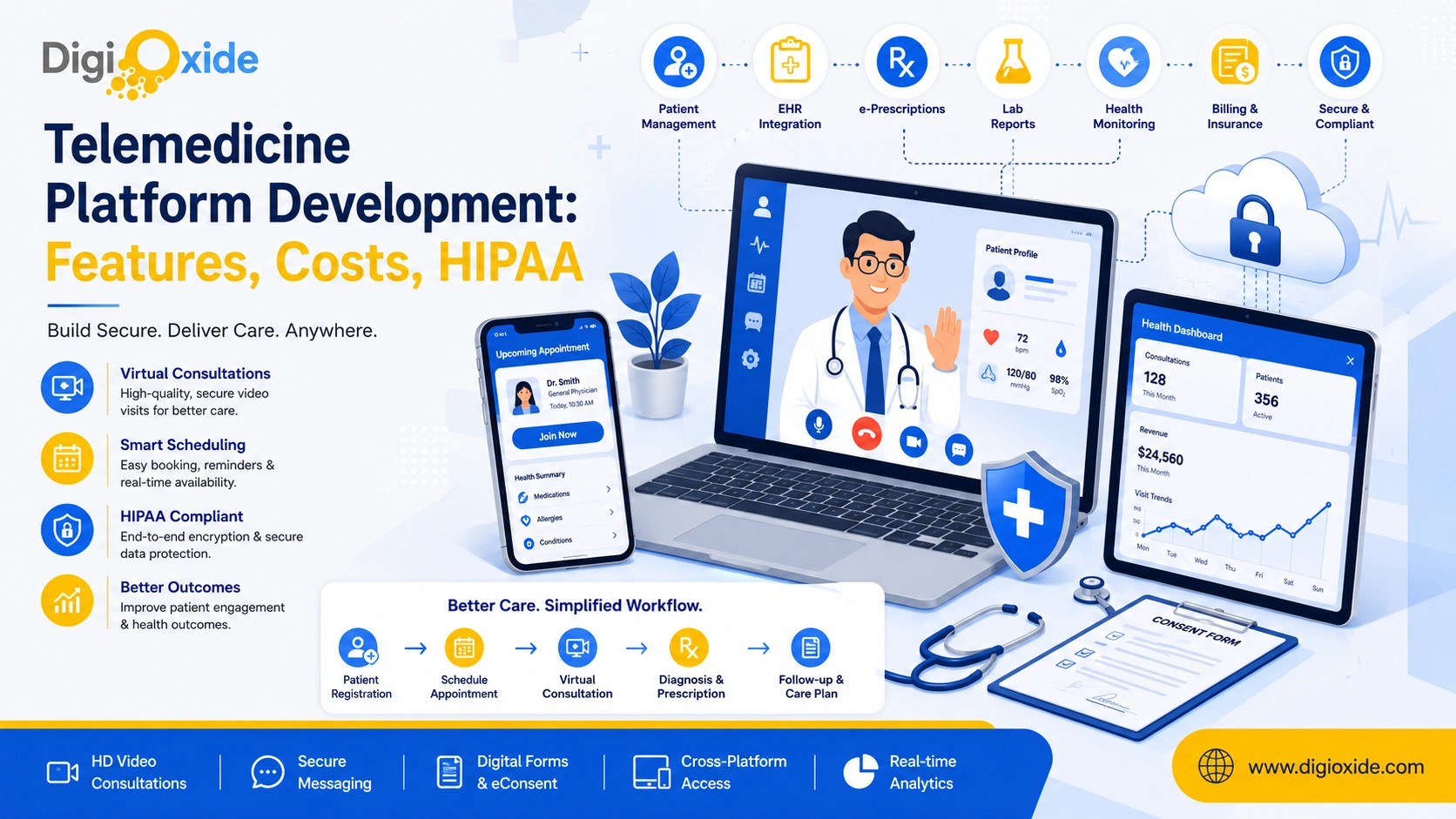
Telemedicine Platform Development: Features, Costs, and Compliance

Quick Summary: Virtual care is now permanent infrastructure in US healthcare, and the buyers of telemedicine platform development have changed: not just startups, but established practices and health systems that need virtual care built around their care model. This guide from Digioxide Technologies Private Limited covers the features a platform actually needs, the specific safeguards that make it HIPAA compliant, realistic 2026 cost and timeline numbers, where FDA oversight begins and ends, and a right-sized path for small practices deciding between white-label products and a custom build.
The question about telemedicine stopped being “will patients accept it” years ago. Patients accepted it, kept it, and now expect it, especially in behavioral health, follow-up care, chronic condition management, and any specialty where driving 40 minutes for a 15-minute conversation never made sense. The question in 2026 is different: whose software will your virtual care run on, and does that software fit how you actually deliver care?
That question has three common answers. Consumer video tools, which are a compliance liability now that pandemic-era enforcement flexibility has ended. White-label telehealth products, which launch fast but cap your differentiation, margins, and data ownership. And custom telemedicine platform development, which costs more up front and returns a platform shaped around your clinical model, your integrations, and your growth plans. Digioxide Technologies Private Limited builds that third option for US providers and digital health companies, and this guide lays out everything a decision-maker needs to evaluate it honestly.
Virtual Care Is Now Permanent Infrastructure
Three forces settled the argument. First, reimbursement for remote care delivery has normalized across payers to a degree that makes hybrid care an operating model rather than an experiment, with virtual visits woven into follow-up protocols, chronic care programs, and behavioral health at scale. Second, the economics work for providers: virtual slots fill schedule gaps, reduce no-shows, and extend specialist capacity across geographies without adding exam rooms. Third, patient expectations locked in. A practice with no virtual option now reads the way a practice with no online scheduling read five years ago.
The result is a market where telehealth is no longer a separate product category. It is a layer of care delivery, and the organizations getting the most from it are the ones whose platforms integrate with scheduling, records, prescribing, and billing instead of floating beside them.
The Three Users Your Platform Must Serve
Telemedicine software fails most often because it was designed for only one of its three audiences. A durable virtual care platform serves all of them:
- Patients need to join a visit in seconds from any device, without downloads, account gymnastics, or technical anxiety. Every extra step before the video connects costs you completed visits.
- Providers need the clinical context in front of them, documentation that lands in the chart, prescribing without app-switching, and a schedule that respects the difference between virtual and in-person workflow.
- Administrators need visibility: utilization, wait times, completion rates, billing status, and the operational levers to fix what those numbers reveal.
Hold every feature decision against all three, and most scope debates resolve themselves.
Core Features Every Telemedicine Platform Needs
Eight feature groups define a serious platform. The first five belong in almost every launch; the rest phase in with scale.
1. Video Consultations Built for Clinical Use
Consumer-grade video is not clinical-grade video. Purpose-built video consultation software adapts quality to weak connections instead of dropping the call, supports virtual waiting rooms with arrival notifications, allows multi-party sessions for interpreters, caregivers, and supervising physicians, and gives providers controls for screen sharing and image capture where clinically appropriate. Recording, if enabled at all, must be a deliberate, consented, securely stored event rather than a default. Reliability is a clinical feature here: a dropped call in a behavioral health session is not an inconvenience, it is a care failure.
2. Scheduling Designed for Virtual Care
Patient scheduling for telehealth has quirks that in-person scheduling engines handle badly: time zone handling for patients and providers in different states, licensing logic that only offers providers licensed where the patient is located, distinct visit types and durations for virtual care, buffer rules between video sessions, and support for both scheduled visits and on-demand queues. Self-scheduling with automated reminders that include the join link, not just the time, measurably lifts completion rates.
3. Digital Intake, Consent, and Identity Verification
Virtual visits need virtual paperwork: registration, insurance capture with eligibility checks, condition-specific questionnaires, and telehealth-specific informed consent captured and stored in a way that satisfies state requirements. Identity verification matters more in virtual care than in person, both for clinical safety and for prescribing workflows, so plan for it at intake rather than retrofitting it later.
4. Secure Messaging and Asynchronous Care
Not every clinical interaction needs live video. Secure two-way messaging, photo submission for dermatology and wound care, structured follow-up check-ins, and store-and-forward workflows extend the platform’s value between visits and let providers work asynchronously at the top of their license. The compliance requirement is absolute: all of it encrypted, access-controlled, and audit-logged, with no protected health information leaking into push notifications or email previews.
5. E-Prescribing Integration
Prescribing inside the visit workflow, with pharmacy routing, formulary and benefit checks, and medication history, is the feature providers ask about first. E-prescribing integration is delivered through certified e-prescribing networks and vendors rather than built from scratch, which makes vendor selection, certification requirements, and integration scope a discovery-phase task. If controlled substances are part of your clinical model, plan for the stricter identity-proofing and two-factor requirements that electronic prescribing of controlled substances carries, and design the workflow to adapt, because federal rules for prescribing controlled substances via telehealth have been extended and revised repeatedly and remain in transition.
6. Documentation and EHR Connectivity
A telemedicine platform that leaves visit documentation stranded outside your electronic health records creates the double-documentation problem that burns providers out. Notes, visit summaries, and relevant structured data should flow to the chart through FHIR APIs or HL7 interfaces, and patient context should flow into the visit so providers are not flying blind. For organizations with certified EHR systems, clean connectivity also keeps you on the right side of information sharing expectations. Integration depth varies by EHR vendor, so the specific interfaces get named in writing during discovery, never assumed.
7. Billing, Eligibility, and Payments
Virtual care has its own billing texture: eligibility verification before the visit, correct coding support for telehealth encounters, patient payments and copay collection in the booking flow, receipts, and clean handoffs to your billing system or clearinghouse. For cash-pay and subscription models, the platform needs recurring billing and plan management built in. Revenue leakage in telehealth is usually a workflow gap, not a payer problem, and the platform is where you close it.
8. Admin Console and Analytics
The operational brain: provider and schedule management, license-state configuration, visit monitoring, wait time and completion dashboards, no-show and technical-failure tracking, and audit and access reporting for compliance reviews. Platforms without a real admin layer force every operational change through a developer, which is how running costs quietly climb.
What Features Does a Telemedicine Platform Need to Be HIPAA Compliant?
HIPAA compliance in telehealth is not a certificate you buy. It is a set of technical and administrative safeguards engineered into the platform and maintained in operation. This is the checklist we build against, and the one to hold any vendor against:
- Encrypted video sessions: HIPAA compliant video calls are encrypted in transit end to end, with session access controlled through unique, authenticated links, and no session content stored unless explicitly designed, consented, and encrypted at rest.
- Encryption everywhere else: All PHI encrypted at rest and in transit: messages, files, recordings, intake data, and backups, with managed keys.
- Access control and unique identities: Role-based permissions, unique user IDs for every provider and staff member, multi-factor authentication for clinical and admin accounts, and automatic session timeouts.
- Complete audit trails: Every access to patient information logged with who, what, and when, retained and reviewable, because an unprovable control is a failed control in an investigation.
- Business associate agreements down the whole chain: Your platform partner signs a BAA, and so does every subprocessor that touches PHI: the video infrastructure provider, cloud host, messaging services, and analytics vendors. A platform is only as compliant as its least compliant component.
- No PHI in the wrong places: Push notifications, calendar invites, emails, and SMS reminders written so they never expose diagnoses, visit reasons, or clinical details.
- Hardened infrastructure: HIPAA-eligible cloud hosting configured correctly: network segmentation, logging, backup, and disaster recovery, with configuration documented for audit.
- Breach readiness: Monitoring, an incident response plan, and the documentation to meet breach notification obligations on the clock if the worst happens.
Two more points worth stating plainly. The pandemic-era enforcement discretion that tolerated everyday consumer video tools ended, and regulators now expect purpose-built, BAA-covered platforms. And the proposed update to the HIPAA Security Rule signals that controls like multi-factor authentication and encryption are heading from best practice to explicit mandate, so building to that standard now is cheaper than remediating later. This is the baseline for HIPAA compliant telehealth platform development, and at Digioxide it is architecture, not an add-on.
Build vs. White-Label vs. Consumer Tools
| Factor | Consumer video tools | White-label telehealth product | Custom telemedicine platform |
|---|---|---|---|
| HIPAA posture | Inadequate; enforcement flexibility has ended | Vendor-managed; verify BAAs and audit access | Engineered to your compliance requirements, documented |
| Time to launch | Immediate | 2 to 8 weeks | 4 to 6 months for an MVP |
| Upfront cost | Minimal | Low setup, ongoing per-provider or per-visit fees | $80,000 and up |
| Differentiation | None | Same product your competitors can license | Your workflows, your brand, your roadmap |
| Data ownership and analytics | Poor | Limited to vendor exports and dashboards | Full ownership, built to your metrics |
| Integrations | None meaningful | Fixed menu, often with added fees | EHR, e-prescribing, billing, devices as scoped |
| Long-run economics | Not viable | Fees scale with volume forever | Investment amortizes; margins improve with scale |
White-label is a legitimate way to test demand quickly. Custom is how you build an asset. The mistake is staying on white-label economics after your volume has outgrown them, and we will show you where that crossover sits for your numbers.
How Much Does a Telemedicine Platform Cost to Build?
Here is the direct answer to how much does a telemedicine platform cost to build, in 2026 US-market planning ranges:
| Scope | Typical investment | Typical timeline | What it includes |
|---|---|---|---|
| Telehealth MVP | $80,000 to $180,000 | 4 to 6 months | Clinical-grade video, scheduling, intake and consent, secure messaging, payments, core admin |
| Full platform | $180,000 to $350,000 | 6 to 10 months | Everything above plus e-prescribing integration, EHR connectivity, multi-state logic, analytics |
| Enterprise or multi-tenant virtual care platform | $350,000 to $700,000 and up | 10 to 18 months | Multi-organization architecture, SSO, advanced compliance controls, device data, white-label capability |
What moves the number most:
- Video infrastructure strategy: Building on proven, HIPAA-capable video components is faster and safer than raw video engineering; the tradeoff is usage-based fees that scale with visit volume, which belongs in your operating model from day one.
- Integration count: E-prescribing, EHR connectivity, payments, eligibility, and identity verification each add engineering, testing, and often vendor fees.
- Native apps versus web: A responsive web platform serves most launches; native iOS and Android telemedicine app development adds cost and app store release cycles, and earns it when notifications, device features, or daily engagement matter.
- Compliance depth: HIPAA safeguards are the baseline; SOC 2 alignment for B2B sales adds audit and documentation work.
- AI features: Intake triage, ambient visit documentation, and smart routing add real value and real data engineering scope.
Hidden costs to plan for: video usage fees that grow with volume, e-prescribing network and certification fees, app store maintenance cycles for native apps, penetration testing, and HIPAA-eligible cloud hosting as a monthly operational line.
Ongoing costs: budget 15 to 20 percent of the build annually for maintenance, security patching, and compliance updates.
The delivery-model lever: US onshore rates of $120 to $200 per hour versus experienced offshore healthcare teams at $25 to $50 per hour mean a well-run blended model delivers the same scope for 40 to 60 percent less. That is the Digioxide Technologies Private Limited model: senior engineers, US-business-hours overlap, and fixed-scope pricing after discovery.
How Long Does It Take to Build a Telehealth Platform?
For a focused MVP, plan on four to six months of calendar time. Here is how the work actually distributes, keeping in mind that phases overlap in a well-run project:
| Phase | Duration | What happens |
|---|---|---|
| Discovery and compliance planning | 2 to 4 weeks | Care model mapping, feature scope, integration and vendor selection, compliance architecture, fixed proposal |
| UX and clinical design | 3 to 5 weeks | Patient, provider, and admin flows prototyped and tested with real users |
| Core development | 12 to 18 weeks | Video, scheduling, intake, messaging, payments, admin, built in reviewable two-week sprints |
| Security hardening and testing | 3 to 5 weeks | Penetration testing, access control and audit verification, load testing, integration testing |
| Launch preparation | 1 to 2 weeks | Pilot cohort, training, monitoring, go-live |
A full platform with e-prescribing and EHR connectivity runs six to ten months, and enterprise builds longer. Three things stretch timelines more than anything else: EHR write-back approvals and vendor review queues, controlled-substance prescribing workflows with their identity-proofing requirements, and multi-state licensing logic. All three are manageable, but only if they are named in week one instead of discovered in month four. A partner who quotes a dramatically shorter timeline for the same scope is not faster; they are skipping the hardening that keeps you out of the incident-response business.
Technology Stack and Team: What Actually Matters
Buyers get shown long technology lists that all look interchangeable. Only a few stack decisions genuinely change outcomes:
- The video layer: WebRTC is the foundation of browser-based clinical video; the real decision is whether to build directly on it or on managed, HIPAA-capable video infrastructure covered by a BAA. For most builds, managed infrastructure wins on time-to-launch and reliability, with usage-based fees as the accepted tradeoff.
- Web-first application frameworks: A responsive web application serves patients with zero downloads, and modern cross-platform frameworks make later native apps economical if engagement patterns justify them.
- Cloud and data architecture: HIPAA-eligible cloud services with encryption, managed backups, and audit logging enabled by configuration, plus a data model designed around FHIR resources from the start, so every future integration gets cheaper instead of harder.
- Interoperability tooling: FHIR API handling and HL7 interface processing as first-class platform components rather than afterthoughts bolted on for one integration.
The team matters more than the logos: a healthcare-experienced architect, engineers who have shipped HIPAA workloads before, a QA lead who tests audit trails as seriously as features, and a project lead who translates fluently between your clinicians and the build. That is the standing composition of a Digioxide telehealth team, and it is the difference between a stack that demos well and a stack that survives an audit.
Do Telemedicine Apps Need FDA Approval?
Most do not, and knowing exactly where the line sits saves both fear-driven overengineering and dangerous underengineering.
Outside FDA oversight: platforms that provide communication, scheduling, intake, documentation, billing, and general administrative workflow. Video visits, secure messaging, and record exchange are practice-of-medicine infrastructure, not medical devices. The same is true of general wellness features that promote healthy habits without diagnostic or treatment claims.
Where FDA territory begins: software functions that diagnose, treat, or drive clinical decisions can qualify as a medical device, sometimes called software as a medical device. Examples include algorithms that analyze images or sensor data to detect a condition, tools that produce a diagnosis or risk score a clinician is expected to act on without independent review, and certain clinical decision support that does not let the provider independently evaluate the basis for its recommendations.
The practical playbook: define your intended use and marketing claims in writing before development, because claims are what regulators evaluate; keep decision support transparent and advisory where you want to stay outside device territory; and if a diagnostic or AI-driven clinical feature is central to your product, get regulatory guidance early and budget for the pathway rather than discovering it after launch. We flag these boundaries during discovery as a matter of course, and we design roadmaps so regulated features can be added deliberately later without rearchitecting the platform.
Compliance Beyond HIPAA
HIPAA is the floor, not the ceiling. A telemedicine platform operating across the US also has to respect:
- State telehealth rules: Consent requirements, permitted modalities, and standards for establishing a provider-patient relationship vary by state, and the platform’s intake and consent flows must flex to match where the patient sits.
- Licensure geography: Providers generally must be licensed where the patient is located at the time of the visit. Interstate licensure compacts ease this for many clinicians, but the platform still needs the state-matching logic that prevents an out-of-scope visit from ever being booked.
- Controlled-substance prescribing rules: Federal requirements for prescribing controlled substances via telehealth have been in flux for years, with temporary flexibilities repeatedly extended and new frameworks proposed. Build prescribing workflows that can tighten or loosen by policy change, not by rewrite.
- State privacy laws: A growing set of state consumer health data laws imposes obligations beyond HIPAA, especially relevant for direct-to-consumer and wellness-adjacent products.
- SOC 2 for B2B credibility: If you sell your platform to employers, payers, or health systems, a SOC 2 report is increasingly the entry fee to procurement.
None of this should scare a well-advised buyer. All of it should disqualify a development partner who has never heard of it.
Telemedicine Platform Development for Small Practices
Small and mid-size practices ask a fair question: is custom telemedicine platform development for small practices realistic, or is white-label the only sane option? The honest answer is a sequence, not a binary.
Start where the economics are obvious: If you are testing whether virtual care fits your patient base at all, a white-label product is a reasonable first step. Watch two numbers as you grow: the per-provider or per-visit fees you pay, and the workflow gaps your staff papers over. When fees pass roughly $30,000 to $50,000 a year, or when the workarounds start costing real staff time, the crossover to owning your platform has arrived.
Take the hybrid path when you build: A custom platform does not mean custom everything. The smart architecture pairs proven, HIPAA-capable video infrastructure with a custom layer for what actually differentiates you: your scheduling logic, intake flows, care programs, branding, and integrations. You get ownership and fit without paying to reinvent video engineering. Scoped this way, a small-practice build starts near the bottom of the MVP range rather than the top, and our MVP development and rapid prototyping practice exists precisely to scope that lean first version around measurable outcomes.
Phase the rest: E-prescribing, EHR write-back, and native apps can each be added when volume justifies them. A platform that launches focused and grows deliberately beats one that launches enormous and late.
And sometimes, do not build yet: A two-provider practice doing a handful of virtual visits a week is usually better served by a compliant white-label product for now. We say that in discovery when it is true, because a platform you did not need is not a project we want on our record.
The KPIs That Prove Your Platform Works
Instrument these from day one and review them monthly, because virtual care programs rarely fail loudly; they fail as a slow drift in numbers nobody was watching:
- Visit completion rate, the share of scheduled virtual visits that actually happen, with the technical-failure slice broken out separately
- Time to connect, measured from tapping the link to live video, because every added second and step costs completed visits
- No-show rate versus your in-person baseline, one of telehealth’s most reliable wins when reminders and join links are engineered well
- Provider documentation time per visit, the number that reveals whether EHR connectivity is genuinely working or quietly double-charting
- Virtual slot utilization and on-demand queue wait times, the operational levers for capacity planning
- Revenue per virtual visit and clean-claim rate, the two numbers that end any remaining boardroom skepticism
A custom platform earns its cost when these metrics are visible without asking a developer, which is why the analytics layer is a launch feature, not a phase-three wish.
How Digioxide Technologies Private Limited Builds Virtual Care
Telehealth software development is unforgiving of generalists, because the failure modes are clinical and regulatory, not just technical. Here is what our clients get:
- Compliance engineered in: HIPAA safeguards, audit logging, and BAA-covered vendor chains designed at the architecture stage, with documentation your compliance officer can hand to an auditor.
- A full product team: Discovery, UI/UX for patients and clinicians, web engineering, native mobile app development for iOS and Android when the model calls for it, QA, and long-term support under one roof.
- Integration experience: E-prescribing networks, EHR connectivity over FHIR and HL7, payment and eligibility services, and device data feeds, scoped in writing with the interfaces named.
- AI where it earns its place: Intake triage, ambient documentation support, and smart scheduling through our AI and machine learning solutions team, built on your data with governance controls rather than bolted on as a demo.
- Economics that widen your runway: Senior engineering at offshore rates with US-business-hours communication, typically 40 to 60 percent below onshore totals, delivered fixed-scope after discovery.
- A partner’s incentives: We build platforms we expect to support for years, which changes every decision made in month one.
Whether you are a practice adding a virtual care platform to an established operation or a founder building a telehealth product for market, the evaluation is the same: fit, compliance, integrations, and a partner who has done it before.
Frequently Asked Questions
What features does a telemedicine platform need to be HIPAA compliant?
Encrypted video sessions and encrypted storage for all PHI, role-based access control with unique user identities and multi-factor authentication, automatic session timeouts, complete audit trails, business associate agreements with the platform partner and every subprocessor including the video infrastructure vendor, notifications engineered to exclude PHI, HIPAA-eligible hosting configured and documented, and a tested breach response plan. Compliance is the sum of these safeguards maintained over time, not a badge on a website.
How much does a telemedicine platform cost to build?
A telehealth MVP with clinical-grade video, scheduling, intake, messaging, and payments typically runs $80,000 to $180,000. A full platform with e-prescribing and EHR integration runs $180,000 to $350,000, and enterprise or multi-tenant builds range from $350,000 to $700,000 or more. Add 15 to 20 percent annually for maintenance and compliance updates, and expect blended offshore delivery to reduce totals by 40 to 60 percent versus onshore-only rates.
How long does it take to build a telehealth platform?
Four to six months for a focused MVP, six to ten months for a full platform with e-prescribing and EHR connectivity, and 10 to 18 months for enterprise builds. EHR vendor review queues, controlled-substance prescribing requirements, and multi-state licensing logic are the three factors that stretch timelines, which is why they are scoped in week one.
Do telemedicine apps need FDA approval?
Usually not. Platforms limited to communication, scheduling, documentation, and administration are not medical devices. FDA oversight can apply when software diagnoses, treats, or drives clinical decisions, such as algorithms that analyze images or sensor data or decision support a clinician cannot independently evaluate. Define intended use and claims early, and get regulatory guidance before building diagnostic features.
Can a telemedicine platform integrate with our EHR and e-prescribing systems?
Yes. EHR connectivity runs through FHIR APIs and HL7 interfaces, with depth varying by vendor, and e-prescribing integrates through certified networks with their own certification requirements. Both are discovery-phase items: the specific interfaces, vendor fees, and write-back permissions get confirmed and documented before development begins.
Is HIPAA compliant telehealth platform development more expensive than a standard app build?
Yes, moderately, and it is the cost of being in this business. Compliance engineering, audit logging, hardened infrastructure, and security testing typically add a modest share to the build compared with an unregulated consumer app. Retrofitting compliance after launch costs a multiple of that, and a reportable incident costs more than any build. Budget for it once, at the start.
Should we launch on the web or build native mobile apps first?
For most providers, a responsive web platform is the right launch: patients join visits without downloads, and you avoid app store cycles. Native telemedicine app development earns its cost when your model depends on push notifications, device integrations, or daily patient engagement, and it phases in cleanly on a well-architected platform.
Build the Platform Around the Care Model
The telehealth platforms that succeed are boring in the best way: patients connect instantly, providers document once, prescriptions route correctly, the schedule fills, and the compliance file is ready before anyone asks for it. That outcome is not bought off a shelf. It is engineered around your care model by a team that has done it before.
If virtual care is on your 2026 roadmap, whether as a practice extending its front door or a company building a product, start with a structured discovery conversation. Digioxide Technologies Private Limited will map your care model, name the integrations and compliance requirements in writing, and give you a fixed-scope proposal with numbers you can defend. Contact our team to schedule it.
