
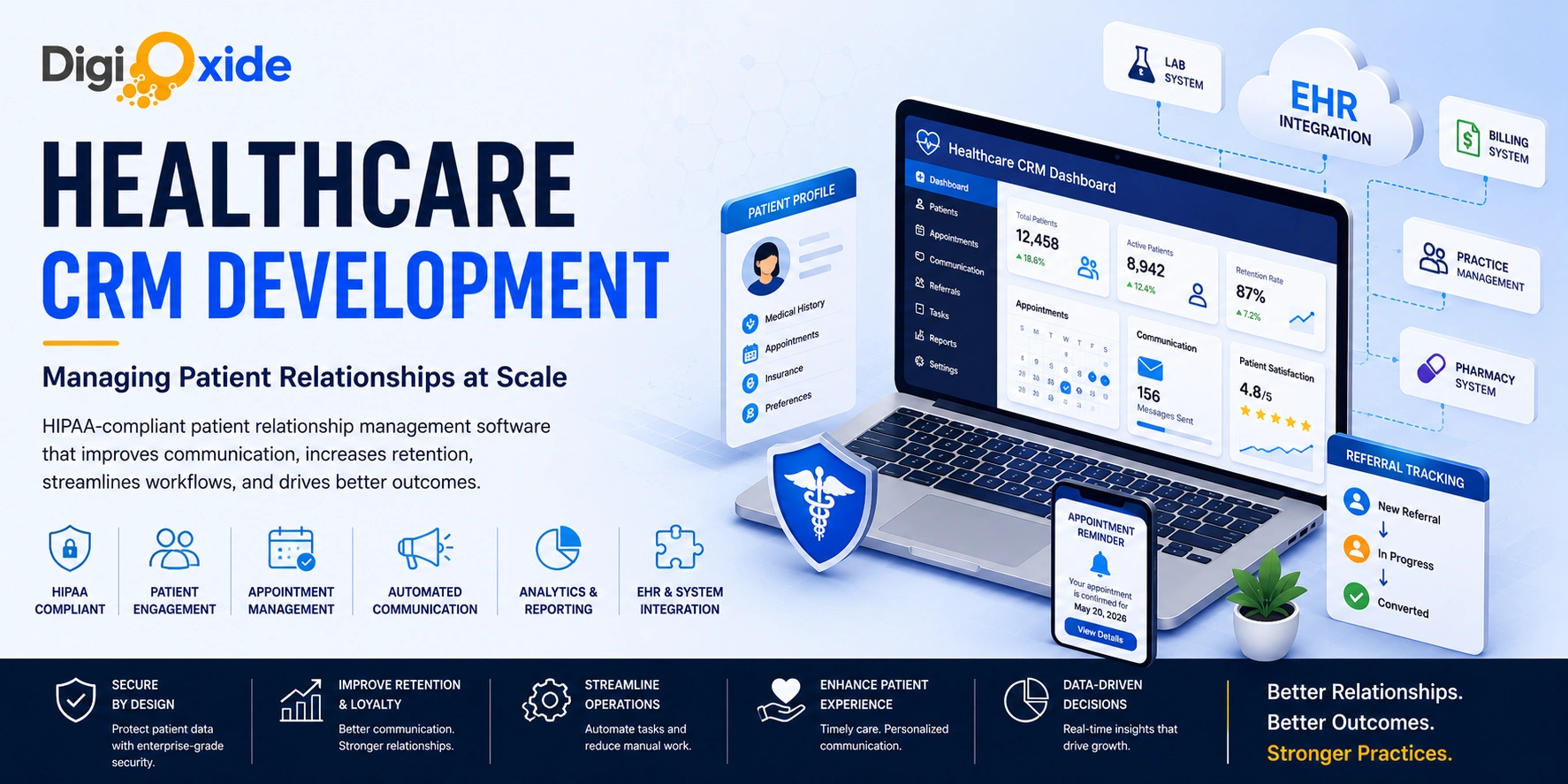
Healthcare CRM Development: Managing Patient Relationships at Scale

A healthcare CRM is not a sales tool with the word “patient” swapped in. It is patient relationship management software designed for the reality of clinical operations: HIPAA-covered data, EHR integration, appointment and communication workflows, referral tracking, and retention metrics that a generic CRM cannot measure or protect. This guide from Digioxide Technologies Private Limited explains what healthcare CRM development actually delivers, whether a regular CRM can be made HIPAA compliant, what a purpose-built patient relationship management platform does differently, and what a custom build costs for multi-provider practices and growing clinics in 2026.
Every growing practice hits a wall where the tools that worked at three providers stop working at fifteen. The receptionists remember fewer patients by name, referral trails go cold, recall reminders miss, satisfaction scores drift, and leadership can no longer answer basic questions like “how many patients did we lose last quarter and why.” The intuitive response, “we need a CRM,” is right in spirit and often wrong in execution.
Consumer and B2B CRMs are built for sales pipelines and marketing lists, not for the compliance, integration, and workflow realities of healthcare. Deployed inside a practice, they typically produce three outcomes: a HIPAA problem, an integration burden, and a system staff avoid because it does not match how they actually work. Digioxide Technologies Private Limited builds healthcare CRM development projects for US clinics, multi-location groups, and digital health companies, and this guide walks through what changes when you build a CRM designed around patient relationships instead of sales quotas.
What a Healthcare CRM Actually Is
A healthcare CRM (also called a patient relationship management platform or medical CRM) is software that centralizes and automates the relationship-side of care: how the organization identifies, communicates with, remembers, retains, and follows up with the people it serves. Think of it as the layer between the front desk and the clinical record: it does not replace the electronic health record, and it does not replace practice management software, but it does the relationship work neither of those systems handles well.
In practice, that means five functional areas:
- Patient identification and segmentation across acquisition, active care, lapsed, and outreach populations
- Communication automation for reminders, recalls, campaigns, education, and satisfaction check-ins
- Referral and lead management, inbound and outbound, with owners and status tracking
- Care journey visibility across visits, communications, follow-ups, and outstanding tasks
- Retention analytics that surface who is leaving, when, and why
Behind those functions sits the same non-negotiable healthcare requirement as every other patient-facing system: HIPAA-grade protection of protected health information, integration with the electronic health record and other core systems, and audit-ready operations.
What Does a Healthcare-Specific CRM Do Differently?
Here is the answer plainly. A healthcare-specific CRM handles six things a generic CRM either cannot do at all, or requires so much customization that the “generic” cost advantage disappears.
1. Patient-model data structure: Contacts in a generic CRM are leads. Contacts in a healthcare CRM are patients with insurance plans, guarantors, care team assignments, allergies where relevant, appointment histories, referral relationships, communication preferences that vary by contact type, and consent flags for specific outreach categories. Forcing a lead model to represent all that produces a mess.
2. Compliance architecture: Role-based access to protected health information, complete audit logging of every read and write, encryption in transit and at rest, and business associate agreements down the vendor chain. Generic CRMs handle none of this as a default; healthcare CRMs treat it as the floor.
3. Communication workflows built for clinical realities: Patient communication automation goes far beyond marketing blasts: appointment reminder workflows, recall campaigns for overdue care, satisfaction surveys tied to specific visits, procedural preparation instructions, birthday and preventive care outreach. Sales-oriented CRMs assume a pipeline moving toward “closed won.” Healthcare communication is cyclical and long-term.
4. EHR integration as a first-class requirement: Demographics from the EHR, appointment status back to the CRM, procedure history that drives recall logic, and clinical context that determines which outreach is appropriate. This is not a nice-to-have; it is what separates a CRM that works from one that adds a new place to type the same information.
5. Referral tracking systems: Inbound referrals from external providers with source, status, and conversion tracking. Outbound referrals with returned-report closure. Provider-network analytics that show where referrals originate and stall.
6. Care team collaboration tools: Tasks and communications routed to the right person on the right care team, escalation paths for missed follow-ups, and shared visibility for handoffs across schedulers, care coordinators, providers, and billing staff.
Everything a generic CRM does well (contact management, campaigns, activity tracking) is a subset of what a healthcare CRM has to do. Everything a healthcare CRM does uniquely is where the value lives.
Healthcare CRM vs EHR vs Practice Management Software
Three systems, three jobs, one common source of confusion. Getting the boundaries right prevents both duplicate spending and gaps in the operational stack.
| Dimension | Electronic health record (EHR) | Practice management (PMS) | Healthcare CRM |
|---|---|---|---|
| Primary job | Clinical documentation and orders | Scheduling, billing, revenue cycle | Patient relationships, communication, retention |
| Sees clinical documentation | Yes (system of record) | Selected data | Selected context, not full charts |
| Sees demographics and insurance | Yes | Yes | Yes, synchronized |
| Sees communication history | Limited (portal messages) | Limited | Full omnichannel history |
| Manages campaigns and outreach | No | No | Yes |
| Manages referrals in and out | Partial | Partial | Primary owner |
| Tracks patient retention | No | No | Yes |
| Serves marketing and growth teams | No | Sometimes | Primary users |
A well-integrated stack uses each system for what it is best at. The EHR remains the clinical truth. The practice management system runs the money side. The healthcare CRM owns the relationship layer that ties acquisition, engagement, and retention together and, done right, is where growth-minded leadership spends their reporting time.
Can a Regular CRM Be Made HIPAA Compliant?
This is the most common question in this category, and the answer has three layers.
Layer one: yes, in theory. Several major CRM platforms (Salesforce, HubSpot, Microsoft Dynamics, Zoho, and others) offer healthcare tiers, higher-security editions, or dedicated Health Cloud products that can sign business associate agreements and support HIPAA-required safeguards for specific configurations. In a technical sense, PHI can flow into these platforms without automatically violating HIPAA.
Layer two: yes, at a cost. Healthcare-tier pricing runs materially higher than standard tiers. Feature access is often gated. And the platform’s default behavior (email templates, marketing automation, integrations with third-party tools that have not signed BAAs) has to be deliberately restricted to keep the environment inside HIPAA boundaries. What arrives as an out-of-the-box product becomes a locked-down, restricted version of that product.
Layer three: yes, and here is where the real cost hides. The two structural mismatches remain even after the compliance layer is bolted on:
- The data model still assumes leads and deals, so representing patient relationships, care teams, and clinical context requires extensive customization, custom objects, and workflow rework.
- Every integration you add (email service, SMS gateway, analytics tool, appointment plugin, marketing automation) requires its own BAA and its own compliance review, and many popular healthcare adjacent tools do not offer BAAs at all.
The honest calculation: making a regular CRM HIPAA compliant is possible for practices whose relationship needs genuinely fit a lead-and-pipeline model with light healthcare-specific customization. For most multi-provider practices and growing clinics, the annual cost of the healthcare tier plus the customization plus the compliance overhead reaches a level where a purpose-built custom CRM breaks even in one to two years and delivers a system that actually matches how the practice operates.
For growth-stage practices comparing off-the-shelf CRMs against custom builds, we walk through this math openly during discovery so the decision is grounded in your specific volumes and workflows, not vendor claims. Where the answer is “configure an existing platform,” we say so; where custom is genuinely the better investment, we show the arithmetic.
Core Features That Actually Matter for Patient Relationships
Below are the features we build against on real healthcare CRM development engagements, organized as must-haves at launch, high-value phase-two additions, and features to add once the foundation is producing clean data.
Must-Have at Launch
Patient profile with healthcare-appropriate structure
Demographics, insurance, guarantor, care team, visit history, communication history, preferences and consents, tags for segmentation. Everything else in the system reads from this record.
Two-way EHR synchronization
Demographics and appointment status flow between systems automatically. Duplicate typing is the number one predictor of CRM abandonment.
Communication automation across channels
Text, email, and secure messaging with unified thread history, automated appointment reminder workflows and recalls, and PHI-safe notification content that never leaks diagnoses or visit reasons into subject lines and previews.
Role-based access and complete audit logging
Every read and write logged with actor, subject, and timestamp. Session timeouts, unique credentials, and multi-factor authentication for staff access.
Business associate agreement coverage across every subprocessor
The email service, SMS gateway, analytics vendor, and cloud host all sign BAAs, or none of them get PHI.
High-Value Phase Two
Referral management, inbound and outbound
Source tracking, conversion status, returned-report closure for outbound, provider-network analytics.
Patient segmentation and outreach campaigns
Recall for overdue preventive care, condition-specific education, satisfaction surveys, and reactivation campaigns for lapsed patients.
Task and escalation workflows for care coordination
Handoffs across schedulers, care coordinators, providers, and billers, with SLAs and escalation paths that make the system a shared source of truth rather than another inbox.
Retention and lifecycle dashboards
Who is due for what, who has slipped from active status, who has left and where they came from, so leadership can act on patterns rather than react to individual cases.
Add When Ready
Predictive scoring
No-show prediction, churn risk, and outreach prioritization based on historical patterns in your own data.
Multi-location optimization
Cross-location scheduling suggestions, provider-load balancing, and referral routing across sites.
Provider CRM
A separate but connected layer for managing your referring-provider network with the same discipline you apply to patients.
AI-assisted drafting
Message drafts and outreach suggestions with human review, cutting writing time while keeping clinical and brand voice control.
The recurring theme: launch on the foundations, prove the data flows, then add capabilities against measured outcomes rather than against a vendor’s feature list.
How Does a Healthcare CRM Improve Patient Retention?
Retention is the metric that finally sold the CRM to leadership at most of the practices we work with, so it deserves a straight answer. A well-designed healthcare CRM improves retention through five specific mechanisms, each measurable.
1. Nobody falls off the calendar
Overdue preventive care, annual visits, and follow-up windows get flagged automatically, with recall communications triggered on the right cadence. This alone recovers meaningful revenue in practices that previously relied on providers or front desk staff to remember.
2. Communication feels personal at volume
Segmented outreach lets a five-person team send communication that looks hand-crafted to thousands of patients: birthday messages, condition-specific check-ins, preparation instructions for upcoming procedures, satisfaction follow-ups after visits.
3. Care handoffs stop dropping
When a referral is placed, a follow-up scheduled, or a task assigned, it goes into a system with an owner and an escalation path. Handoff failures, one of the largest quiet causes of patient loss, become traceable events rather than invisible ones.
4. Satisfaction issues get addressed while they are still fixable
Post-visit surveys captured by the CRM route low scores to a human within hours, not weeks. Practices that catch a dissatisfied patient before they leave a public review keep patients that would otherwise be gone.
5. Leadership sees the pattern, not just the anecdote
Retention dashboards show which providers, locations, visit types, or segments are losing patients faster than others. Interventions get targeted at the actual problem instead of at whatever complaint reached the executive team most recently.
None of these mechanisms depend on a single silver-bullet feature. They depend on the CRM working end-to-end: clean data flowing from the EHR, communication reaching patients through their preferred channels, staff acting on the tasks the system generates, and leadership seeing patterns in the reports. That is why implementation and adoption matter as much as feature selection, and why patient relationship management software succeeds or fails at the front desk more than in the server room.
Healthcare CRM Development for Multi-Provider Practices
Multi-provider practices have a specific version of this problem, and it looks different than either a solo practice CRM need or an enterprise health system rollout.
The typical picture: 8 to 40 providers, two to six locations, one shared brand, distinct provider preferences on communication and scheduling, and a growing feeling that the data lives everywhere and nowhere. Off-the-shelf CRMs struggle with the shape of this problem for three reasons: their permission models rarely handle “shared patient, different provider workflows” cleanly, their scheduling and communication logic assumes one location or many identical ones, and their reporting is designed for aggregate views that hide the provider-level and location-level patterns that matter operationally.
Healthcare CRM development for multi-provider practices addresses this with four design decisions:
- Provider and location as first-class dimensions in every workflow, permission, and report, so a patient assigned to Provider A at Location X does not fall out of Provider B’s view at Location Y when they schedule elsewhere.
- Communication preferences and templates configurable per provider or per location, respecting that a pediatric group’s voice differs from an orthopedic group’s, and a downtown clinic differs from a suburban satellite.
- Referral routing across the group, so a patient referred out for cardiology finds the group’s cardiologist first, and internal-referral leakage becomes a solvable problem.
- Cross-location retention analytics, so leadership sees which providers, locations, or visit types are churning patients faster than others, at a level of detail that would embarrass a generic CRM’s dashboard.
Practices in this middle segment typically get a stronger business case for custom development than either solo practitioners (who often do fine with configured tools) or enterprise health systems (who often need larger Health Cloud platforms). The economics of custom, when the practice is neither too small nor too large, are usually in the practice’s favor once the second location or the 15th provider joins the roster.
Patient Relationship Management Software for Growing Clinics
Growth-stage clinics face the tools problem before the operating model has stabilized. Sequenced correctly, patient relationship management software becomes an accelerator; sequenced wrong, it becomes a project that consumes the leadership bandwidth needed for the actual growth.
The playbook we recommend:
Start with the workflow that hurts most
Usually recalls, or intake follow-through, or the referrals that never close. Pick one measurable problem, quantify the leakage in dollars, and scope the first module around fixing it.
Integrate to what you keep
The EHR stays, the practice management stays, and the CRM sits alongside them. New integrations, not new replacements.
Prove the return in one quarter of data
Recall response rate, referral conversion, no-show rate, or patient reactivation. Real numbers on a single dashboard.
Add the next capability when the first has earned it
Communication automation, segmentation, satisfaction workflows, and retention analytics get built once the foundation is producing clean data.
Structuring the first phase this way keeps investment proportional to proven value and builds the operational muscle for the next phase, and it is exactly what our guide to minimum viable product development describes as the disciplined path for growth-stage builds in general. Growing clinics that follow this pattern typically reach a mature, custom-fit CRM within two to three phases spread over 18 to 30 months, at a total investment that fits the trajectory of the practice.
Integration: What Your Healthcare CRM Must Connect To
A CRM that does not talk to the systems around it recreates the exact double-entry problem it was supposed to solve. Serious healthcare CRM development starts with an integration inventory. Common connections, and what they enable:
- EHR (Epic, Oracle Health, athenahealth, eClinicalWorks, DrChrono, others). Demographics, insurance, appointment status, procedure and diagnosis context that drives recall logic. Read is usually easier than write; scope the specific FHIR resources and HL7 messages during discovery.
- Practice management and billing systems. Coverage details, balance and payment status, and pattern-of-collection data that informs financial outreach without exposing details staff should not see.
- Communication channels: SMS gateway, transactional email, patient portal messaging. Each with a BAA and each configured to keep PHI out of previews and templates.
- Marketing and website systems. Web form capture, ad platform conversion data, and content engagement, feeding into segmentation and campaign attribution.
- Analytics and business intelligence. Retention, growth, and operations dashboards that leadership actually opens.
- Optional: telehealth, patient app, referral network platforms. Each adding one more data source and one more BAA to the vendor chain.
Every integration is a compliance conversation as well as a technical one. A partner who scopes integrations without naming the specific vendors, interfaces, and BAAs required is scoping half the project.
HIPAA Compliant CRM Development Cost
Healthcare CRM development sits at the intersection of two disciplines that each carry their own cost profile: CRM engineering and healthcare compliance work. Here are the ranges we quote for 2026 US-market projects, delivered as fixed-scope proposals after discovery.
| Scope | Typical investment | Typical timeline | What it includes |
|---|---|---|---|
| Focused module (single workflow: recalls, referrals, or intake follow-up) | $40,000 to $90,000 | 3 to 5 months | Core data model, one to two integrations, one or two communication workflows |
| Custom healthcare CRM for growing practice | $100,000 to $220,000 | 5 to 8 months | Full patient profile, EHR sync, campaigns and reminders, referral tracking, staff console, basic analytics |
| Multi-provider or multi-location platform | $200,000 to $400,000 | 8 to 12 months | Provider and location dimensions in every workflow, cross-location analytics, richer segmentation, SSO and richer access controls |
| Enterprise or multi-tenant patient relationship platform | $400,000 to $800,000 and up | 10 to 18 months | Multi-organization architecture, advanced compliance controls, provider CRM layer, extensive integrations, predictive features |
Cost drivers to name openly:
- Integration count and EHR vendor requirements. Each added integration is engineering, testing, and often vendor fees for API access or interface certification.
- User roles and locations. Each distinct role needs its permission model and screens; each location adds workflow complexity.
- Data migration. Bringing patient contact history, communication logs, and segmentation cleanly from legacy tools is real work.
- Compliance depth. HIPAA safeguards are the baseline; SOC 2 alignment for organizations selling their platform to health systems adds audit work.
- AI features. Predictive scoring, message drafting, and personalization add data engineering and governance scope.
Ongoing costs. Budget 15 to 20 percent of the initial build annually for maintenance, security patching, dependency updates, and compliance changes as rules evolve.
Communication-volume costs. SMS gateway, email service, and voice charges are a monthly operational line that scales with your outreach volume. Model these separately in the business case.
The rent-versus-own math for the multi-provider segment. A 20-provider group paying $150 per provider per month for a healthcare-tier CRM spends $36,000 a year, every year. Add customization fees, integration surcharges, and add-on modules, and the annual line often exceeds $60,000. A $180,000 custom build with $30,000 annual maintenance breaks even during year three and owns the roadmap and data thereafter. The arithmetic favors custom faster than most subscription-first vendors would like to admit.
The delivery-model lever. US onshore rates of $120 to $200 per hour versus experienced offshore healthcare teams at $25 to $50 per hour mean a blended model reduces total delivery cost by 40 to 60 percent without cutting scope. That is the Digioxide model: senior engineers, US-business-hours communication, fixed-scope pricing after discovery.
How Healthcare CRM Development Works, Step by Step
Six stages, disciplined execution, and no surprises after month three. Delivered through our custom CRM development services, this is the standard sequence:
Step 1: Discovery and workflow mapping (2 to 4 weeks)
We interview front desk, care coordination, providers, and leadership, document the current-state patient journey, quantify the leakage in hours and dollars, and produce a fixed-scope proposal.
Step 2: Compliance and architecture design
Data model, PHI flow map, EHR integration plan with named interfaces, BAA-covered vendor chain, encryption and access approach, and audit logging strategy. Business associate agreement executed here.
Step 3: UI/UX design with the people who will live in the system
Front desk screens tested with real users at front-desk speed. Care coordination workflows tested with the people who own them. Adoption is a design outcome, not a training problem.
Step 4: Agile development in reviewable increments
Two-week sprints, working software you can test, course corrections while they are still cheap.
Step 5: Testing beyond features
Security testing, access control verification, audit log validation, integration testing against realistic messy data, and load testing at your projected volumes.
Step 6: Deployment and adoption
Phased rollout, parallel-run periods where they make sense, role-based training, and a support channel that answers during your business hours. Post-launch iteration continues on a defined schedule.
Adoption is the metric that separates a CRM investment that earned its keep from one that became shelfware, so we track adoption from day one and design the system to earn it.
Common Mistakes in Healthcare CRM Projects
Six failure patterns we see repeatedly:
- Buying the CRM before defining the workflows: The tool cannot fix a process that was never designed. Fix the workflow during discovery and build the fixed version.
- Underestimating the EHR integration effort: “It just needs to sync” is where projects stall in month four. Scope the specific interfaces, vendor fees, and permissions in writing before the build begins.
- Treating compliance as a checklist for the end: HIPAA safeguards designed in from architecture cost a small share of the build; retrofitted after launch they cost multiples.
- Overinvesting in features nobody will use: Every phase-two feature that ships before phase one is stable is a feature that will not get adopted. Sequence deliberately.
- Skipping the retention baseline: Without a measured starting point, there is no way to prove the CRM is working. Baseline the numbers during discovery.
- Launching with no adoption plan: Working software that staff will not use returns nothing. Training, change management, and visible leadership support are part of the project, not optional extras.
The through-line: healthcare CRM software is an operational capability, not a purchase. Managed like a capability, it repays the investment for years. Managed like a purchase, it becomes another expensive subscription line.
How Digioxide Approaches Healthcare CRM Development
Digioxide Technologies Private Limited builds healthcare CRM development projects with the operational empathy the category requires. What that looks like:
- Healthcare-first engineering: HIPAA safeguards designed in from the first diagram, EHR integration experience across the major platforms, and audit-ready documentation from day one.
- A complete team under one roof: Discovery, UI/UX, engineering, quality assurance, security testing, and long-term support without the seams that create risk.
- Analytics muscle: Retention, lifecycle, and outreach dashboards built to answer your specific questions, informed by our data analytics and AI development services practice when predictive or advanced analytics features are on the roadmap.
- Engagement models that match reality: Fixed-scope module builds for clinics starting with one workflow, dedicated development teams for organizations with a platform roadmap, and staff augmentation for teams needing experienced reinforcements.
- Delivery economics that widen your runway: Senior engineering at 40 to 60 percent below onshore-only totals, priced fixed after discovery.
- Honest consultation: When configuring an existing platform genuinely beats a custom build for your situation, we will tell you, in writing.
Frequently Asked Questions
Can a regular CRM be made HIPAA compliant?
Technically yes, in specific ways: major platforms offer healthcare tiers or Health Cloud editions that sign business associate agreements and support HIPAA-required safeguards when configured correctly. Practically, the healthcare-tier pricing is materially higher, default behaviors have to be locked down to keep the environment compliant, and every integration you add requires its own BAA. For most multi-provider practices, the total cost of licensing plus customization plus compliance overhead crosses the threshold where a purpose-built custom CRM breaks even in one to two years while fitting the practice’s actual workflows.
What does a healthcare-specific CRM do differently?
Six things a generic CRM does not: patient-model data structure with insurance and care team relationships, HIPAA compliance architecture as the default, communication workflows built for clinical cycles rather than sales pipelines, EHR integration as a first-class requirement, referral tracking systems in and out, and care team collaboration tools with escalation paths. Everything a generic CRM does well is a subset of what a healthcare CRM must do; everything a healthcare CRM does uniquely is where the operational value lives.
How does a healthcare CRM improve patient retention?
Through five specific mechanisms: automatic flagging and recall of overdue care so nobody falls off the calendar, segmented communication that feels personal at volume, tracked care handoffs so referrals and follow-ups do not drop, satisfaction workflows that route unhappy patients to a human within hours, and retention dashboards that show leadership which providers, locations, or segments are losing patients faster than others. Retention improves because the CRM works end-to-end, not because any single feature is magical.
How much does healthcare CRM development cost?
A focused single-workflow module typically runs $40,000 to $90,000 over three to five months. A custom healthcare CRM for a growing practice runs $100,000 to $220,000 over five to eight months. Multi-provider and multi-location platforms run $200,000 to $400,000 over 8 to 12 months. Enterprise or multi-tenant platforms range from $400,000 to $800,000 or more. Budget an additional 15 to 20 percent annually for maintenance, plus separate operational costs for SMS, email, and voice volume.
How long does healthcare CRM development take?
A focused module ships in three to five months. A full custom CRM for a growing practice takes five to eight months. Multi-provider platforms take 8 to 12 months, and enterprise builds 10 to 18 months. Disciplined discovery at the start is what keeps timelines honest, because scope discovered mid-build is what blows schedules apart.
Can a healthcare CRM integrate with our EHR?
Yes, and it should. Modern EHR platforms expose FHIR APIs and HL7 v2 interfaces that support exchanging demographics, appointment status, and selected clinical context. The specific interfaces available, vendor access fees, and write-back permissions vary by EHR vendor and version; get them in writing during discovery before development begins. A CRM that does not sync with the EHR creates the exact duplicate-entry problem it should be solving.
Should we build a custom healthcare CRM or configure an existing platform?
Configure an existing platform when your relationship needs genuinely fit a lead-and-pipeline model and healthcare-tier configuration is cost-effective for your scale. Build custom when your workflows require patient-model data structures, deeper EHR integration, or multi-provider and multi-location design that off-the-shelf tools cannot cleanly express. The decision usually turns on scale, integration depth, and how much your competitive differentiation lives in the relationship layer.
Is a HIPAA compliant CRM the same as a healthcare CRM?
No. HIPAA compliance is a floor, not a definition. A HIPAA-compliant environment can still run a data model designed for sales, communication workflows designed for pipelines, and reporting designed for aggregate metrics that hide healthcare-specific patterns. A healthcare CRM is HIPAA-compliant by architecture and is designed around patient relationships from the ground up. The distinction matters because the second delivers value the first does not.
Build the Relationship Layer Your Practice Deserves
The practices that grow through 2026 are not the ones with the most patients on paper. They are the ones whose systems remember every patient, communicate on the schedule that matters, close the referrals that should have closed, and give leadership a clear view of who is staying, who is leaving, and why. Sales tools cannot deliver that. Purpose-built patient relationship management software can, and increasingly must.
If healthcare CRM development is on your roadmap, start with a structured discovery conversation, not a proposal request. Digioxide Technologies Private Limited will map your patient journey, quantify the leakage, model both configuration and custom paths, and give you a fixed-scope proposal you can defend to your board or your partners. Contact our team to schedule it, and bring the workflow that hurts most. That is where the best CRM projects begin.
