
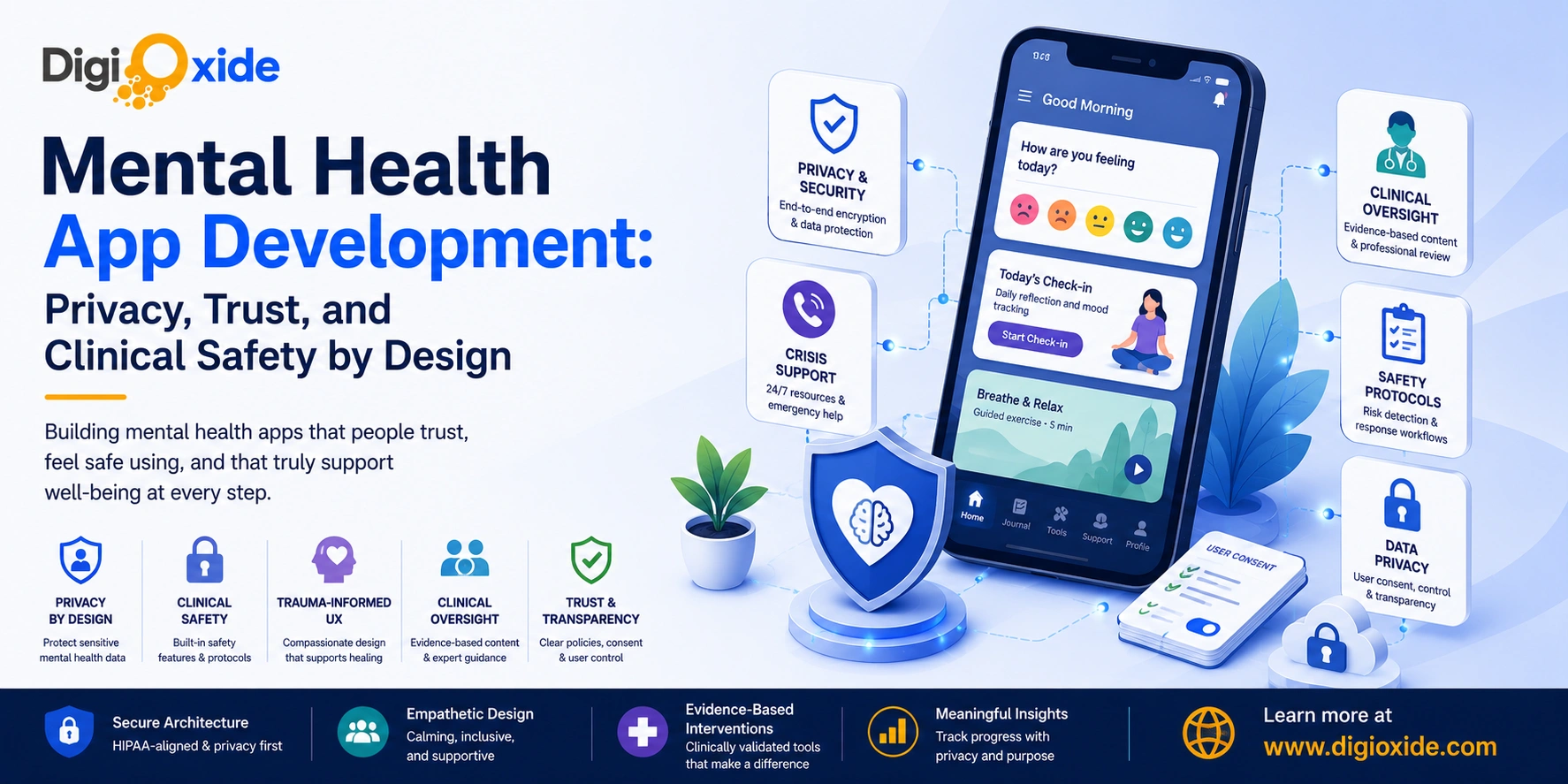
Mental Health App Development: Privacy, Trust, and Clinical Safety by Design

Mental health apps operate at a higher trust bar than any other software category. Users are often disclosing information they have not shared with anyone else in their lives, and the consequences of a bad experience, a mishandled crisis, or a privacy failure are not measured in refund requests. This guide from Digioxide Technologies Private Limited walks founders and product leaders through what actually matters in mental health app development: the safety features a serious app should include, how responsible apps handle crisis situations without overstepping their scope, the privacy standards that reach beyond HIPAA, the trauma-informed UX design principles that separate a trusted app from an anxious one, and how clinical oversight fits into a modern product. The goal is a product that earns the trust it needs, protects the people who use it, and does so within a design and engineering discipline the whole team can defend.
Mental health apps have moved from novelty to infrastructure in the past few years, and they now represent one of the most consequential segments of healthcare app development. Employers offer them as benefits. Health systems prescribe them. Insurers cover a growing share. Millions of people turn to them every week for support they would not otherwise have. That growth carries responsibility. The category has also produced high-profile privacy failures, regulatory actions, and clinical concerns that no reputable founder wants to repeat. What separates the products that keep growing from the ones that get pulled is rarely feature count; it is how carefully they were designed.
Digioxide Technologies Private Limited works as a mental health app development company for wellness startups, digital therapeutics teams, and healthcare providers extending mental health services digitally. This guide reflects how we scope and build in this category, and it is written for the people who have to sign off on the choices that decide whether a product is trusted or feared by its users.
Why Mental Health App Development Is Different
Every healthcare app is high-stakes. Mental health apps sit even higher on the stakes ladder for three reasons.
The information is uniquely sensitive: People disclose things to mental health apps they have not disclosed to partners, employers, or their primary care doctor. The consequences of misuse or exposure go beyond embarrassment into employment, insurance, custody, and safety. This is why leading privacy regulators around the world treat mental health data as a special category.
Users are often in vulnerable states: A person opening an app in the middle of a hard night is not the same person filling out a fitness log. Every design choice, from color to copy to friction, either lands well in that moment or does harm.
The line between wellness and treatment is real and it moves: A meditation app is not a therapist. An intervention that measures symptoms and delivers evidence-based content can be. Some products are regulated as medical devices; others operate as general wellness. Knowing which side your product sits on decides half of the engineering and compliance work.
This is why the questions this guide addresses (safety features, crisis handling, privacy beyond HIPAA, trauma-informed UX, clinical oversight) matter more than the tech stack. Get these right and the rest of the build follows. Get them wrong and no marketing budget will save the launch.
The Categories You Might Be Building In
Different mental health app categories carry different obligations. Placing your product accurately shapes everything downstream.
- Wellness and mindfulness apps: Meditation, sleep, breathing, and stress reduction, positioned as general wellness rather than treatment. This is the segment where most wellness platform development happens outside clinical scope. Typically outside FDA oversight, but subject to consumer privacy laws and honest-marketing rules.
- Mood, symptom, and self-management apps: Track mood, symptoms, sleep, and behaviors, often coupled with journaling and psychoeducation. Positioning matters here: pure self-tracking is usually general wellness, while apps that give diagnostic or treatment guidance edge closer to regulated territory.
- Teletherapy and coaching platforms: Connect users with human providers for therapy, coaching, or peer support. Providers on the platform practice under their licensure; the platform itself is healthcare software with all the compliance obligations that implies.
- Digital therapeutics: Deliver evidence-based interventions for specific conditions, often as prescription or clinician-recommended tools. These are frequently regulated as software as a medical device and require clinical evidence to make treatment claims.
- Caregiver support and family apps: Support the people around a person with a condition, with coordination, education, and communication features. Caregiver support app development has become its own category, with its own privacy and consent considerations.
- Enterprise and employer wellness platforms: Offered as a benefit, with utilization reporting that must never expose individual behavior back to employers.
Products often span two or three of these categories. That is fine, and it is why scoping a mental health app development company on this category is not the same as scoping any other healthcare app.
What Safety Features Should a Mental Health App Include?
Safety is a design decision, not a feature you add at the end. A serious mental health app plans safety features into the architecture, the content, and the user journey from the first sprint. The core layers we build against:
Onboarding and expectation-setting: Users need to understand quickly what the app is and is not, in language that respects their intelligence. If the product is not a substitute for professional care, that is stated clearly at onboarding, and again at moments where it matters. Overpromising in the app store listing and underdelivering in the onboarding is a pattern that both harms users and attracts regulatory attention.
Content warnings and consent to sensitive material: Some content (discussions of trauma, self-harm, disordered eating, specific diagnostic language) needs advance flagging so users can choose whether to engage. Users retain control of what they see and when.
Safe language throughout: Copy, alerts, and system messages avoid stigmatizing terms, avoid clinical jargon where lay language is available, and avoid pathologizing normal responses. Language is a safety feature, and it is one of the least expensive to get right if it is in scope from day one.
Access to human help, always visible: The path from any screen to human support (a crisis line, a therapist, an emergency service, or a trusted person) is one tap away, discoverable without effort, and available offline where possible. Not buried in settings.
Clinician oversight features for products with clinical scope: For teletherapy, digital therapeutics, or clinician-recommended tools, features that keep human providers in the loop: shared dashboards, alerting on meaningful changes, session notes, and escalation channels for concerns that need attention faster than the next appointment.
Confidentiality with clarity about limits: Users understand what happens to their data, who can access it, and, importantly, the limits of confidentiality (mandatory reporting when applicable, provider access on teletherapy platforms). The clarity itself builds trust.
Feedback and reporting channels: Users have a clear way to report content, features, or interactions they found harmful, and those reports go to a human on a real timeline. This is how design gets better over time.
Accessibility built in: WCAG-conformant design, plain-language content, and consideration for users navigating with assistive technology, all of it more important in a category whose users disproportionately face barriers.
The safety features above are the floor. What matters more is that safety is a lens the whole team applies to every design and product decision, not a QA pass at the end.
How Do Mental Health Apps Handle Crisis Situations Responsibly?
This is the question that most product teams underestimate until the first difficult moment happens. Responsible handling begins with a fundamental humility: a software application is not the right tool to resolve an acute crisis, and pretending otherwise puts users at risk. What a well-designed app can do is recognize signals, respond calmly, and connect users to human help quickly.
The framework we build against, in five layers:
1. Recognize signals without overreach: Language, patterns of engagement, and self-reported distress can all signal that a user may be struggling. Recognition is done conservatively; the cost of a false positive (interrupting a fine moment) is far lower than the cost of a false negative in this category, but the product should not shove crisis language at users who did not signal it either. Recognition happens quietly.
2. Respond with calm, warmth, and clear next steps: When the app responds to a distress signal, the tone is warm and unhurried, the message acknowledges what the user is going through without diagnosing or dramatizing, and the next steps are specific. This is the moment for language that has been reviewed by clinicians, not for engagement copy.
3. Route to human support quickly: The single most important design principle in this category: crisis escalation protocols route users to human help, not to more AI. In the United States, the 988 Suicide and Crisis Lifeline (call or text 988) and the Crisis Text Line (text HOME to 741741) are the standard connections; internationally, the app surfaces the appropriate local resource. The route is one tap, not a menu.
4. For products with a clinician on the platform, alert appropriately: Teletherapy platforms, digital therapeutics, and clinician-recommended tools bring the user’s clinical team into the loop through the mechanisms the clinical relationship was set up to support. The app does not become the clinician; it strengthens the connection.
5. Follow up thoughtfully: After a distress moment, the product checks in gently, offers additional resources, and gives the user control over how much or how little continued engagement they want. Silence is sometimes right; disappearance is not.
Two design patterns to explicitly avoid: chatbots that impersonate crisis counselors and try to “hold” a user through a crisis moment, and gamified engagement mechanics applied to distress content. Both are harmful patterns that appear in low-quality products, and both are strong reasons for users, clinicians, and regulators to distrust the category as a whole.
Every one of these decisions benefits from clinical review before it ships. Building a mental health app without clinical involvement in these specific choices is a category of shortcut that always looks less expensive at the estimate stage and always becomes more expensive later.
What Privacy Standards Apply to Mental Health Apps Beyond HIPAA?
HIPAA is the starting point for products that handle protected health information on behalf of covered entities. It is not the ceiling, and it is not the only rule. A serious mental health app plans for the broader privacy landscape from architecture.
HIPAA when applicable
If your product acts on behalf of a covered entity (health system, provider, health plan) or its business associates, HIPAA applies with the full weight described in our broader healthcare compliance work. Direct-to-consumer wellness apps that do not act on behalf of a covered entity may sit outside HIPAA, but that does not mean they sit outside regulation.
FTC Health Breach Notification Rule
The FTC has expanded and enforces this rule against health-adjacent products that experience unauthorized disclosures of individually identifiable health information. Mental health apps are a squarely in-scope category. The rule imposes notification obligations comparable to HIPAA’s breach notification when a breach occurs.
State consumer health privacy laws
Washington’s My Health My Data Act, Nevada’s SB 370, Connecticut’s expanded data privacy statute, California’s expanded CCPA/CPRA provisions on sensitive personal information, and comparable statutes elsewhere impose meaningful obligations on companies collecting mental health, wellness, or biometric information. Several allow private rights of action, which changes the risk calculus for lax practices.
GDPR for European users
Where mental health data qualifies as a special category under GDPR, additional legal bases, consent standards, and protections apply. Products serving European users need to design against these from architecture, not retrofit them later.
App store rules
Both Apple’s App Store and Google Play have specific rules for health and medical apps, including disclosure requirements, evidence requirements for medical claims, and restrictions on data usage. Violation triggers takedowns, not warnings.
Emerging AI-specific rules
AI systems that make consequential decisions about individuals face growing scrutiny under state and federal frameworks. Mental health apps using AI to guide, screen, or intervene are within the scope of most emerging AI governance regimes.
The consolidated view: designing to HIPAA is necessary for many mental health products and insufficient for almost all of them. A privacy architecture that reflects the broader landscape (data minimization by default, no third-party trackers on sensitive screens, no advertising IDs coupled to mental health behavior, no data sales, explicit consent for any secondary use, provable deletion) is the actual bar.
Three practical rules we apply on every mental health product:
- No advertising or analytics identifiers on screens where users disclose sensitive information. This is not a compliance rule; it is a category-of-product decision that keeps the product on the trusted side of a line that has already ensnared several well-funded competitors.
- No third-party pixel trackers on any mental health content. The disclosures that seemed innocuous in a marketing dashboard become regulatory findings when a mental health context is attached to them.
- Explicit, revocable consent for anything beyond the minimum data required to deliver the product. Users control what happens with their data, in language they understand.
Trauma-Informed UX Design: What It Actually Means
Trauma-informed UX design is the practice of building interfaces that assume some users are approaching the product in a fragile state, and that design choices can either lower their anxiety or amplify it. It is not a checkbox; it is a way of making dozens of small decisions differently.
The principles we apply:
Predictability over surprise: The user always knows what will happen before they tap. No dark patterns, no unexpected modals, no gamified reveals with distressing content. Anxiety is expensive to the user; predictability is cheap.
Control at every step: The user can pause, back out, save and continue later, or leave content without penalty. Sessions that lock users into a flow to boost completion rates are inappropriate here.
Language that respects: Second-person, calm, uncondescending. No exclamation points on distressing screens. No cutesy copy on serious content. No shaming for skipped days.
Sensory calm: Color palettes that soothe rather than energize. Animations that are gentle, not jumpy. Sound design that considers users using the app in bed at 3 a.m.
Consent for exposure: Any content that could be difficult (discussions of trauma, self-harm, specific diagnoses) is flagged in advance and requires user consent before display. Never the default.
Failure states that reassure: When something goes wrong, the app apologizes plainly, offers help, and reminds the user that their data is safe. Angry error dialogs and technical stack traces belong nowhere in this category.
Accessibility beyond compliance: Screen reader compatibility, keyboard navigation, reduced motion options, and readable typography at large sizes. Trauma-informed design and accessibility overlap heavily; both assume users may be approaching the product from a harder-than-average moment.
Trauma-informed UX is where design fluency becomes a differentiator in this category. Our mobile app UI/UX design practice treats it as core discipline rather than as a specialty add-on, because the design decisions decide whether a mental health app becomes something users trust or something they delete after one session.
Clinician Oversight Features: What Products With Clinical Scope Should Include
Products with clinical scope (teletherapy, digital therapeutics, clinician-recommended tools) sit inside a therapeutic relationship, and the app is one participant in that relationship, not the therapist. Clinician oversight features are what keep the relationship whole.
Common features and what they enable:
- Clinician dashboards showing enrolled patients, key trends, and outstanding items requiring attention, without exposing every piece of the user’s raw activity
- Configurable alerts when specific indicators (self-reported symptom worsening, disengagement from a program, distress signals from in-app content) exceed thresholds the clinician has set
- Session notes and integration with the clinician’s EHR, so the app’s data becomes part of the clinical record rather than a parallel silo
- Secure messaging between clinician and patient with the same protections as the rest of the platform
- Assignment and progress tracking for programs, homework, or between-session exercises, with completion status and self-reported difficulty
- Escalation channels for the clinician to raise concerns to a broader clinical team or supervisor as needed
The design principle behind all of these: the app helps the clinician do their job, does not replace them, and does not put users in a position where the software is the only line of care. Products that get this right are also products that clinicians will recommend, which is one of the strongest acquisition channels in this category.
Anonymized Data Handling for Research and Product Improvement
Mental health apps generate data that could improve care if used responsibly and endanger users if used carelessly. Anonymized data handling is the practice of separating the operational data your product needs from the analytical or research data your product wants, with real safeguards between them.
The disciplines that make this work:
- True de-identification, not just removed names. Removing direct identifiers is necessary and insufficient. Behavioral fingerprints, combinations of quasi-identifiers, and small-population attributes can re-identify users even after obvious identifiers are gone. Real de-identification follows established methods and is periodically re-evaluated.
- Data minimization at collection. The data you never collected is data you never need to protect. Every metric added has to justify its inclusion.
- Separate environments for research data. Aggregated or de-identified datasets used for research live separately from operational systems, with their own access controls and their own governance.
- User-visible controls. Users see what data is collected, why, and can opt out of analytics or research uses without losing access to the product. Consent for research is separate from consent to use the product.
- No sharing with advertisers, no matter how de-identified the claim. In this category, the reputational cost of being wrong once is larger than the revenue from being right many times.
- Auditable practices. Documented policies, periodic reviews, and a trail that shows what data flowed where. If a question arises, the answer is retrievable in hours, not weeks.
This is the operational bar we build to. Products that treat data as a resource to be strip-mined rarely last in this category, and the ones that treat it as a responsibility often become the durable brands.
Caregiver-Patient Communication Tools
A growing category of mental health apps supports the person around a patient: family members, spouses, parents of teens, and other caregivers. Caregiver-patient communication tools sit at a nuanced intersection of privacy, consent, and clinical practice.
Design considerations that matter:
Consent is layered: A patient consents to what a caregiver can see, in what detail, and for what purpose. Consent is revocable and versioned. Default access is minimal.
Age and jurisdictional considerations: For adolescents, the intersection of parental oversight and adolescent privacy is legally and clinically complex, varies by state, and requires deliberate design rather than defaults.
Distinct messaging patterns: Communication between caregivers and patients often has different tone requirements than clinician communication or peer support, and the product recognizes this in templates, notification behavior, and moderation.
Sensitive-topic guardrails: Some content shared to a caregiver could be harmful (a symptom flare shared with a critical family member) and the product gives the patient real control over what propagates. Silent forwarding to a family group chat is not a feature; it is a betrayal.
Emergency exceptions with care: In defined emergency situations, caregivers may need visibility they do not have day-to-day. Those exceptions are designed with clinical input, documented in the user experience, and are not the default.
Products in this space earn trust when patients feel supported rather than surveilled, and lose it quickly when the caregiver features feel weaponized. Design decisions decide which way it goes.
Regulatory Landscape You Need to Understand
Mental health app development in 2026 requires fluency across several bodies of rules. A partner who cannot map your product against each is not equipped for the category.
- HIPAA: Applies when your product acts on behalf of covered entities. Governs safeguards, business associate agreements, breach response, and workforce training.
- FTC Health Breach Notification Rule: Applies to health-adjacent products handling identifiable health information. Imposes notification obligations comparable to HIPAA.
- State consumer health privacy laws: A rapidly moving landscape; several states now impose specific obligations on mental health and wellness data, with private rights of action in some jurisdictions.
- FDA guidance on software as a medical device: Products that diagnose, treat, or make consequential clinical recommendations may fall within FDA oversight, with corresponding evidence and quality management requirements. Products positioned as general wellness typically do not, but positioning is a legal question with consequences.
- Digital therapeutics standards: For products claiming clinical effect, the DTx category has emerging norms around clinical evidence, prescription pathways, and payer coverage. Meeting these norms is what separates a marketing claim from a defensible one.
- App store policies: Apple’s App Store and Google Play both have specific rules for health, medical, and mental health apps, including evidence requirements for claims and restrictions on data use. Non-compliance triggers takedowns, not warnings.
- International rules: GDPR for Europe, PIPEDA for Canada, LGPD for Brazil, and comparable statutes elsewhere. Products serving international users need to design for these, not translate their US-only architecture at launch.
Compliance is neither a checkbox at the end nor a marketing checkbox in the middle. It is a set of design choices baked into the architecture from day one, matched to where your product actually sits and where it is going.
Cost and Timeline for Mental Health App Development
Cost depends on category, feature depth, clinical involvement, regulatory scope, and integrations. Ranges we quote for 2026 US-market projects, delivered as fixed-scope proposals after discovery:
| Scope | Typical investment | Typical timeline |
|---|---|---|
| Wellness or self-help MVP (single platform, foundational safety features) | $80,000 to $180,000 | 4 to 6 months |
| Mood tracker or mindfulness app with basic clinical positioning | $120,000 to $250,000 | 5 to 8 months |
| Teletherapy or coaching platform (patient app, clinician tools, integrations) | $200,000 to $450,000 | 7 to 12 months |
| Digital therapeutic with clinical evidence and SaMD path | $400,000 to $900,000 and up | 10 to 18 months, plus clinical study time |
| Enterprise or multi-tenant mental health platform | $500,000 to $1,200,000 and up | 12 to 24 months |
Cost drivers to plan for:
- Clinical involvement: Working with clinicians on content review, protocols, and safety design is not optional in this category, and its cost belongs in the plan.
- Regulatory positioning: SaMD path, clinical evidence, and quality management systems add scope proportional to the claims your product makes.
- Integration count: EHRs, video, secure messaging, wearables, and payment systems each add engineering, testing, and compliance work.
- AI features: Adaptive content, triage assistance, clinician alerting: each adds data engineering, model governance, and evaluation scope.
- Multi-language and internationalization: In this category, translation is not enough; culturally appropriate content review is required.
Ongoing costs: Budget 15 to 25 percent of the build cost annually for security, content updates, clinical review, and adaptation to evolving rules. Communication volume (SMS, email, voice) is a separate operational line.
The delivery-model lever: US onshore rates of $150 to $250 per hour versus experienced offshore healthcare-fluent teams at $30 to $60 per hour mean a well-run blended model reduces total cost by 40 to 60 percent without cutting scope. That is how Digioxide runs mental health app engagements, with senior engineers, US-business-hours overlap, and fixed-scope pricing after discovery.
For lean early-stage products, our MVP development and rapid prototyping approach scopes a first release that ships the safety and privacy foundations in a genuinely lean form, so the initial deliverable earns user and clinician trust rather than shipping features that will get pulled at the first review.
Common Pitfalls in Mental Health App Development
Six failure modes we see, listed here so they can be planned around:
- Skipping clinical input: Building a product intended for a vulnerable population without clinician involvement is a category of shortcut that always looks cheaper at the estimate stage and always becomes more expensive later, in user harm, in regulatory attention, or in the reputational failure that ends the product.
- Designing safety as a feature list: Safety is a design lens, not a feature module. Products that treat it as the latter always miss the specific moments where design actually decides outcomes.
- Relying on chatbots to handle crisis moments: No production-grade product uses a chatbot as a substitute for human crisis response. Every serious product routes to human help.
- Stopping at HIPAA: The category is regulated by a broader set of rules that many teams discover after launch. Design against the fuller landscape at architecture, not later.
- Treating engagement as the ultimate metric: Engagement mechanics that work in consumer social do harm here. Wellbeing, retention on healthy usage patterns, and clinician-reported outcomes are the metrics that matter.
- Underinvesting in accessibility: Users who most need mental health support disproportionately face barriers to using non-accessible products. Accessibility is not compliance; it is core reach.
None of these are hard to avoid if the team designs against them from the start. All of them are expensive if discovered after launch.
How Digioxide Approaches Mental Health App Development
Digioxide Technologies Private Limited approaches mental health app development as a category that rewards discipline and punishes shortcuts. What working with us looks like:
- Clinical partnership from discovery. We recommend and work alongside clinical advisors on every mental health project because we have seen what happens when teams do not.
- Safety and privacy as architecture. HIPAA safeguards, broader consumer health privacy compliance, no third-party trackers on sensitive screens, and no advertising IDs coupled to mental health behavior are defaults, not options.
- Trauma-informed UX as a core discipline. Our designers approach these projects with the assumption that some users are approaching the product in a fragile moment, and they build accordingly.
- A complete team under one roof, delivered through our mobile app development services: discovery, product strategy, UI/UX, engineering, quality assurance, compliance, and long-term support without the seams that create risk.
- Regulatory fluency. Real experience with HIPAA, FTC Health Breach Rule, state consumer health privacy laws, GDPR, and the SaMD framework, so your product’s positioning and compliance obligations are named openly at scoping.
- Delivery economics that widen your runway. Senior engineering at offshore rates with US-business-hours communication, typically 40 to 60 percent below onshore-only totals.
- A partner’s incentives. We build systems we expect to support for years, which changes every design and architecture decision made in month one.
For a founder or product leader who takes this category seriously, the evaluation of a mental health app development company for startups is not a feature list comparison. It is a check on whether the partner understands what could go wrong, has done the work to prevent it before, and will design your product to be one of the trusted ones.
Frequently Asked Questions
What safety features should a mental health app include?
At minimum: clear onboarding that sets accurate expectations, content warnings and user control over sensitive material, safe and non-stigmatizing language throughout, one-tap access to human help visible from every screen, clinician oversight features for products with clinical scope, clarity about the limits of confidentiality including any mandatory reporting circumstances, real user-reporting channels, and accessibility that meets WCAG standards. What matters more than the list is that safety is applied as a design lens across every decision the team makes, not added as a QA pass at the end.
How do mental health apps handle crisis situations responsibly?
They recognize distress signals conservatively, respond with warm and clinician-reviewed language, route users to human help within one tap (in the US, 988 Suicide and Crisis Lifeline and Crisis Text Line), alert clinical teams on platforms where clinicians are involved, and follow up thoughtfully without making the user feel surveilled. They do not use chatbots as substitutes for human crisis response, and they do not apply engagement mechanics to distress content. Responsible crisis handling is a design and clinical discipline, not a feature.
What privacy standards apply to mental health apps beyond HIPAA?
The FTC Health Breach Notification Rule, state consumer health privacy laws (Washington’s My Health My Data Act, Nevada’s SB 370, Connecticut, California, and a growing list), GDPR for European users, app store health-category rules, and emerging AI governance rules. HIPAA is a starting point where applicable, not a ceiling. The practical bar is a privacy architecture that reflects the broader landscape: data minimization, no third-party trackers on sensitive screens, no advertising IDs coupled to mental health behavior, no data sales, and provable deletion.
How to design a mental health app that patients trust?
Trust comes from a combination of accurate onboarding, safe language, predictable interactions, respectful design, real privacy protections users can see, clinical involvement in the content, clear paths to human help, and a track record of doing what the product says it will do. It is built through hundreds of small design decisions, not through marketing language. Trauma-informed UX design is the practice of making those decisions the right way.
What clinical safety considerations belong in mental health app design?
Clinical involvement in content and safety design, conservative recognition of distress signals with clinician-reviewed responses, one-tap escalation to human help, clinician oversight features on products with clinical scope, honest limits on the app’s role in acute crisis, and thoughtful handling of situations where mandatory reporting may apply. Clinical safety considerations in mental health app design touch architecture, content, engineering, and operations, and are a discipline rather than a compliance checkbox.
How much does mental health app development cost?
A wellness or self-help MVP typically runs $80,000 to $180,000 over four to six months. A mood tracker or mindfulness app with basic clinical positioning runs $120,000 to $250,000 over five to eight months. Teletherapy and coaching platforms run $200,000 to $450,000 over seven to twelve months. Digital therapeutics with SaMD paths run $400,000 to $900,000 and up plus clinical study time. Enterprise platforms range $500,000 to $1,200,000 or more. Add 15 to 25 percent of the build cost annually for ongoing operations and compliance, and expect blended offshore delivery to reduce totals by 40 to 60 percent versus onshore-only rates.
Is my mental health app subject to FDA oversight?
Sometimes. Products positioned as general wellness, without diagnostic or treatment claims, typically fall outside FDA oversight. Products that diagnose, treat, or make consequential clinical recommendations may be regulated as software as a medical device, with corresponding requirements. Positioning matters legally, so this is a decision made carefully during discovery with clinical and regulatory input, not one taken retroactively after marketing has set expectations.
Do we need HIPAA compliance for a direct-to-consumer app?
Direct-to-consumer wellness apps that do not act on behalf of a covered entity may sit outside HIPAA, but they are increasingly regulated by the FTC Health Breach Notification Rule, state consumer health privacy laws, and app store policies. The right design bar is the broader privacy landscape, not the narrower HIPAA test alone. A safe rule of thumb: if you would not be comfortable with a state attorney general reviewing your data practices, redesign until you would.
What is a good mental health app development company for startups?
One that will not build unsafe products, that treats clinical input as required rather than optional, that architects for the full privacy landscape rather than just HIPAA, that has real experience with mental health category regulation, and that will tell you when a shortcut is a shortcut. Those are the criteria that separate a durable partner from a one-time vendor in this category, and they matter more than portfolio slide counts.
How do we handle sensitive user data responsibly?
Collect the minimum data your product needs to work. Encrypt it in transit and at rest. Give users clear visibility and control. Never sell it. Never share it with advertisers regardless of the de-identification claim. Keep no third-party trackers on sensitive screens. Get explicit consent for any use beyond delivering the product. Document your practices so a question can be answered in hours. This is the operational bar the trusted products in the category meet, and it is the bar we build to.
Build the Product Users Will Trust
Mental health app development is one of the most consequential categories a technology team can work in. The people using your product may be reaching for it in the hardest hours of their lives. Every design decision your team makes lands in that context.
The good news: the disciplines that produce trusted products in this category (clinical input, safety by design, privacy architecture that reflects the broader landscape, trauma-informed UX, responsible crisis handling, and clinician oversight where applicable) are learnable and executable. The teams that adopt them build products that grow because users trust them, that clinicians recommend, that regulators support, and that will still be in the market three years from now.
If mental health app development is on your roadmap, start with a structured discovery conversation. Digioxide Technologies Private Limited will help you position your product accurately, plan the safety and privacy architecture, model the regulatory obligations, and give you a fixed-scope proposal you can defend to your board, your investors, and, most importantly, the users you will serve. Contact our team to schedule it, and bring what you know about the people your product will help. That is where every good mental health product begins.
