
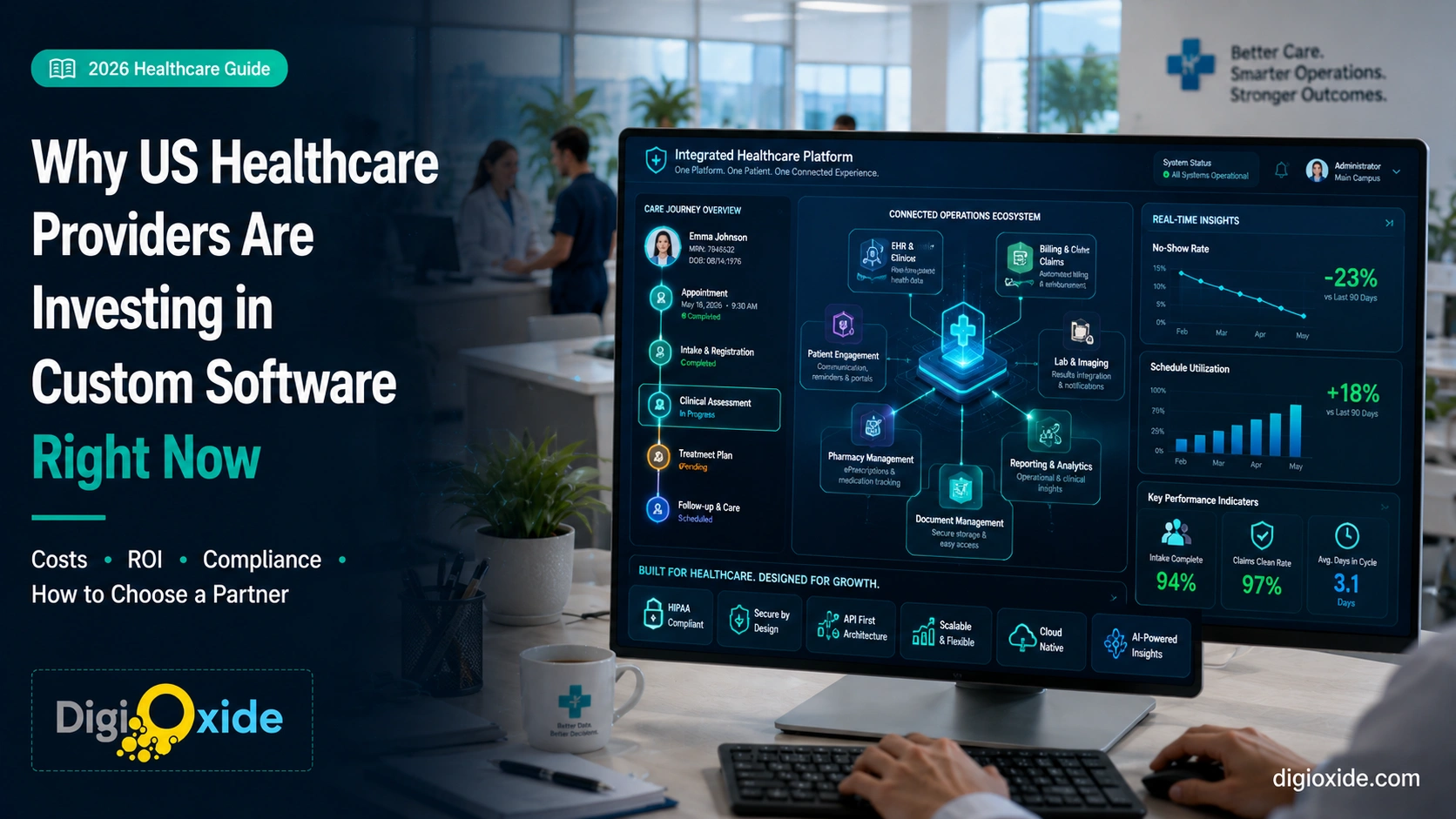
Why USA Healthcare Providers Are Investing in Custom Software Right Now

US healthcare organizations are moving budget away from generic licensed tools and toward custom healthcare software development. The drivers are concrete: interoperability mandates with 2026 and 2027 deadlines, a proposed tightening of HIPAA security requirements, workforce shortages that make automation the most affordable new hire, and patients who expect consumer-grade digital experiences. This guide from Digioxide Technologies Private Limited explains why the shift is happening now, what custom builds actually cost, when custom software makes sense for a small practice, and how to evaluate healthcare software development companies before you commit.
Ask a hospital IT director what slows their organization down, and the answer is rarely a shortage of software. Most provider organizations already run dozens of applications. The real problem is that those applications were designed for an average organization that does not exist. Staff bridge the gaps with spreadsheets, duplicate data entry, fax machines, and phone calls, and every workaround quietly adds cost, risk, and clinician frustration.
That is the backdrop for a visible shift in US healthcare technology budgets. Providers are no longer debating whether generic tools are holding them back. They are deciding which workflows to rebuild first, and which healthcare software development companies can deliver those systems without creating compliance problems along the way.
Digioxide Technologies Private Limited delivers custom software development for US healthcare providers, from independent clinics and specialty groups to hospital networks and digital health startups. Drawing on that work, this article breaks down the forces driving the investment wave, the numbers behind it, and a practical framework for deciding whether a custom build is right for your organization.
What Is Driving Digital Health Transformation in 2026
Digital health transformation stopped being a conference slogan the moment the deadlines, penalties, and dollar figures became specific. Five forces are pushing US providers toward purpose-built systems this year, and together they explain why healthcare companies need custom software in 2026 rather than eventually.
Regulatory Pressure Now Has Real Deadlines
Interoperability is no longer a talking point. It is a set of dated obligations:
- Information blocking rules under the 21st Century Cures Act now carry financial disincentives for providers, not just for technology vendors.
- The CMS Interoperability and Prior Authorization Final Rule requires payers to run FHIR-based APIs, with electronic prior authorization capabilities on a compliance timeline that runs through January 2027 and reaches directly into provider workflows.
- TEFCA, the national framework for trusted health information exchange, has moved from policy documents to live network traffic.
- The proposed update to the HIPAA Security Rule signals where enforcement is heading: mandatory multi-factor authentication, encryption, network segmentation, and documented technology asset inventories.
Meeting regulatory healthcare standards with a patchwork of disconnected tools gets harder every quarter. Custom development lets you build compliance into the architecture from day one instead of bolting it on after an audit finding, which is exactly how Digioxide approaches every healthcare build.
Cybersecurity Is Now a Board-Level Budget Line
Healthcare remains one of the most heavily targeted industries for ransomware, and the 2024 attack on one of the country’s largest claims clearinghouses showed how a single vendor outage can freeze cash flow across thousands of practices at once. Off-the-shelf tools concentrate that risk in systems you cannot inspect. A custom system does not make you immune, but it puts encryption choices, access controls, audit logging, and vendor dependencies under your governance instead of someone else’s.
The Workforce Math Has Changed
Clinical and administrative staffing shortages have turned automation into the most affordable new hire in the building. Digital intake, automated eligibility checks, self-service scheduling, and documentation support each reclaim hours per employee per week. Providers that automate high-volume workflows are effectively adding capacity without adding payroll, which is why operational software has moved from the wish list to the capital plan.
Patients Expect Consumer-Grade Digital Experiences
The same patients who book flights and move money from their phones now judge your practice by its digital front door. Self-scheduling, digital intake, transparent billing, and secure messaging are retention issues, not luxuries. Practices that force patients to call during business hours for basic tasks are losing those patients to practices that do not.
AI Moved From Pilot Projects to Production
Ambient clinical documentation, intake triage, claims scrubbing, and denial prediction have crossed from experiments into daily operations at organizations of every size. The catch is that AI tools only create value when they connect to your data and your workflows, and that connective layer almost always requires custom engineering: clean data pipelines, integration with existing systems, and governance controls. This is healthcare IT modernization in practice. It is rarely about replacing everything. It is about building the layer that lets modern care delivery technology work together.
Why Are Healthcare Companies Moving Away From Off-the-Shelf Software?
Off-the-shelf products earned their place for a reason: low entry cost, fast deployment, and predictable functionality. The move away from them is not ideological. It is a response to five structural problems that surface once an organization grows past the vendor’s idea of an average customer.
1. The average-user problem:
Generic platforms are designed for a hypothetical typical practice. Your infusion chair scheduling, behavioral health group sessions, or multi-location referral routing are not typical, so staff compensate with workarounds. Workarounds are where documentation errors, burnout, and compliance gaps live.
2. Licensing costs compound forever
Per-provider, per-user, and per-module pricing looks manageable in year one. A 20-provider group paying $400 per provider per month spends $96,000 a year, indefinitely, for software it will never own, and the price rarely moves in the customer’s favor at renewal. Renting is fine until the rent exceeds the mortgage.
3. Integration ceilings
Many vendors restrict API access, charge per-interface fees, or simply do not support connections to the lab, billing, or telehealth systems you rely on. Data ends up trapped in silos, and your staff becomes the integration layer.
4. Compliance stays your problem
Plenty of general-purpose tools will not sign a business associate agreement, lack granular audit logs, or store protected health information in ways you cannot verify. Under HIPAA, responsibility does not transfer to the vendor just because the marketing page says “secure.”
5. You do not control the roadmap
Your feature requests sit in a queue behind thousands of others. If the vendor pivots, raises prices, or gets acquired, you migrate on their schedule, not yours.
Here is how the two paths compare on the factors that matter to healthcare decision-makers:
| Decision factor | Off-the-shelf software | Custom healthcare software |
|---|---|---|
| Fit to your workflows | Built for an average buyer; staff fill gaps with workarounds | Designed around your clinical and administrative processes |
| Cost pattern | Low entry cost; per-user fees grow indefinitely | Higher upfront investment; you own the asset |
| Integrations | Limited to vendor-approved connectors, often with added fees | Built to connect with your EHR, labs, billing, and payer systems |
| Compliance control | Depends on vendor practices and willingness to sign a BAA | HIPAA safeguards designed into the architecture |
| Data ownership and analytics | Data lives in vendor formats; export options vary | Full ownership with reporting built around your metrics |
| Scalability | Tier upgrades and add-on modules | Scales with users and locations on your terms |
| Competitive differentiation | The same features your competitors can buy | Capabilities your competitors cannot buy |
At Digioxide Technologies Private Limited, a large share of our healthcare engagements begin exactly here: replacing a stack of workarounds and half-connected subscriptions with one system built around how the organization actually operates.
Where Custom Healthcare Software Delivers the Most Value
Not every system in a provider organization should be custom. Core EHRs, for example, are almost always bought rather than built. The strongest returns come from the layers around and between those core systems, where generic software fits worst. These are the healthcare technology solutions we are asked to build most often:
Patient Intake and Scheduling Automation
Digital registration, insurance eligibility checks, automated reminders, and waitlist management reduce no-shows and reclaim front-desk hours. A well-built intake flow captures demographics, consents, and history before the patient arrives, verifies coverage automatically, and writes clean data into your records instead of onto a clipboard. For most clinics, this is the fastest payback of any build, because the costs it removes, phone tag, re-keyed forms, and empty appointment slots, are easy to measure and painful to keep.
Custom Patient Portals and Engagement Apps
Purpose-built portals and native apps keep patients connected between visits: results, care plans, secure messaging, bill pay, and education content in one place. Generic portal modules are among the most common complaints we hear from providers, because patients abandon clunky experiences and staff absorb the fallout by phone. Our mobile app development team builds iOS and Android applications designed around accessibility standards and HIPAA-conscious data handling, which is exactly where consumer app templates fall short. Adoption is the metric that matters here, and adoption is a design problem before it is a technology problem.
Telehealth and Virtual Care Platforms
Video visits, asynchronous messaging, e-prescribing connections, virtual waiting rooms, and documentation that lands in the chart instead of in a silo. Custom telehealth builds matter most when your care model does not fit subscription products: hybrid in-person and virtual programs, multi-state licensing logic, group sessions in behavioral health, or specialty-specific visit workflows. The principle is simple. Build the platform around the care model, not the care model around the platform.
EHR-Connected Workflow Applications
Specialty tools that read from and write to your existing EHR through HL7 interfaces and FHIR APIs, filling clinical workflow gaps without the cost and disruption of replacing core systems. Think surgical case tracking, referral management, chronic care protocols, or prior authorization workflows that pull patient context automatically instead of forcing staff to copy it between screens. This category is where custom development and your existing EHR investment reinforce each other rather than compete.
Remote Patient Monitoring and Chronic Care Dashboards
Device data feeds, alert thresholds, escalation rules, and care coordination views that let one care manager watch an entire panel instead of chasing individual readings. As reimbursement for remote monitoring programs has matured, the limiting factor is rarely the devices. It is the software layer that turns thousands of daily readings into a short, prioritized worklist a nurse can actually act on.
Analytics, Reporting, and Revenue Cycle Tools
Dashboards that surface denial patterns, provider productivity, payer performance, and cost per encounter, drawn from systems that were never designed to talk to each other. This is where patient outcomes technology earns its budget line: when leadership can tie a workflow change to readmission or no-show numbers, the next investment case writes itself. It is also where finance teams find money, because denial and underpayment patterns stay invisible until something aggregates them.
Healthcare SaaS Products
For founders building multi-tenant platforms for the healthcare market, our SaaS development services cover architecture, compliance groundwork, and launch, so the product is enterprise-ready when the first health system asks hard security questions. The difference between a health SaaS product that closes enterprise deals and one that stalls in security review is usually decided in the first three months of architecture decisions, long before any sales conversation begins.
The common thread across all of these software solutions for healthcare industry buyers: they connect, they comply, and they fit. Point tools that do none of the three are how organizations end up with 40 applications and no answers.
How Custom Healthcare Software Development Actually Works
Decision-makers evaluating a build deserve to know exactly what they are signing up for. A disciplined custom healthcare software development engagement runs through seven stages, and the quality of the first two determines the cost of the last five.
Step 1: Discovery and workflow mapping (2 to 4 weeks)
We sit with the people who do the work: schedulers, nurses, billers, physicians. The output is a documented map of current workflows, pain points quantified in hours and dollars, a prioritized scope, and a fixed proposal. Rushing discovery is the single most expensive mistake in this industry, because healthcare workflows always contain exceptions nobody mentions until the software breaks on them.
Step 2: Compliance and architecture design
Before any screen is designed, the system architecture is defined around HIPAA technical safeguards: where protected health information lives, how it is encrypted, who can access what, and how every access is logged. Integration points with your EHR, labs, and billing systems are specified here, along with the FHIR resources and HL7 interfaces involved. This is also the stage where a business associate agreement is executed.
Step 3: UI/UX design with clinical input
Clinical software fails when it adds clicks. Wireframes and prototypes are tested with actual end users across front desk, clinical, and administrative roles before development begins, because changing a screen in design costs a fraction of changing it in code.
Step 4: Agile development in reviewable increments
Working software ships in two-week sprints you can see and test, not a big reveal at month six. Course corrections happen early, while they are still cheap.
Step 5: Testing that goes beyond features
Functional QA, yes, but also security testing, access control verification, audit log validation, load testing, and integration testing against real-world data patterns, including the messy edge cases healthcare data always contains.
Step 6: Deployment and training
Phased rollouts, parallel-run periods where they make sense, role-based training materials, and a support channel that answers during your business hours. Adoption is part of the project, not an afterthought delegated to your office manager.
Step 7: Support, maintenance, and compliance updates
After launch, the system needs security patching, dependency updates, performance monitoring, and engineering changes when regulations move. This is why Digioxide structures long-term support into every healthcare engagement rather than treating launch as goodbye.
Digioxide Technologies Private Limited runs this process with a named project lead, weekly stakeholder reviews, and documentation your compliance officer will actually want to keep.
What Does Custom Healthcare Software Actually Cost?
The honest answer is that cost depends on scope, but “it depends” is useless for budgeting. Here are the planning ranges we quote most often, along with the variables that move them.
The biggest cost drivers:
- Scope and complexity: the number of user roles, workflows, and modules
- Compliance depth: HIPAA technical safeguards, audit logging, and SOC 2 alignment for products sold to health systems
- Integrations: each EHR, lab, e-prescribing, or payment connection adds engineering and testing effort
- Data migration: moving records out of legacy systems cleanly is real work
- AI and analytics features: valuable, but they add data engineering scope
- Team model and location: the single biggest lever on the total number
Typical 2026 market ranges for US healthcare projects:
| Project type | Typical investment | Typical timeline |
|---|---|---|
| Single-workflow automation tool | $30,000 to $70,000 | 8 to 12 weeks |
| Patient portal or patient-facing app (MVP) | $60,000 to $150,000 | 3 to 5 months |
| Telehealth platform (MVP) | $80,000 to $180,000 | 4 to 6 months |
| Custom patient management system | $120,000 to $300,000 | 5 to 9 months |
| Enterprise platform with multiple EHR integrations | $250,000 to $600,000 and up | 9 to 18 months |
Treat these as planning ranges rather than quotes; a structured discovery phase produces the real number. Two more figures belong in every budget conversation:
Where the budget actually goes
Across typical healthcare builds, spending distributes roughly like this:
| Phase | Share of budget | What you are paying for |
|---|---|---|
| Discovery and planning | 5 to 10 percent | Workflow mapping, requirements, fixed-scope proposal |
| Architecture and UI/UX design | 10 to 15 percent | Compliance-first system design, prototypes, clinical usability |
| Core development | 40 to 50 percent | Engineering the application and its integrations |
| Testing and QA | 15 to 20 percent | Functional, security, integration, and load testing |
| Deployment, training, and stabilization | 10 to 15 percent | Rollout, data migration, user training, early fixes |
If a proposal allocates almost nothing to testing or training, the vendor is planning for those costs to become your costs after launch.
Hidden costs to budget for up front
The quoted build price is not the whole picture, and the difference between a smooth project and a budget fight is naming these early:
- Third-party integration fees: some EHR vendors and clearinghouses charge for API access, sandbox environments, or interface certification
- Cloud infrastructure: hosting, backup, and disaster recovery in a HIPAA-eligible environment, typically a monthly operational cost
- Data migration surprises: legacy data is always dirtier than anyone remembers
- Security assessments: penetration testing and, for SaaS products, SOC 2 audit costs
- Staff time: your team’s hours for discovery interviews, testing feedback, and training are real costs even though they never appear on an invoice
A transparent partner puts all of this in the proposal. We do, because the alternative is a client who feels ambushed in month four, and no project survives that intact.
Ongoing costs
Plan for roughly 15 to 20 percent of the initial build cost per year for maintenance, security patching, dependency updates, and compliance changes. Healthcare software is never finished, because the regulations it lives under are never finished.
The team-location lever
US onshore agencies commonly bill $120 to $200 per hour for senior engineers. Experienced offshore teams with genuine US healthcare delivery experience typically bill $25 to $50 per hour. A well-run blended model routinely brings total delivery cost down 40 to 60 percent without cutting scope. This is the model Digioxide Technologies Private Limited operates: senior engineering talent, working hours that overlap with US business days, and fixed-scope pricing after discovery, so the number you approve is the number you pay.
How the math compares with renting
Return to the 20-provider group spending $96,000 a year on licenses. A $150,000 custom build with $25,000 in annual maintenance costs more in year one, roughly breaks even during year two, and saves money every year after that, while the practice owns the asset, the data, and the roadmap. That arithmetic, more than any technology trend, is why finance leaders have warmed to custom healthcare software development.
Is Custom Software Worth It for a Small Healthcare Practice?
Sometimes, and a trustworthy development partner will tell you plainly when it is not. We regularly advise smaller practices to wait, because a build that does not pay for itself is bad for the client and, eventually, bad for us.
Custom software makes sense for a small practice when:
- A measurable bottleneck exists: front-desk phone volume, manual insurance verification, or no-show rates with a cost you can put a number on
- Annual licensing spend has crept past roughly $40,000 to $50,000 for tools that still require workarounds
- Your specialty workflow is poorly served by mainstream products, which is common in behavioral health, home health, infusion services, and multi-disciplinary clinics
- You operate multiple locations that need coordinated scheduling, records, and reporting
- You are building a differentiated service line, such as concierge care, cash-pay programs, or hybrid virtual care, where the software is part of the product itself
Waiting is usually smarter when:
- You are a solo or two-provider practice whose workflows are genuinely standard and already covered by your existing systems
- Nobody on your team has time to own product decisions during a build
- The real problem is a process problem that software would only automate faster
The middle path most small practices should take: start with one custom module that integrates with the systems you already run, such as intake automation, a scheduling layer, or a reporting dashboard. Prove the return, then expand. Digioxide structures engagements this way deliberately, so a clinic can start with a focused 8-to-12-week build instead of a platform-scale commitment.
The return-on-investment math is straightforward to model before any code is written. Two administrative hours saved per day is more than 500 hours a year. Cutting no-shows by even a few percentage points across thousands of annual visits is recovered revenue you can calculate today. We run that modeling with clients during discovery, and if the numbers do not work, we say so.
What the Return Actually Looks Like: Three Realistic Scenarios
Abstract ROI claims are easy to write and impossible to budget with, so here are three illustrative scenarios built on conservative, checkable arithmetic. The numbers are hypothetical, but the math is the same math we run with clients during discovery.
Scenario 1: The independent clinic drowning in intake
A six-provider clinic handles roughly 90 appointments a day. Front-desk staff spend a combined four hours daily on phone scheduling, manual insurance checks, and re-keying paper forms. A $55,000 intake and scheduling automation build removes most of that. Four hours a day at a $28 fully loaded hourly cost is about $28,000 a year in recovered staff capacity, before counting the reduced no-shows that automated reminders reliably deliver. Payback lands around the two-year mark on staff time alone, and everything after that is margin.
Scenario 2: The multi-location group paying rent forever
A 20-provider group across three locations pays $400 per provider per month for a practice platform it constantly works around: $96,000 a year, every year. A $180,000 custom patient management system with $30,000 in annual maintenance costs more through year one, breaks even during year two, and by year five the group has spent roughly $300,000 instead of $480,000, while owning its data, its reporting, and its roadmap.
Scenario 3: The telehealth startup that needs to pass security review
A digital health founder can launch on a white-label platform for less money, faster. But white-label margins are thin, differentiation is minimal, and enterprise buyers ask security questions white-label vendors cannot answer on your behalf. A $140,000 custom MVP built HIPAA-first, with clean architecture and audit-ready documentation, is what turns a demo into a signed contract with a health system. For a startup, the ROI of custom is not saved cost. It is the enterprise revenue that off-the-shelf infrastructure cannot unlock.
Every organization’s numbers differ, which is exactly why we model your version of this arithmetic during discovery before recommending anything.
The Regulatory Healthcare Standards Your Software Must Respect
Every custom build in this industry lives inside a regulatory framework, and that framework is tightening. The non-negotiables:
- HIPAA Privacy, Security, and Breach Notification Rules: Administrative, physical, and technical safeguards: role-based access control, encryption for data in transit and at rest, automatic session timeouts, and complete audit trails. The proposed Security Rule update points toward stricter mandatory controls, so the smart move is to build to where the rule is going, not where it has been.
- Information blocking provisions of the 21st Century Cures Act: Patients have a right to their electronic health information, and providers face disincentives for practices that interfere with legitimate access and exchange.
- HL7 and FHIR interoperability standards: FHIR R4 APIs have become the common language of clinical data exchange in the US, alongside the USCDI data classes that define what must be shareable.
- SOC 2 for commercial credibility: Not a legal requirement, but if you plan to sell software to health systems, a SOC 2 report is increasingly the price of a first meeting.
- FDA awareness for clinical functionality: Software that diagnoses, treats, or drives clinical decisions can cross into medical device territory. Know where that line sits before you design features that cross it.
- State-level health privacy laws: A growing set of state consumer health data statutes now imposes obligations that reach beyond HIPAA-covered entities, especially for wellness and direct-to-consumer products.
Digioxide Technologies Private Limited treats this as an architecture problem, not a paperwork problem. Threat modeling happens during design, audit logging is a default rather than an add-on, production data never appears in development environments, and we come to healthcare engagements prepared to sign a business associate agreement. Compliance retrofitted after launch always costs more than compliance designed in.
Technology Trends Shaping Custom Healthcare Software in 2026
The build decisions you make this year should account for where care delivery technology is heading, not just where it stands today. Five trends are shaping the healthcare technology solutions we architect right now:
AI embedded in workflows, not bolted beside them: The AI wins in healthcare are unglamorous and valuable: ambient documentation that drafts notes, intake triage that routes patients, coding assistance that catches missed charges, and denial prediction that flags claims before submission. Every one of them depends on custom integration with your data. An AI feature without a data pipeline is a demo.
Interoperability-first architecture: New systems are being designed with FHIR APIs as a core requirement rather than a future add-on, because every regulatory signal points toward more mandatory exchange, not less. Building interoperability in from the start costs a fraction of retrofitting it later.
Cloud-native by default: HIPAA-eligible cloud infrastructure has matured to the point where on-premise deployment is the exception, reserved for specific institutional requirements. Cloud-native design brings elastic scaling for telehealth peaks, faster disaster recovery, and infrastructure costs that track actual usage.
Remote monitoring and connected devices as standard inputs: Blood pressure cuffs, glucose monitors, wearables, and home-care sensors are becoming routine data sources. The systems that win treat device data as a first-class input with alerting logic, not as a PDF attached to a chart.
Security architecture moving toward zero trust: Continuous verification, least-privilege access, network segmentation, and immutable audit logging are shifting from best practice to expected practice, a direction the proposed HIPAA Security Rule changes make explicit. Systems designed this way today will not need emergency rework tomorrow.
None of these trends requires chasing novelty. They require a partner who builds for the direction of the industry, which is a core part of the digital health transformation roadmaps we help clients shape.
Common Mistakes to Avoid When Investing in Custom Software
We have been called in more than once to rescue projects that went wrong somewhere else, and the failure patterns repeat. Avoid these six and you avoid most of the risk:
1. Skipping discovery to save money: A two-week shortcut at the start becomes a two-month overrun in the middle. Requirements discovered during development are the most expensive requirements there are.
2. Boiling the ocean: Trying to replace every system at once maximizes cost, risk, and staff resistance simultaneously. The organizations that succeed sequence their builds: one high-value workflow, proven, then the next.
3. Leaving clinicians out of design: Software designed for clinicians without clinicians produces beautiful screens nobody uses. End users belong in the design phase, not the complaint phase.
4. Choosing a vendor on hourly rate alone: The cheapest rate with weak healthcare experience routinely produces the most expensive project once rework, compliance remediation, and delays are counted. Evaluate healthcare software development companies on delivered outcomes in regulated environments first, then negotiate rate.
5. Ignoring change management: Working software that staff will not adopt returns nothing. Training, phased rollout, and visible leadership support are part of the investment, not optional extras.
6. Budgeting for launch instead of for life: Software with no maintenance budget decays: unpatched dependencies, drifting compliance, accumulating bugs. Plan the annual 15 to 20 percent from day one and the system stays an asset instead of becoming a liability.
The common denominator is treating a custom build as a purchase instead of a program. The providers who see outsized returns treat it as an operational capability they are acquiring, with a partner accountable for the long run.
How to Evaluate Healthcare Software Development Companies
The gap between a generalist agency and a genuine healthcare engineering partner shows up months after the contract is signed, which is exactly when it is most expensive to discover. Use this checklist before you commit:
- Test their healthcare fluency: Ask how they handle protected health information in non-production environments. A vague answer here disqualifies a vendor faster than anything else you can ask in a first meeting.
- Look for compliance-by-design: HIPAA safeguards, encryption standards, and audit logging should appear in their architecture discussion, not just on a slide about certifications.
- Probe the integration track record: Which EHR platforms have they connected to? Which HL7 interfaces and FHIR resources have they actually worked with? Specific answers signal real experience.
- Assess the vendor’s own security posture: Where does code live, who can access client data, and what happens when an engineer rolls off the project? Your risk includes their practices.
- Match the engagement model to your situation: A defined project suits fixed-scope delivery. An evolving product needs a dedicated team. A stretched internal team may just need reinforcement. The best healthcare software development companies offer all three and will tell you honestly which one fits.
- Check communication logistics: Daily standups, US business-hours overlap, and a named point of accountability prevent the slow drift that kills outsourced projects.
- Ask about life after launch: Maintenance retainers, response-time commitments, and a defined process for shipping compliance updates when regulations change.
- Ask for proof under pressure: A portfolio in regulated industries matters, but the more revealing question is how they handled a project that went sideways.
The pattern to avoid is any partner who treats HIPAA as a checkbox for the final sprint. In this industry, that approach does not just create risk. It creates rework, and rework is the most expensive software you will ever buy.
A Healthcare Technology Partner for Hospitals and Clinics
Digioxide Technologies Private Limited is a custom and AI software development company that builds healthcare technology solutions for the realities of US healthcare: regulated data, entrenched legacy systems, clinical workflows that cannot afford downtime, and budgets that answer to boards. What working with us looks like:
- End-to-end capability under one roof: Product discovery, UI/UX design, web and mobile engineering, cloud architecture, quality assurance, and long-term support through our custom software development services.
- Healthcare-grade engineering practices: HIPAA-conscious data handling, encryption in transit and at rest, audit logging by default, and interoperability built on HL7 and FHIR standards.
- Flexible engagement models: Fixed-scope builds for defined projects, dedicated development teams for ongoing product work, and staff augmentation when your internal team needs experienced reinforcements.
- A cost structure that funds more product: Offshore economics with senior talent and US-business-hours communication, which typically stretches the same budget 40 to 60 percent further than onshore-only delivery.
- A consultative stance: If a configured off-the-shelf product plus light integration will solve your problem, we will tell you that, because a partner who recommends against their own invoice is a partner you can trust with the projects that do require a build.
That combination is why organizations searching for a healthcare technology partner for hospitals and clinics shortlist Digioxide: the engineering depth of a large firm, the economics of offshore delivery, and the accountability of a team that expects to support what it builds for years.
Frequently Asked Questions
Why are healthcare companies moving away from off-the-shelf software?
Because generic tools force staff into workarounds, licensing fees compound indefinitely, integration options hit vendor-imposed ceilings, and HIPAA responsibility stays with the provider even when the vendor’s practices fall short. Once an organization’s workflows diverge from the vendor’s average customer, the hidden costs of forcing the fit exceed the visible savings of the subscription.
What does custom healthcare software actually cost?
Most projects fall between $30,000 for a single-workflow automation tool and $600,000 or more for enterprise platforms with multiple EHR integrations. A typical patient-facing MVP runs $60,000 to $150,000 over three to five months. Plan an additional 15 to 20 percent of the build cost annually for maintenance and compliance updates, and expect blended offshore delivery to reduce totals by 40 to 60 percent compared with onshore-only rates.
Is custom software worth it for a small healthcare practice?
It is worth it when a measurable bottleneck exists, when licensing spend already exceeds roughly $40,000 to $50,000 a year, or when a niche workflow is poorly served by mainstream products. Solo practices with standard workflows are usually better served by their existing systems. The smart middle path is a single custom module, built in 8 to 12 weeks, that integrates with what you already run and proves its return before you expand.
How long does custom healthcare software take to build?
A focused single-workflow tool takes 8 to 12 weeks. A patient-facing MVP typically takes three to five months. Multi-module platforms run five to nine months, and enterprise systems with several EHR integrations can take nine to 18 months. A disciplined discovery phase at the start is what keeps those timelines honest.
Why do healthcare companies need custom software in 2026 specifically?
Because several pressures are peaking at once: interoperability and prior authorization mandates with compliance dates through January 2027, a proposed tightening of HIPAA security requirements, persistent staffing shortages that reward automation, and AI tools that only deliver value when custom integration connects them to real clinical data and workflows.
Do healthcare software development companies sign business associate agreements?
Reputable ones do, without hesitation, whenever they will create, receive, maintain, or transmit protected health information on your behalf. If a development vendor stalls or pushes back on a BAA, treat it as a disqualifying answer. Digioxide Technologies Private Limited comes to every healthcare engagement prepared to execute a BAA as part of standard onboarding.
Can custom software integrate with our existing EHR?
In most cases, yes. Modern EHR platforms expose FHIR APIs and HL7 interfaces that support integrations for scheduling, demographics, clinical data, and documents. The practical questions are which integration pathway your EHR supports, what the vendor charges for access, and whether your development partner has done it before. Integration scope should be confirmed during discovery, not assumed during the sales conversation.
Should we build custom software in-house or outsource it?
Building in-house makes sense when software is your core business and you can recruit, retain, and manage a full engineering team with healthcare compliance experience. For most provider organizations, that is an expensive distraction from delivering care. Outsourcing to a specialized partner delivers senior engineering capacity immediately, with staff augmentation available if you later decide to grow an internal team alongside it.
What is the difference between custom software and a configured off-the-shelf platform?
Configuration adjusts settings inside boundaries the vendor decided. Custom development moves the boundaries. Configuration is faster and cheaper when your needs fit inside the box, and we will recommend it when they do. Custom becomes the right answer when workflows, integrations, or differentiation requirements fall outside what any vendor’s settings can reach.
How do we keep custom healthcare software compliant after launch?
Through a maintained relationship, not a one-time certificate. That means scheduled security patching, dependency updates, periodic access reviews, audit log monitoring, and engineering changes when regulations move, as they always eventually do. Digioxide includes a defined maintenance and compliance-update track in every healthcare engagement, so the system you launch compliant stays compliant.
Make the Investment Count
The shift toward custom healthcare software development is not a technology fashion. It is arithmetic: compliance deadlines with real dates, labor costs with real dollar figures, licensing spend that never ends, and patient expectations that punish organizations still running on workarounds. The providers winning right now are not the ones spending the most. They are the ones that picked the right workflows, the right scope, and the right partner.
If you are weighing a build in 2026, start with a conversation rather than a contract. Digioxide Technologies Private Limited offers a structured discovery consultation that maps your workflows, models the return, and produces a fixed-scope proposal you can take to your board. Contact our team to schedule it, and bring your hardest workflow problem. That is the one we want to hear about first.
