
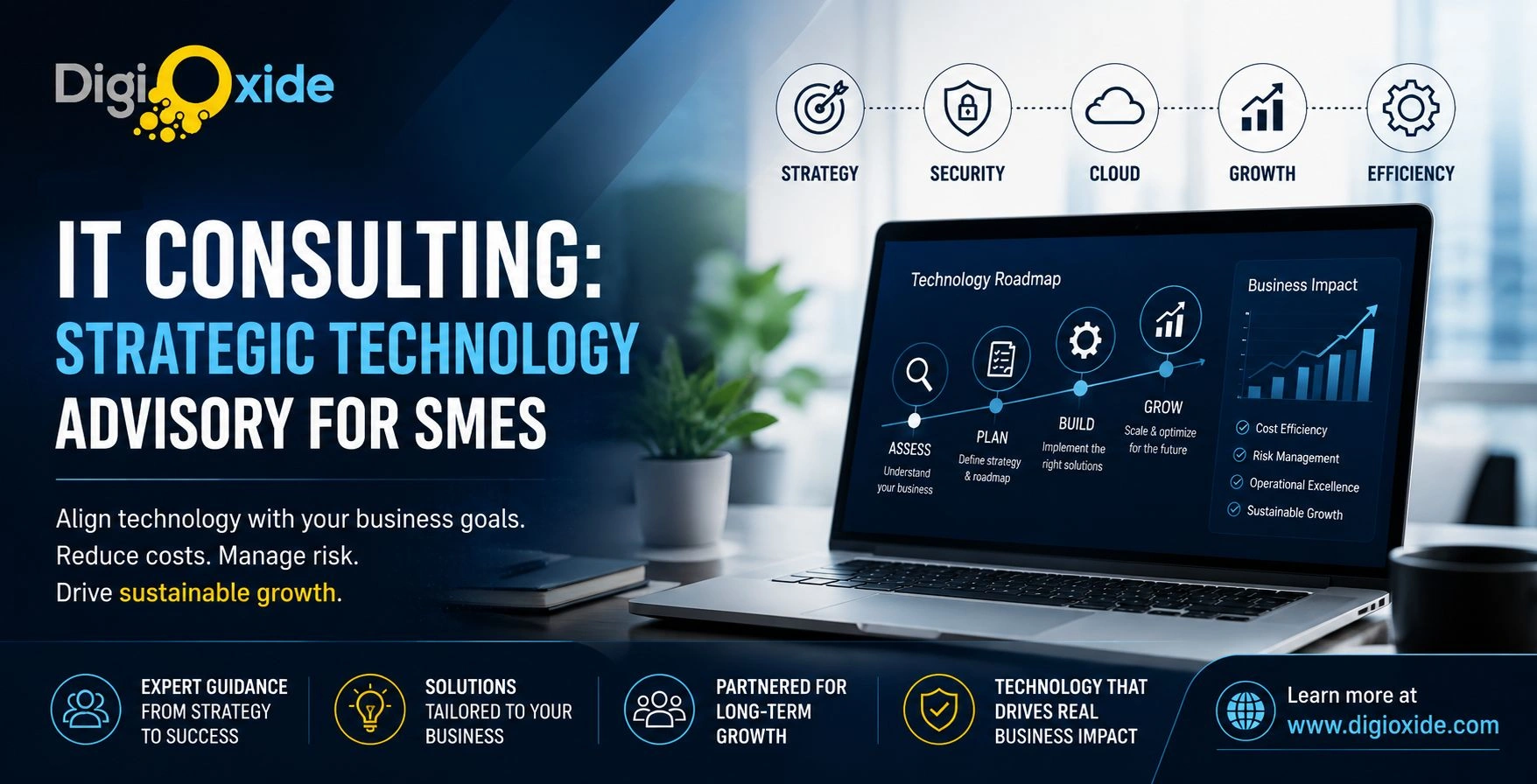
IT Consulting: Strategic Technology Advisory for SMEs

Small and mid-sized businesses tend to acquire technology the way a house accumulates clutter: one tool at a time, each bought to solve an immediate problem, none chosen with the whole picture in mind. A CRM here, a few cloud subscriptions there, an accounting package, a website built by whoever was available. Each decision made sense on its own. Together they produce a tangle that costs more than it should, does less than it could, and quietly holds the business back.
That gap — between technology a business has and technology a business needs — is exactly what IT consulting closes. Not by selling more tools, but by bringing strategic clarity: aligning technology with business goals, building a roadmap, controlling cost, managing risk, and making sure every pound spent on technology actually moves the business forward.
This guide is for SME leaders weighing whether IT consulting services are worth it. We cover what IT consulting actually is (and how it differs from IT support), the specific challenges SMEs face, where consulting drives real growth, the rise of the fractional CIO and CTO, what an engagement looks like, how to choose the right partner, what it costs, and how to tell whether your business needs it. The aim is genuine clarity, not a pitch.
What IT consulting actually is
IT consulting — also called technology consulting or strategic technology advisory — is expert guidance on how a business should use technology to reach its goals. A consultant assesses where you are, defines where you should be, and builds the plan to get there: which systems to adopt, how to integrate them, how to secure them, what to budget, and in what order to act.
The defining word is strategic. IT consulting is about decisions and direction — the what and the why of your technology — rather than the day-to-day running of it.
IT consulting vs managed IT support — a crucial distinction
These two are constantly confused, and the confusion costs SMEs money. The difference is simple but fundamental:
- Managed IT support keeps the lights on. It is reactive and operational: fixing what breaks, maintaining systems, resetting passwords, patching servers, responding to tickets. It answers “is everything working?”
- IT consulting sets the direction. It is proactive and strategic: deciding what technology the business should invest in, how to align it with goals, how to plan for growth, and how to manage risk. It answers “are we doing the right things?”
A business can have excellent support and still be heading in the wrong direction — paying for the wrong tools, missing security gaps, and making technology decisions reactively. Support keeps you running; consulting makes sure you are running somewhere worth going. Many SMEs need both, but they should not mistake one for the other.
Why SMEs in particular need strategic technology advisory
Large enterprises have a CIO, an IT strategy team, and the budget to plan technology properly. Most SMEs have none of that. They have a few people doing IT alongside other jobs, decisions made under pressure, and no one whose job is to think about technology strategically. That structural gap is precisely why technology consulting services matter more for SMEs than for the enterprises that can afford to do it in-house.
The specific challenges SMEs face:
- No strategic IT leadership: Decisions get made operationally, tool by tool, with no one owning the overall direction.
- Limited budgets and a low tolerance for waste: An SME cannot afford to spend heavily on the wrong technology; every decision carries more weight.
- A fast-moving technology landscape: Cloud, AI, automation, and security threats evolve faster than a busy owner can track.
- Rising security and compliance pressure: SMEs are increasingly targeted precisely because they are assumed to be under-protected, and regulations apply regardless of company size.
- Technology that does not scale: Tools and processes chosen for a ten-person company break at fifty, and nobody planned the transition.
- Decision paralysis: Faced with endless options and no expert guidance, leaders either freeze or buy reactively.
IT consulting addresses all of these by supplying the strategic capability an SME cannot justify hiring full-time expertise on demand, focused on the business’s actual goals.
Where IT consulting drives real growth
Strategic technology advisory is not abstract. It produces concrete results across several areas.
Aligning technology with business goals
The core job. A consultant starts not with technology but with the business — your goals, your constraints, your growth plans and works backward to the technology that serves them. The result is technology spending that advances the business rather than accumulating as cost. This alignment is the single most valuable thing IT consulting delivers.
Cost efficiency and accountability
SMEs routinely overspend on overlapping tools, unused licences, and systems that do not fit. A consultant audits what you have, eliminates waste, and ensures future spending is justified. Crucially, good consulting makes technology investment accountable — every spend tied to a measurable business outcome rather than a hopeful purchase. For a budget-conscious SME, this alone often covers the cost of the engagement.
A technology roadmap
Instead of reacting to problems as they arise, a roadmap lays out what technology the business will adopt, when, and why sequenced to match growth and budget. It turns technology from a series of fire-fights into a planned progression, which is far cheaper and far less stressful.
Cybersecurity and risk management
SMEs are prime targets and often under-defended. A consultant assesses your risk, identifies gaps, and builds a security posture proportionate to your business covering threats, data protection, and the compliance obligations that apply regardless of company size. For most SMEs, this is no longer optional.
Cloud and infrastructure strategy
Cloud decisions what to move, how, and to which provider have lasting cost and capability implications. A consultant guides cloud readiness and migration so you capture the agility and scalability without the common mistakes that turn cloud into an unexpected cost centre.
Digital transformation and automation
Beyond keeping up, consulting helps SMEs use technology to genuinely change how they operate automating manual processes, integrating disconnected systems, and adopting tools that create competitive advantage. This is where business transformation advisory turns technology from a support function into a growth engine.
AI readiness
The newest and fastest-moving area. Most SMEs know AI matters but have no idea where to start. A consultant cuts through the hype to identify where AI can realistically help your business, what foundations you need first, and how to adopt it without wasting money on solutions chasing problems that do not exist.
The fractional CIO and CTO: enterprise strategy without the enterprise cost
One of the most useful developments in IT consulting for SMEs is the rise of fractional technology leadership a virtual or fractional CIO or CTO. This is a senior technology leader who works with your business part-time, providing the strategic direction a full-time executive would, at a fraction of the cost.
For an SME, hiring a full-time CIO is unaffordable and usually unnecessary, but going without strategic IT leadership is exactly what causes the problems above. A fractional CIO bridges that gap: senior strategic guidance, an owned technology roadmap, vendor management, and accountable decision-making, scaled to what an SME actually needs and can afford. It is one of the clearest examples of consulting solving a structural problem that SMEs cannot solve any other way.
What an IT consulting engagement actually looks like
Strategic technology advisory is not a vague conversation; it follows a recognisable shape.
- Discovery and assessment: The consultant audits your current technology, processes, costs, and risks, and learns your business goals and constraints. This is the foundation — good advice starts with an accurate picture.
- Strategy and roadmap: Based on the assessment, the consultant defines where the business should go technologically and builds a prioritised, budgeted plan to get there.
- Recommendations and decisions: Specific, justified guidance — which systems, which providers, which investments, in which order — each tied to a business outcome.
- Implementation support or oversight: Depending on the engagement, the consultant either guides your team through execution or provides oversight to keep projects on track and accountable. Some engagements connect strategy directly to delivery.
- Review and ongoing advisory: Technology and business needs evolve, so the best engagements include periodic review and adjustment rather than a one-off report that gathers dust.
The thread running through all of it is accountability: clear goals, measurable outcomes, and decisions you can justify, rather than advice with no follow-through.
Common misconceptions that hold SMEs back
A few persistent myths stop SMEs from getting strategic guidance they would benefit from. Worth clearing up:
- “We’re too small for IT consulting.” Size is not the qualifier — complexity and stakes are. A ten-person business making a major cloud or security decision has as much to gain from good advice as a larger one, often more, because it has less margin for an expensive mistake.
- “Our IT support already handles this.” Support and strategy are different jobs, as covered above. A capable support provider keeps your systems running but is rarely positioned, or incentivised, to question whether you should be running those systems at all.
- “We’ll deal with technology strategy once we’re bigger.” This gets the order backwards. The technology decisions you make while small determine how smoothly you scale. Fixing a tangled, unscalable setup later is far more expensive than planning it well now.
- “Consultants just produce reports nobody uses.” This happens only with the wrong kind of engagement. Good consulting is accountable and tied to delivery — recommendations you act on, with measurable outcomes, not a document that gathers dust.
- “It’s too expensive.” Measured against the cost of wasted spend, security incidents, and missed growth, strategic advice is usually one of the cheaper line items, not one of the more expensive ones.
Clearing these away matters because the businesses most hurt by going without strategic technology advisory are often the ones most convinced they do not need it.
What this looks like in practice
A concrete picture helps. Consider a growing SME — say a services business that has doubled headcount in two years. Along the way it acquired a CRM that the sales team half-uses, two overlapping project tools, cloud storage spread across three providers, an ageing on-premise server nobody wants to touch, and a security setup that amounts to “we have antivirus.” Nothing is on fire, but everything is slightly wrong: staff waste time switching between tools, leadership cannot get a clear view of the business, the monthly software bill keeps creeping up, and a quiet anxiety about a breach sits in the background.
A strategic technology advisory engagement would start by mapping all of that — every tool, every cost, every risk — against where the business actually wants to go. It would likely find duplicate tools to consolidate, unused licences to cut, a clear case to retire the on-premise server in favour of a properly planned cloud setup, and concrete security gaps to close. From there it would produce a sequenced roadmap: what to fix first, what to invest in as the business grows, and a budget that ties each step to a business outcome. The result is not a pile of new technology — it is less wasted spend, a clearer view of the business, a defensible security posture, and a plan that turns technology from a low-grade worry into an advantage. That arc, repeated across thousands of SMEs, is what IT consulting is for.
How to choose the right IT consulting partner
Not all IT consulting firms are equal, and the wrong choice wastes money and time. What to look for:
- Business understanding, not just technical knowledge. The best consultants speak business outcomes first and technology second. If a firm leads with products rather than your goals, be cautious.
- Independence and objectivity. A consultant who profits from selling you specific products is conflicted. Look for advice driven by what is right for your business, not by what the firm happens to resell.
- Relevant experience with businesses like yours. SME challenges differ from enterprise ones; experience with your size and sector matters.
- A clear, structured approach. Good firms have a defined method — assessment, strategy, roadmap, review — not improvisation.
- The ability to connect strategy to delivery. Advice you cannot execute is worth little. A partner who can both advise and help build bridges the gap between plan and reality.
- Transparency on cost and outcomes. Clear pricing and clear measures of success protect you.
The objectivity point deserves emphasis. The value of an independent advisor is precisely that their recommendation is not influenced by what they want to sell — which is why genuinely useful IT consulting firms lead with your goals rather than their catalogue.
What IT consulting costs
IT consulting is priced in a few common ways, and the right one depends on your needs:
- Project-based, for a defined piece of work like a cloud migration strategy or a security assessment — a fixed scope and price.
- Retainer or fractional, for ongoing strategic advisory such as a fractional CIO — a regular monthly cost for continuous guidance.
- Hourly or day-rate, for ad-hoc advice and shorter engagements.
The more useful question than “what does it cost” is “what does it return.” IT consulting pays for itself by eliminating wasted technology spend, preventing expensive mistakes, reducing security and compliance risk, and enabling growth that would otherwise stall. For most SMEs, the cost of not having strategic guidance — overspending on the wrong tools, security incidents, missed opportunities, technology that cannot scale — far exceeds the cost of the advice. Framed against that, consulting is usually one of the higher-return investments an SME can make.
How to tell whether your SME needs IT consulting
You probably need strategic technology advisory if several of these ring true:
- You are growing or scaling, and your technology is starting to strain.
- You are facing a major technology decision — a cloud move, a new core system, an AI initiative — and lack the expertise to make it confidently.
- You have no one who owns technology strategy, only people who keep it running.
- You suspect you are overspending on tools but cannot see clearly where.
- You are worried about security or compliance but unsure where you actually stand.
- You went through a merger, acquisition, or office move and need to integrate or rebuild your technology.
- Your technology decisions are reactive — you fix problems as they arise rather than planning ahead.
Any one of these is a reason to consider it. Several together mean the cost of continuing without strategic guidance is already higher than the cost of getting it.
Where Digioxide fits in
Most of this guide is deliberately about helping you judge whether and what kind of IT consulting you need, because the value of strategic technology advisory lies in objectivity rather than in selling you something. Where Digioxide Technologies Private Limited adds value is in pairing that strategic clarity with the ability to actually build what the strategy calls for.
Our IT and technology consulting services help SMEs align technology with business goals, build a roadmap, control cost, and make confident decisions — including the AI-readiness questions most businesses now face but few know how to answer. For SMEs looking to use technology to genuinely change how they operate, our business transformation consulting connects strategy to operational change, and our product strategy consulting brings the same rigour to the products and platforms you build.
Because advice you cannot execute is worth little, we connect strategy to delivery: when a roadmap calls for new systems, our custom software development team builds them, and when it calls for more hands, our IT staff augmentation provides them. The point is one partner across the whole arc from deciding the right thing to do to actually doing it.
You can see the kind of work that follows our advice in our project portfolio, and when you want an objective read on where your technology should go next, our team is ready to talk.
Frequently asked questions
What is the difference between IT consulting and IT support?
IT support is reactive and operational — fixing and maintaining systems. IT consulting is proactive and strategic — deciding what technology the business should invest in and how to align it with goals. Support keeps you running; consulting decides where you are running to.
Do small businesses really need IT consulting?
Often more than large ones, because SMEs rarely have in-house strategic IT leadership and cannot afford to waste budget on the wrong technology. Consulting supplies that strategic capability on demand without a full-time executive hire.
What is a fractional or virtual CIO?
A senior technology leader who works with your business part-time, providing the strategic direction and roadmap a full-time CIO would, at a fraction of the cost — ideal for SMEs that need strategic leadership but cannot justify a full-time executive.
How much does IT consulting cost?
It is priced by project, by retainer (for ongoing or fractional advisory), or by day-rate. The more useful measure is return: consulting typically pays for itself by cutting wasted spend, preventing costly mistakes, and enabling growth.
How is IT consulting different from technology consulting?
The terms are used interchangeably. Both refer to strategic advice on using technology to achieve business goals, as distinct from the day-to-day support that keeps systems running.
When should an SME bring in an IT consultant?
When growing or scaling, facing a major technology decision, lacking strategic IT leadership, suspecting overspend, worried about security or compliance, or making technology decisions reactively. Several of these together mean the cost of waiting already exceeds the cost of advice.
Will a consultant just try to sell me products?
A good one will not — objectivity is the whole point. Look for firms that lead with your business goals rather than their catalogue, and whose advice is not driven by what they profit from reselling.
The bottom line
IT consulting gives SMEs something they structurally lack and cannot easily build in-house: strategic technology leadership. It is distinct from IT support — support keeps systems running, consulting decides what the business should do with technology in the first place. The value shows up as aligned spending, a clear roadmap, controlled cost, managed risk, smarter cloud and AI decisions, and the ability to grow without your technology becoming the bottleneck.
For most SMEs, the real question is not whether consulting is worth the cost, but whether they can afford to keep making technology decisions without it. The cost of drifting — wasted spend, security gaps, missed opportunities, systems that cannot scale — is usually already higher than the cost of getting strategic guidance. If you would like an objective read on where your technology should go next, that is a conversation our team is glad to have.
