
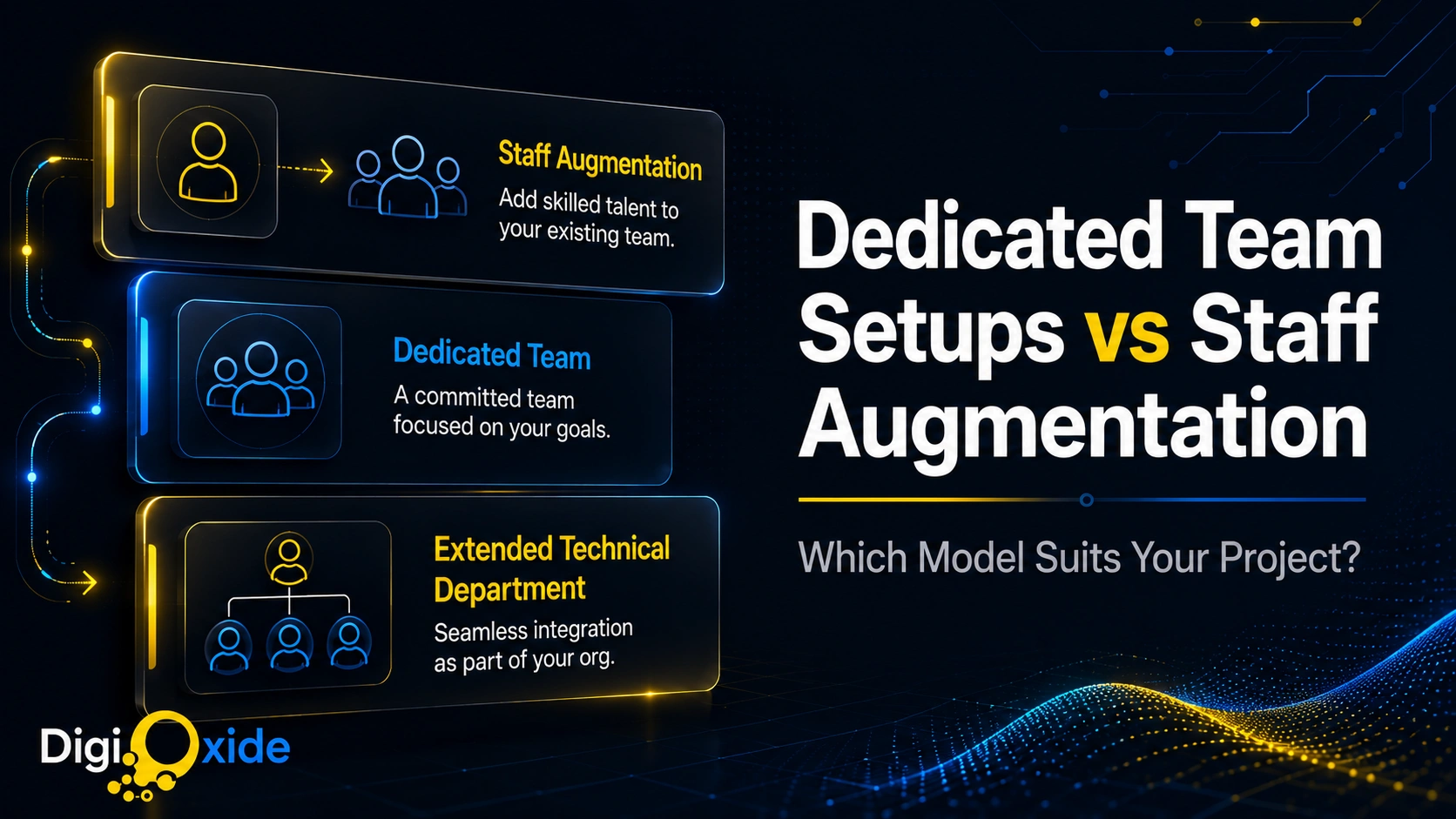
Dedicated Team Setups vs Staff Augmentation: Which Model Suits Your Project?

Every company that builds software eventually faces the same fork in the road: you need more engineering capacity than you have, and you have to decide how to get it. Hire permanently? Too slow and too rigid for most situations. Use external talent? Almost certainly — but in what shape?
That last question is where most of the confusion lives. “We need developers” is the easy part. How you bring those developers in — as individuals who plug into your existing team, or as a self-contained unit that owns a slice of the work — changes your costs, your management load, your delivery speed, and your risk profile. Choose the wrong model and you spend months fighting friction you created on day one. Choose the right one and the extra capacity feels like it was always part of the company.
This guide breaks down the two dominant engagement models — staff augmentation and dedicated team setups — plus the extended technical department variant that sits between them. We cover how each one actually works, what they cost, who manages whom, where the hidden risks live, and a clear framework for matching a model to your specific situation. No vendor spin, just the trade-offs as they play out in real projects.
The fundamental question: who owns the work?
Strip away the jargon and the entire decision comes down to a single distinction:
who is responsible for managing the people and delivering the outcome?
- With staff augmentation, you bring in individual professionals who join your team. You manage them, you assign their tasks, you own the delivery. They add capacity and specific skills; you supply the direction.
- With a dedicated team setup, you bring in a complete, ready-formed unit — developers, often a team lead, sometimes QA and a project manager — that takes ownership of a defined area of work and delivers it for you.
That single difference cascades into everything else: cost structure, speed to productivity, how much of your own time gets consumed, how knowledge is retained, and where accountability sits when something slips. Hold that distinction in mind and the rest of this guide falls into place.
What is staff augmentation?
Software staff augmentation means adding external specialists to your in-house team on a temporary or ongoing basis. They work under your direction, follow your processes, attend your stand-ups, and use your tools. To the rest of your organization they function like employees — they simply happen to be sourced through a partner rather than hired directly.
The defining traits:
- You manage them directly. Task assignment, prioritisation, and day-to-day direction are yours.
- They integrate into your existing team and workflow. There is one team, with the augmented staff inside it.
- You scale precisely. Need one React developer and one DevOps engineer? You get exactly that, and you can add or remove people as the work changes.
- You retain full control over the product and the process.
When staff augmentation is the right call
Staff augmentation fits best when you have a capable internal team and a clear plan, but you are short on hands or missing a specific skill. Common situations:
- You have a strong product and engineering leadership and just need more developers to hit a deadline.
- You need a niche skill a specialist in a framework, a security expert, a data engineer that does not justify a permanent hire.
- Your workload fluctuates and you want to flex capacity up and down without the cost and commitment of permanent headcount.
- You want to keep full ownership of the architecture, the codebase, and the decisions.
The trade-offs of staff augmentation
The model’s strength total control is also where its costs hide. Because the augmented staff work under your management, the management burden is entirely yours. Onboarding, direction, quality oversight, and integration all consume your team’s time. Add several people across different areas and you have effectively taken on a larger team to lead, even though they sit on someone else’s payroll.
Other realities to plan for:
- Onboarding time is real: New people, however skilled, need to learn your codebase and domain before they are fully productive.
- Knowledge can walk out the door: When an augmented engineer rolls off, the context they built up leaves with them unless you have captured it.
- Scaling individuals has limits: Adding ten separate specialists is not the same as adding a coordinated team of ten; the coordination overhead lands on you.
Done well, software staff augmentation is the most flexible and controllable way to add capacity. Done without the management capacity to absorb it, it quietly turns into a second job for your engineering leads.
What is a dedicated team setup?
A dedicated team setup gives you a complete, pre-assembled unit that works exclusively on your project. Rather than individuals slotting into your team, you get a functioning team typically developers plus a team lead, often with QA, and sometimes a project manager that takes ownership of a defined scope and delivers it.
The defining traits:
- The team is managed for you, usually through a team lead or delivery manager who handles day-to-day coordination.
- They work as a cohesive unit, already accustomed to collaborating, with established internal processes.
- They own a slice of the outcome, not just individual tasks.
- Your management load is far lighter, because you direct strategy and priorities rather than micromanaging individuals.
When a dedicated team is the right call
A dedicated team fits long-term, substantial work where you want delivery owned by people you do not have to manage hour by hour:
- You have a long-running product or a major build and want a stable team committed to it.
- Your internal management capacity is limited and you would rather set direction than supervise daily execution.
- You want a team that develops deep domain knowledge over time and retains it.
- You are building something significant a new platform, a custom software product, a long-term modernization where continuity matters more than fine-grained control.
The trade-offs of a dedicated team
The model’s strength outcomes owned and managed for you comes with its own costs:
- You give up some direct control: You steer the team, but you do not assign every task. For organizations that want their hands on everything, that can feel like a loss.
- It works best at scale and over time: A dedicated team is over-structured for a two-week task; its value compounds over months.
- Alignment requires investment up front: Getting the team’s understanding of your goals, standards, and domain right takes deliberate onboarding, even though the day-to-day load afterward is light.
The pay-off is stability and momentum: a team that knows your product, retains its knowledge, improves over time, and frees your leadership to lead rather than supervise.
The extended technical department: a third option
Between pure staff augmentation and a fully owned dedicated team sits a model that many growing companies actually want without having a name for it: the extended technical department sometimes called an extended team or offshore development centre.
In this model, your partner builds and runs a team that functions as a genuine extension of your own engineering organization long-term, deeply integrated, sharing your culture and standards, yet hosted and supported by the partner. It blends the integration and cultural alignment of staff augmentation with the stability, structure, and managed support of a dedicated team.
The defining traits:
- Long-term and stable, designed as a permanent part of your organization rather than temporary cover.
- Deeply integrated into your culture, processes, and product, so the line between “internal” and “external” blurs.
- Backed by the partner’s infrastructure, HR, and retention support, which reduces your administrative load.
- Scalable as a unit, grown and shaped over time alongside your own team.
This model suits companies that have outgrown ad-hoc augmentation but want more cultural and operational integration than a hands-off dedicated team for example, a scaling product company that needs a reliable, long-term engineering arm that feels like its own. An extended technical department gives you the continuity of permanent headcount without the full overhead of building and retaining that team yourself.
Side-by-side: how the three models compare
| Factor | Staff Augmentation | Dedicated Team | Extended Technical Department |
|---|---|---|---|
| Who manages day-to-day | You | The team / partner | Shared, partner-supported |
| Integration with your team | Full — they join your team | Moderate — works as a unit | Deep and long-term |
| Your management overhead | High | Low | Low to moderate |
| Control over tasks | Total | Strategic, not granular | High |
| Best for | Short-to-mid gaps, specific skills | Long-term, defined scope | Long-term scaling capacity |
| Speed to add capacity | Fast for individuals | Fast for a whole team | Built over time |
| Knowledge retention | Risk when staff roll off | Strong within the team | Strongest |
| Scaling style | Individual by individual | By the team | As an organizational unit |
| Cost predictability | Variable with headcount | Stable | Stable |
The table is a map, not a verdict. The right model depends on the specifics below.
Cost: comparing the real economics
Surface comparisons of hourly rates miss the point. The true cost of each model includes the management time it consumes and the risk it carries.
Staff augmentation typically bills per person, often hourly or monthly. The rate looks clean, but remember to add the cost of your own team’s management time — onboarding, direction, and oversight all draw on your most expensive internal people. The model is most economical when your management capacity already exists and is underused.
Dedicated teams usually bill as a unit, on a monthly retainer covering the whole team including its lead. The per-head rate may look higher because it bundles coordination and management, but it removes a large chunk of your management cost. For sustained work, the total cost of ownership is often lower than augmentation once you account for the time you would otherwise spend managing.
Extended technical departments are priced for the long term, reflecting a stable, retained team. The economics favour duration: the longer the engagement, the more the up-front integration investment pays back through retained knowledge and steady productivity.
A useful principle: compare total cost of ownership, not rate cards. A cheaper hourly rate that consumes twenty hours a week of your lead’s time is not cheap. A higher unit price that frees your leadership to focus on the business often wins on the full ledger.
Speed to productivity
Time-to-value differs in an important way.
Staff augmentation can add an individual quickly, but that individual still needs onboarding before they are productive, and several individuals added at once create coordination work that slows the whole.
Dedicated teams can be slower to stand up initially you are aligning a whole team but once running, they move fast because they already collaborate well internally and own their scope. There is no daily coordination tax on your side.
Extended technical departments are the slowest to establish, by design, because they are built for the long haul. Once embedded, they reach the highest sustained productivity because they combine deep domain knowledge with cultural fit.
The honest takeaway: if you need a specific skill next week, augmentation wins on raw speed. If you need sustained delivery over many months, the team-based models win on throughput once they are up to speed.
The factors most teams overlook
Beyond cost and speed, three considerations separate engagements that thrive from ones that quietly struggle.
Knowledge retention and attrition
Software value lives largely in the heads of the people who built it. When an augmented engineer rolls off, that context can leave with them unless you have deliberately documented it. Dedicated teams and extended departments retain knowledge far better because the team persists, even as individuals within it change. If your project is long-lived, weight knowledge retention heavily — it is one of the largest hidden costs in the whole decision.
Intellectual property and security ownership
Who owns the code, the data, and the IP? In every model the contractual answer should be you, but the practical safeguards differ. With augmentation, your security and IP controls govern people working inside your systems. With dedicated and extended teams, you rely more on the partner’s security posture, access controls, and contractual protections. Whichever model you pick, settle IP ownership, confidentiality, and data security in writing before work starts — this is not a detail to leave to trust.
Communication, time zones, and culture
Distributed teams succeed or fail on communication. Overlapping working hours, clear processes, shared tools, and cultural alignment matter more than raw skill in a remote engagement. Extended technical departments are explicitly built to maximise cultural fit; augmentation depends on how well the individuals integrate; dedicated teams sit in between. Factor in the practical reality of how your teams will actually talk to each other every day.
A practical framework for choosing
Run your situation through these questions and the right model usually becomes clear.
- How long is the work? Weeks to a few months → augmentation. Many months to years → dedicated team or extended department.
- How much management capacity do you have? Plenty, and you want control → augmentation. Limited, and you want delivery owned → dedicated team.
- Do you need specific skills or whole-team delivery? A skill gap → augmentation. An owned outcome → dedicated team.
- How much does continuity and retained knowledge matter? A lot → dedicated team or extended department.
- Do you want the capacity to feel like part of your own organization long-term? Yes → extended technical department.
- How much control do you need over day-to-day tasks? Total → augmentation. Strategic direction is enough → team-based models.
If your answers conflict, that is informative in itself — it usually means a hybrid is right.
Hybrid models: you do not have to choose just one
In practice, mature engineering organizations rarely pick a single model and stop. A common and effective pattern is a dedicated team or extended department as the stable core, supplemented by staff augmentation for spikes and specialist needs. The core owns the product and retains knowledge; augmentation flexes capacity for deadlines or brings in niche skills temporarily.
This hybrid gives you stability where you need it and flexibility where you need it. Companies also commonly transition between models as they grow — starting with augmentation to test a partner and meet immediate needs, then converting the relationship into a dedicated team or extended department once trust and momentum are established. Treating the models as points on a spectrum rather than rigid boxes is usually the smartest approach.
Governance: making any model work
Whichever model you choose, a few practices separate smooth engagements from frustrating ones:
- Define success up front. Agree on what good delivery looks like, and how you will measure it, before work begins.
- Establish clear communication rhythms. Regular check-ins, shared visibility into progress, and a single point of accountability prevent drift.
- Invest in onboarding regardless of model. Even the best people need context. Time spent here is recovered many times over.
- Settle the contract details — IP, security, data, exit terms — in writing. Good fences make good partnerships.
- Review and adjust. Reassess the fit periodically; the right model at launch may not be the right model a year in.
These fundamentals matter more than the model label. A well-governed augmentation engagement beats a poorly governed dedicated team every time.
Where Digioxide fits in
The point of this guide is that there is no universally “best” model — there is only the model that fits your project length, your management capacity, your need for control, and your growth plans. Where Digioxide Technologies Private Limited adds value is in helping you choose honestly and then delivering whichever model you land on.
We offer all three approaches rather than pushing one. Our IT staff augmentation and extended team services cover everything from individual specialists who plug into your team to fully managed dedicated teams and long-term extended technical departments that operate as an arm of your own organization. Because we work across the spectrum, the recommendation you get is based on your situation, not on what we happen to want to sell.
For long-term builds, our custom software development and product strategy teams provide the dedicated capacity and direction that sustained projects need, while our operations and support capability keeps delivered systems healthy over time. If you are still validating an idea, our MVP development and rapid prototyping service is a low-commitment way to start.
You can see the kind of work we deliver across our project portfolio, and when you want a straight read on which engagement model fits your project, our team is ready to talk.
The bottom line
Staff augmentation gives you flexibility and total control, at the cost of management overhead ideal when you have a capable team and a clear plan but need more hands or a specific skill. A dedicated team setup gives you owned outcomes and low management load, at the cost of some direct control ideal for substantial, long-running work. An extended technical department gives you a stable, deeply integrated long-term arm of your organization ideal for sustained scaling.
Match the model to your project’s length, your management capacity, and your need for control, treat the models as a spectrum rather than fixed boxes, and revisit the choice as you grow. The model is only the frame; the partner you build it with is what decides whether it works. If you would like an honest, model-neutral read on what fits your project, that is a conversation our team is glad to have.
Frequently asked questions
What is the main difference between staff augmentation and a dedicated team?
Who manages the work. With staff augmentation you manage individuals who join your team. With a dedicated team, a complete unit is managed for you and owns a defined scope of delivery.
Which model is cheaper?
It depends on total cost, not the rate. Staff augmentation has a lower visible rate but consumes your management time. Dedicated teams bundle management into a higher unit price but often cost less overall for sustained work once you account for the time saved.
What is an extended technical department?
A long-term team built and supported by a partner that functions as a deeply integrated extension of your own engineering organization — combining the integration of augmentation with the stability of a dedicated team.
Can I switch between models later?
Yes, and many companies do. A common path is starting with augmentation, then converting to a dedicated team or extended department as the relationship and the work mature.
Which model is best for a long-term product?
A dedicated team or extended technical department, because they retain knowledge, deliver consistent momentum, and reduce your management load over time.
Can I use both models at once?
Yes, a hybrid of a stable dedicated core plus augmentation for spikes and specialist skills is one of the most effective setups in practice.
Who owns the code and IP?
You should, in every model. Make IP ownership, confidentiality, and data security explicit in the contract before work starts, regardless of which model you choose.
