
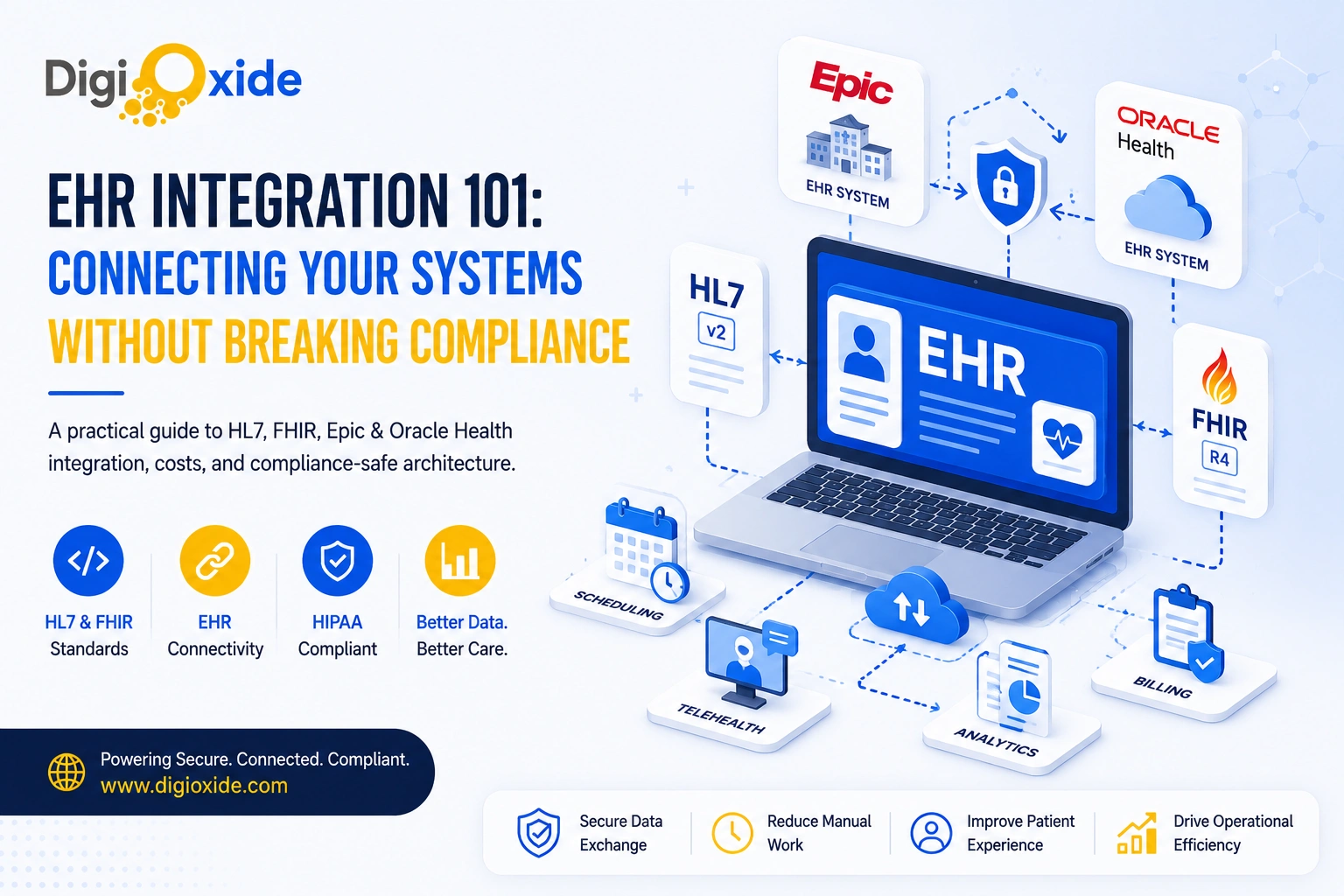
EHR Integration 101: Connecting Your Systems Without Breaking Compliance

EHR integration is how new software earns its place in a healthcare organization: telehealth, patient apps, analytics, and workflow tools only create value when they exchange data with the electronic health record instead of floating beside it. This guide from Digioxide Technologies Private Limited explains what EHR integration involves, how HL7 and FHIR standards actually work, what connecting to Epic or Oracle Health realistically takes, what integration costs in 2026, and how to keep every data flow inside HIPAA boundaries. It is written for practice leaders, hospital IT directors, and healthcare startup founders who need straight answers before committing budget.
Every healthcare organization eventually hits the same wall. The EHR holds the clinical truth, but the work of running the organization happens in a growing ring of other systems: scheduling tools, telehealth platforms, billing software, analytics dashboards, patient apps. When those systems do not talk to the EHR, people become the interface. Staff retype demographics, fax results, copy notes between screens, and reconcile mismatched records, and every manual hop adds cost, delay, and a chance for an error that ends up in a patient’s chart.
EHR integration services, sometimes discussed under the broader banner of EHR interoperability, exist to remove the human middleware. Done well, integration is invisible: data appears where it is needed, when it is needed, with an audit trail behind it. Done badly, it is a compliance incident with a project number attached. Digioxide Technologies Private Limited builds and integrates healthcare software for US providers and digital health companies, and this guide covers the questions we answer in every discovery call, including the ones vendors tend to dodge.
What Is EHR Integration and Why Does It Matter?
EHR integration is the engineering work that connects your electronic health record to the other software your organization depends on, so patient information flows between systems automatically, accurately, and securely. Electronic health record integration can be one-directional, such as a reporting tool that reads visit data, or bidirectional, such as a telehealth platform that pulls patient context in before the visit and writes documentation back to the chart afterward.
Why it matters comes down to four things:
- Care quality and safety: Clinicians make better decisions with complete information in front of them. Patient record interoperability means the allergy documented in one system is visible in every system that needs it, without a phone call.
- Staff time: Duplicate data entry is a full-time job hiding inside other jobs. Integration returns those hours to patient-facing work, which is exactly where staffing shortages hurt most.
- Revenue integrity: Clean demographic and coverage data flowing into billing means fewer rejected claims and faster payment. Most denials are born at the front end, and integration is how the front end gets fixed.
- Regulatory direction: Federal policy has spent a decade steering healthcare toward open, standardized clinical data exchange: certified EHRs must expose standardized APIs, information blocking rules penalize interference with legitimate data access, and national network exchange under TEFCA is live and growing. Integration is not a nice-to-have anymore. It is the direction the entire US system is being pushed.
If you remember one line from this section, make it this: an application that cannot connect to your EHR is not a solution, it is another silo, and you already have enough of those.
The Standards That Make Integration Work: HL7 and FHIR
Healthcare integration runs on shared standards, and understanding the two big ones at a decision-maker level makes every vendor conversation sharper. HL7 and FHIR standards are not competitors so much as generations, and most real-world integration programs use both.
HL7 v2: The Workhorse
HL7 version 2 has moved clinical messages between systems since the late 1980s, and it still carries an enormous share of hospital traffic today. It works through event-driven messages: an ADT message fires when a patient is admitted, discharged, transferred, or has demographics updated; SIU messages carry scheduling events; ORM and ORU messages carry orders and results; DFT messages carry billing charges. HL7 v2 is fast, proven, and everywhere. It is also famously flexible, which means every hospital’s implementation is a slightly different dialect, and every interface needs mapping and testing against the local version rather than a textbook.
C-CDA: The Document Layer
Consolidated Clinical Document Architecture is the standard for exchanging structured clinical documents, such as continuity of care documents and discharge summaries. When systems need to move a whole clinical picture rather than a single data point, C-CDA is often the vehicle.
FHIR: The Modern API Layer
Fast Healthcare Interoperability Resources, pronounced “fire,” is the modern standard, and it looks like the rest of the internet: RESTful APIs exchanging discrete resources such as Patient, Appointment, Observation, and MedicationRequest in developer-friendly formats. FHIR R4 is the version US federal policy standardized on, and the USCDI defines the expanding set of data classes certified systems must be able to share. Two pieces built on FHIR are worth knowing by name: SMART on FHIR, the framework that lets third-party applications launch inside an EHR with the right patient context and permissions, and CDS Hooks, which lets decision-support services plug into specific moments in clinical workflow.
How HL7 FHIR Makes EHR Integration Easier
Here is the practical answer to how FHIR changed the economics of integration:
- Standardized resources replace custom parsing: A Patient resource looks the same across conforming systems, which shrinks the mapping work that dominates HL7 v2 projects.
- Web-native technology widens the talent pool: Modern healthcare API integration uses the same patterns developers already know from every other industry, so projects no longer wait on rare interface-engine specialists for every task.
- Federal policy mandates the front door: Certified EHRs are required to expose standardized FHIR R4 APIs for patient and application access, so a documented, supported entry point exists at every major vendor instead of being a negotiation.
- Sandboxes shorten timelines: Major EHR vendors publish developer documentation and test environments, so integration work can start the week the project does.
- App launch is a solved problem: SMART on FHIR provides a repeatable pattern for putting your application inside the clinician’s existing screen, which is where adoption actually happens.
| Factor | HL7 v2 | FHIR R4 |
|---|---|---|
| Style | Event-driven messages over dedicated interfaces | RESTful APIs exchanging discrete resources |
| Best at | High-volume hospital event feeds: ADT, orders, results, charges | On-demand reads and writes, app connectivity, patient access |
| Consistency | Flexible standard; local dialects require mapping | Standardized resources with defined US profiles |
| Typical effort | Higher per interface; specialist tooling | Lower for supported use cases; web-native skills |
| Where you will meet it | Hospital feeds and legacy systems | New apps, patient-facing tools, modern exchange |
The takeaway for buyers: a competent partner is fluent in both, chooses per use case, and can name exactly which standard and which interfaces your project requires before anyone writes code. That specificity is a reliable test of whether you are talking to engineers or to a sales deck.
Can Any App Be Integrated With Epic or Cerner?
The honest answer: most applications can achieve meaningful integration with Epic and with Oracle Health (formerly Cerner), but “integrated” spans a wide range, and knowing the tiers keeps both expectations and budgets realistic.
Reading standardized data is broadly achievable: Because certified EHRs must expose FHIR R4 APIs, applications can read the standardized data classes, from demographics and problem lists to medications and results, through documented endpoints. Epic publishes its interfaces through its developer programs, including open.epic and Epic on FHIR, and Oracle Health exposes FHIR R4 through its Ignite APIs and developer program. For patient-authorized data access, this front door exists as a matter of federal policy, not vendor goodwill.
Workflow integration is a program, not just an API call: Launching your application inside the clinician’s screen with SMART on FHIR, subscribing to event feeds, or exchanging documents typically means enrolling in the vendor’s developer or partner program, passing their security and review processes, and in some cases paying program or listing fees. It is entirely doable. It is also a workstream with its own timeline, and it belongs in your project plan from day one.
Write-back is the gated tier: Writing data into the chart, such as documentation, orders, or scheduling changes, is more restricted than reading. Permissions vary by vendor, by API, and by the individual health system’s policies, and some write scenarios still run over HL7 v2 interfaces negotiated with the specific organization rather than through a public API. Any vendor who promises unrestricted write-back to any EHR before scoping has started the relationship with a claim they cannot keep.
The health system is a party to the integration: Even where vendor APIs exist, the provider organization governs its own environment: security review, interface approval, and connection scheduling run through their IT processes. A realistic plan budgets for that coordination instead of discovering it in month three.
So, can any app be integrated with Epic or Cerner? Almost any app can read. Serious apps can embed. Write-back is earned through scoping, vendor programs, and approvals. We map exactly which tier your use case requires during discovery, in writing, before you commit to a build.
What Gets Integrated: The Common Use Cases
The same handful of integration patterns account for most of the demand we see:
- Telehealth platforms that pull patient context in before the visit and land documentation in the chart afterward
- Patient-facing apps and portals reading records, schedules, and results so patients stop calling for what software can show them
- Remote monitoring programs feeding device observations into care team worklists instead of PDF attachments
- Analytics and reporting tools aggregating clinical, operational, and financial data into answers leadership can act on
- Patient and practice management systems syncing demographics, schedules, and status events so the front desk types things once
- Billing and revenue cycle tools receiving clean charge and coverage data, which is where denial rates are actually decided
- Referral and care coordination workflows exchanging documents and updates across organizations
If your roadmap includes more than two of these, the architecture decision below matters more than any single integration.
Integration Architecture: Four Patterns and When Each Fits
Point-to-point connections: A direct link between two systems. The right answer for a first, single integration, and the wrong answer as a strategy, because connections multiply as the square of your systems, and ten applications wired point-to-point becomes an unmanageable web nobody fully understands.
Interface engines: The hospital-grade hub that routes, transforms, and monitors HL7 v2 traffic between many systems. The right answer for organizations with high message volumes and many feeds, and the standard pattern inside hospitals for decades.
Third-party EHR connectors and integration platforms: Commercial platforms that maintain pre-built connections to major EHRs and sell integration as a service. The right answer for startups that need connectivity to many EHR brands quickly. The tradeoffs are real: per-connection or per-record fees that scale forever, and a dependency sitting in the middle of your most sensitive data flow, which your enterprise customers will scrutinize.
API-first custom middleware: A purpose-built integration layer that you own, speaking FHIR and HL7 v2 outward while giving your own applications one clean internal API. The right answer when integration is core to your product or operations for the long haul, because it converts permanent platform fees into an owned asset and keeps every future integration cheaper than the last. This is where our custom software development services do their most valuable healthcare work.
The pattern choice is a strategy decision with five-year cost consequences, not a technical detail, which is why we treat it as an architecture conversation through our IT consulting practice before it ever becomes an engineering ticket.
Keeping Integration Compliant
Integration moves protected health information between systems, which makes it a compliance surface, not just plumbing. These are the controls that keep healthcare data integration inside HIPAA boundaries:
- Minimum necessary by design: Scope each interface to the data elements the use case genuinely requires. “Sync everything” is an anti-pattern that turns a small application into a large liability.
- BAAs across the whole chain: Your integration partner, any connector platform, the cloud host, and every subprocessor that touches PHI signs a business associate agreement. One missing signature breaks the chain, and the chain is only as strong as its weakest link.
- Encrypt every hop: Transport encryption on every connection, encryption at rest for anything staged or queued, and no PHI leaking into logs, error messages, or monitoring tools.
- Audit the exchange itself: Record which system requested what data about which patient and when, and keep those logs reviewable. In an investigation, interface logs are evidence, and their absence is a finding.
- Authenticate systems like users: Every connected application gets its own credentials and scoped permissions. Shared service accounts are how small integrations cause large breaches.
- Test with synthetic data: Production PHI does not belong in development or sandbox environments. No exceptions, no shortcuts.
- Respect information sharing rules in both directions: The same policy framework that guarantees your access to data governs how you respond when others request data you hold.
Compliance-safe clinical data exchange is entirely achievable. It simply has to be designed in from the first diagram, which by now you will recognize as the recurring theme of everything we build.
How Much Does EHR Integration Cost?
Published EHR integration cost figures are often quoted per interface and per hour, which is useful once and useless as a planning number. Here are the ranges we actually build against, expressed as delivered scope:
| Scope | Typical investment | Typical timeline | What it includes |
|---|---|---|---|
| Single read-only integration | $15,000 to $40,000 | 4 to 10 weeks | One FHIR-based data pull, one system, standard resources |
| Bidirectional integration with one EHR | $40,000 to $100,000 | 8 to 16 weeks | Read and write for defined resources, error handling, monitoring |
| Multi-endpoint integration platform | $80,000 to $200,000 | 3 to 6 months | Multiple EHR vendors, HL7 v2 feeds plus FHIR APIs, integration middleware |
| Enterprise integration layer | $200,000 to $500,000 and up | 6 to 12 months | Full API-first middleware, dozens of interfaces, SSO, high-throughput event processing |
Costs shift with these variables:
- Which EHR vendors you connect to and which APIs they license or gate, since program enrollment, sandbox access, and sometimes ongoing fees vary by vendor
- Read versus write, since bidirectional integration is meaningfully more work than one-way reads
- HL7 v2 versus FHIR, since HL7 interfaces require mapping against the specific site’s implementation while FHIR builds against standardized resources
- Volume and reliability requirements, since batch jobs are simpler than real-time event streams with retries, monitoring, and alerting
- Data migration or backfill scope, since moving historical data cleanly is a project inside the project
Hidden costs to plan for: EHR vendor program enrollment and listing fees, sandbox access, interface certification, HIPAA-eligible cloud infrastructure for the middleware, penetration testing, and the health system’s own security review costs. Naming these up front is the difference between a project that finishes on budget and one that quietly ships surprises.
Ongoing costs: Budget 15 to 20 percent of the initial build annually for interface monitoring, error handling, dependency updates, and adapting to vendor API changes. Interfaces are not “set and forget,” because the systems on both sides do not stand still.
The delivery-model lever: As with every other healthcare build, US onshore rates of $120 to $200 per hour versus experienced offshore healthcare teams at $25 to $50 per hour make a blended model 40 to 60 percent more cost-efficient without cutting scope. Digioxide Technologies Private Limited runs that model with senior integration engineers, US-business-hours overlap, and fixed-scope pricing after discovery.
Cost of EHR Integration for Healthcare Startups
Startups have a specific version of this problem: they need to demonstrate connectivity to enterprise buyers before they have enterprise revenue. The pragmatic playbook:
- Prove one integration first, thoroughly: One clean FHIR integration with a well-documented major EHR proves the pattern, the compliance posture, and the team’s capability. Enterprise buyers care that you can do it well, not that you have done it eighteen times.
- Choose the connector-versus-custom balance deliberately: A third-party integration platform can accelerate reach to many EHR brands at the cost of permanent per-record fees and a dependency in your data path. Custom middleware costs more up front and creates an owned asset. The right answer depends on your capital structure, margin profile, and how strategic connectivity is to your product. We will model both paths honestly during discovery.
- Design the integration surface once and reuse it: A single internal API in front of a growing set of EHR adapters means the second and third integrations cost a fraction of the first. Skipping this discipline is why some startups end up rewriting their integration layer at year two.
- Front-load the compliance work: Enterprise security reviews are where startups lose deals, and integrations are where those reviews spend the most time. Building the documentation, controls, and BAA structure into version one turns those reviews from crises into checkboxes.
Our MVP development and rapid prototyping practice scopes the lean first integration deliberately, so the initial deliverable does the demo, passes the review, and provides a foundation you can extend, rather than a throwaway that you replace six months later.
EHR Integration Services for Independent Practices
For independent practices, the integration question is usually smaller and more concrete than the platform-scale conversations above. Common scenarios:
- A specialty tool or workflow app the practice wants to add without living inside a browser tab that never talks to the EHR
- A patient engagement layer that needs demographics, schedules, and results from the EHR
- A reporting dashboard aggregating data across the EHR, the billing system, and one or two ancillary systems
- A telehealth platform that must land documentation in the chart to be worth deploying
For most of these, a focused read-only or narrowly bidirectional integration in the $15,000 to $60,000 range is the right investment, and it can ship in a couple of months when the EHR vendor exposes the interfaces the use case needs. The sequence that works: confirm the specific FHIR resources or HL7 messages available on your EHR, scope only the data the workflow requires, and pilot with one provider before rolling out. A practice that starts here builds integration muscle that pays off with every subsequent addition, instead of accumulating another disconnected subscription.
How to Integrate a New App With Existing EHR Software
The question “how to integrate a new app with existing EHR software” gets asked more than any other in this category, so here is the sequence, compressed to the useful essentials:
- Name the workflow, not the technology. Which staff, which patients, which decisions, and which existing systems does the new app touch. If you cannot describe the workflow in a paragraph, integration is not your first problem.
- List the data the workflow actually needs, in and out, and nothing more. Minimum necessary is both good compliance and good scoping.
- Confirm what your EHR exposes. Which FHIR resources, which HL7 message types, which sandbox is available, and what write-back permissions you can obtain. Get this in writing from the vendor before signing a build contract.
- Choose the architecture pattern. Point-to-point for one small integration, custom middleware if this is the first of several, and evaluate connector platforms honestly if breadth of EHR support is the near-term priority.
- Design compliance in. BAAs across the chain, scoped credentials, encryption on every hop, and audit logging of the exchange itself, all in the initial architecture document.
- Build in reviewable increments. Ship a working end-to-end thread first, in a sandbox, then harden and expand. Vaporware integrations are the ones that surprise everyone at go-live.
- Test with real-world data patterns. Healthcare data is famously messy. Test against the exceptions, not just the happy path, because production will hit them within days.
- Plan the rollout with the health system. Their security review, interface windows, and downtime rules are part of your timeline. Coordinate them from week one.
- Instrument and monitor from day one. Message counts, error rates, latency, and reconciliation reports go to a dashboard someone actually watches. Silent integration failures are the most expensive kind.
Every step above is what we do. Every step skipped is where trouble finds a project later.
How Digioxide Technologies Private Limited Approaches EHR Integration
Digioxide Technologies Private Limited treats EHR integration services as a first-class capability, because the healthcare products and platforms our clients build depend on getting integration right. What that looks like in practice:
- Standards fluency across HL7 v2, C-CDA, and FHIR R4, with real experience against major EHR sandboxes and production environments
- Compliance-first architecture, with BAA-covered vendor chains, scoped credentials, encryption on every hop, and audit logging of exchanges as defaults
- Discovery that gets specific, naming the exact resources, interfaces, vendor programs, and approvals your integration will require, so the proposal is a plan rather than an estimate
- API-first middleware as our preferred long-term pattern, so the second, third, and tenth integrations cost less than the first, and your integration layer is an owned asset rather than a rented dependency
- Blended delivery economics that put senior integration engineers on your project with US-business-hours communication, typically 40 to 60 percent below onshore-only totals
- Long-term partnership, because interfaces need monitoring, patching, and adaptation as vendor APIs evolve, and we build the systems we expect to support
Whether the goal is a single connection to Epic or Oracle Health, a multi-EHR platform for a startup, or an integration layer for a hospital’s next decade of digital growth, the evaluation is the same: standards depth, compliance posture, honest scoping, and a partner accountable for what happens after launch.
Frequently Asked Questions
What is EHR integration and why does it matter?
EHR integration is the engineering work that connects an electronic health record to other software, so patient data flows automatically, accurately, and securely between systems instead of being copied by hand. It matters because it removes manual double-entry that costs staff time and creates errors, delivers complete clinical context to the point of care, cleans the demographic and coverage data that determines whether claims get paid, and keeps organizations aligned with a federal policy direction that has spent a decade steering healthcare toward open, standardized data exchange.
How does HL7 FHIR make EHR integration easier?
FHIR uses modern web APIs and standardized resources such as Patient, Appointment, Observation, and MedicationRequest, so much of the custom mapping that dominated HL7 v2 projects is unnecessary. Federal policy requires certified EHRs to expose FHIR R4 APIs for patient and application access, major vendors publish documentation and sandbox environments, and SMART on FHIR provides a repeatable pattern for launching applications inside the EHR with the right context and permissions. FHIR does not replace HL7 v2 for hospital event feeds, but for new applications and patient-facing use cases it substantially lowers cost and effort.
Can any app be integrated with Epic or Cerner?
Most applications can achieve meaningful integration with Epic and Oracle Health (formerly Cerner), but the depth varies by use case. Reading standardized data through FHIR R4 APIs is broadly achievable through documented developer programs. Embedded workflows using SMART on FHIR are common, subject to vendor program enrollment and security review. Write-back is more restricted, varies by vendor and API, and often requires HL7 v2 interfaces negotiated with the specific health system. Any vendor promising unrestricted write-back to any EHR before scoping is overpromising, and it is a warning sign worth taking seriously.
How much does EHR integration cost?
A single read-only integration typically runs $15,000 to $40,000, a bidirectional integration with one EHR $40,000 to $100,000, a multi-endpoint platform $80,000 to $200,000, and an enterprise integration layer $200,000 to $500,000 or more. Plan an additional 15 to 20 percent of the build cost annually for monitoring, maintenance, and adapting to vendor API changes. Blended offshore delivery typically reduces totals by 40 to 60 percent versus onshore-only rates.
How long does an EHR integration project take?
Simple read-only integrations ship in 4 to 10 weeks. Bidirectional integrations with one EHR run 8 to 16 weeks. Multi-endpoint platforms take three to six months, and enterprise integration layers 6 to 12 months. Vendor security reviews, sandbox access, and health system approval processes are the factors most likely to stretch timelines, which is why they belong in the plan on day one rather than as surprises in month three.
Do we need HL7 or FHIR, or both?
Most real programs use both. HL7 v2 continues to carry the majority of high-volume hospital event traffic such as ADT, orders, results, and charges. FHIR R4 is the modern standard for on-demand reads and writes, application connectivity, and patient access, and it is the required front door on certified EHRs. A partner that is fluent in both and chooses per use case is the right partner.
Are there off-the-shelf EHR connectors we can use instead of custom integration?
Yes. Third-party integration platforms maintain pre-built connections to many EHRs and can accelerate reach, especially for startups. The tradeoffs are real: per-record or per-connection fees that scale forever, and a dependency sitting inside your most sensitive data flow that enterprise customers will scrutinize during security review. For long-lived platforms where integration is core, API-first custom middleware you own typically wins on total cost and control. We will model both paths honestly during discovery instead of defaulting to one.
How do we keep EHR integrations HIPAA compliant?
Design the interface to move only the minimum necessary data, get business associate agreements from every party in the chain including cloud host and connector platforms, encrypt every hop and everything at rest, log the exchange itself so who requested what data about which patient and when is reviewable, give each connected system its own scoped credentials rather than shared accounts, and never let production PHI touch development environments. Compliance in integration is the sum of these controls designed in at the start and maintained in operation.
Make Integration a Strategic Advantage
The organizations that get the most from healthcare software in 2026 will not be the ones with the most applications. They will be the ones whose applications talk to each other, share the clinical truth of the EHR, and give staff and clinicians one accurate picture instead of ten partial ones. Integration is not overhead. It is the compounding investment that makes every future addition cheaper, faster, and more valuable.
If EHR integration is on your roadmap, whether as a single interface for a new tool or as a platform strategy for the next decade, start with a discovery conversation, not a proposal request. Digioxide Technologies Private Limited will map your systems, name the standards and interfaces your use cases require, and give you a fixed-scope plan with numbers you can defend. Contact our team to schedule it.
