
What is Enterprise Mobility Management (EMM)? 2026 Guide

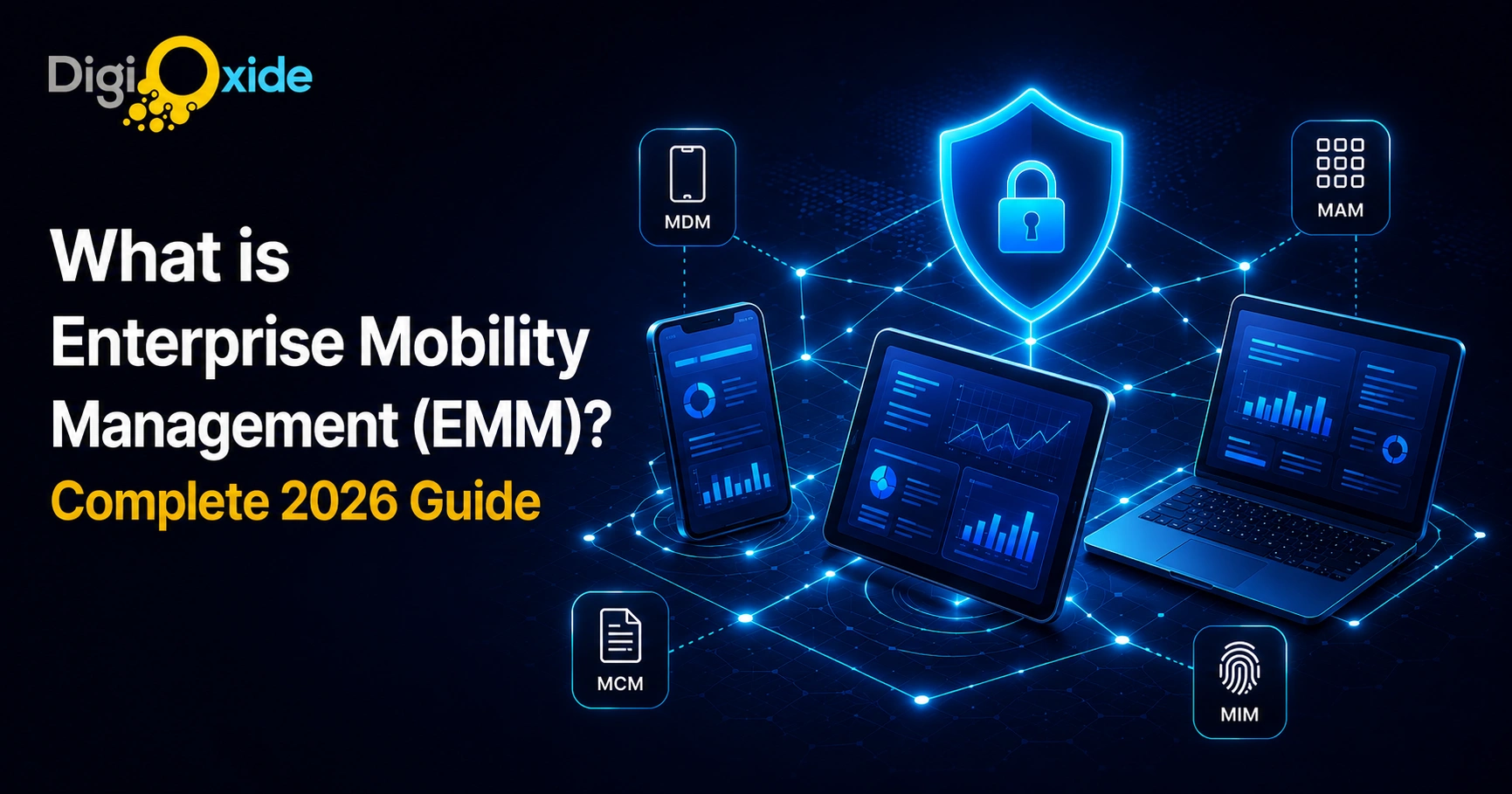
Enterprise Mobility Management (EMM) is the set of people, processes, and technology a business uses to secure, manage, and monitor the mobile devices, applications, content, and identities employees use for work. EMM combines four pillars: MDM (Mobile Device Management) for the device, MAM (Mobile Application Management) for the work apps, MCM (Mobile Content Management) for the documents and data, and MIM (Mobile Identity Management) for the users and access. The goal is to let people work from anywhere on any device, corporate-owned or personal under BYOD, without losing control of corporate data.
Leading EMM platforms in 2026 include Microsoft Intune, VMware Workspace ONE, Jamf, SOTI MobiControl, IBM MaaS360, Hexnode UEM, and ManageEngine Endpoint Central. Most EMM platforms today are sold as Unified Endpoint Management (UEM), extending the same controls to laptops, desktops, IoT, and wearables.
At Digioxide Technologies Private Limited, we approach EMM as a combination of platform selection, policy design, and (most importantly) the work apps that sit on top. A locked-down phone with a bad CRM is worse than no EMM at all; employees route around it. Our enterprise mobility practice combines EMM strategy with custom mobile app development so the management layer and the apps it manages reinforce each other.
Enterprise Mobility Management Defined
Enterprise Mobility Management is a framework of tools, policies, and processes designed to manage and secure mobile devices, applications, and corporate data used in a business context. EMM helps organizations enable mobile and remote work while maintaining security, compliance, and productivity across a diverse fleet of devices and platforms.
The discipline emerged from Mobile Device Management (MDM) in the early 2010s as smartphones, tablets, and BYOD policies made device-only management insufficient. Today, EMM encompasses integrated capabilities for MDM, MAM, MCM, MIM, and enterprise app stores. Advancements in data privacy, secure containerization, conditional access, and AI-driven anomaly detection have shaped modern EMM platforms.
Today’s EMM platforms can enforce per-app encryption policies, manage application permissions, deliver real-time analytics on device health and usage, automatically wipe corporate data from a lost device, and block access from a device that does not meet security policy, all without exposing IT to the device’s personal content.
A practical enterprise mobility program in 2026 is rarely just one product. It is an integrated stack of EMM/UEM platform, identity provider, endpoint detection and response (EDR), and a set of well-designed work apps that employees actually want to use. Digioxide builds this stack end-to-end for clients in healthcare, financial services, retail, logistics, and manufacturing.
Why EMM Is Essential in 2026
Five structural forces make EMM non-optional for most organizations in 2026.
Hybrid and remote work is permanent:- Most knowledge workers split time between office, home, and travel. Mobile devices are the primary endpoint for a meaningful share of corporate work.
BYOD is the default in many markets:- Even companies that issue corporate phones see employees prefer their own devices for certain workflows. Without MAM-style separation, BYOD means corporate data on uncontrolled hardware.
Mobile threats are growing:- Industry reports show mobile cyberattacks rose sharply (a 147% year-over-year increase in some 2023 measurements), driven by phishing, malicious apps, network-level attacks, and OS exploits.
Regulators expect provable controls:- GDPR, HIPAA, PCI DSS, India’s DPDP Act, and a long list of sector regulations assume the organization can prove who accessed what data, on which device, when.
The workforce is changing:- Millennials and Gen Z, who expect mobile-first tooling and BYOD options, are now the dominant share of the workforce.
The economics are stark. The average cost of a single major mobile data breach routinely exceeds the entire lifetime cost of an EMM rollout. EMM is one of the highest-ROI security investments a mid-sized or larger organization can make. Digioxide’s enterprise mobility engagements typically pay for themselves within 12 to 18 months in IT support cost reduction alone, before accounting for the security and compliance benefits.
The Four Pillars of EMM
EMM is not a single product. It is a stack of four interrelated disciplines that usually live inside one integrated platform.
1. Mobile Device Management (MDM)
MDM controls the device itself: enrollment, configuration, OS updates, encryption, remote lock, and remote wipe.
Key MDM capabilities:
- Device enrollment workflows (Apple Business Manager, Android Zero-Touch, Windows Autopilot, Samsung Knox)
- Configuration profiles for Wi-Fi, VPN, email, certificates, restrictions
- Compliance policies: passcode complexity, encryption, jailbreak detection, OS version enforcement
- Remote lock and remote wipe
- OS patch management
- Lockdown (kiosk) mode for single-purpose devices
- Inventory and asset tracking
- Geofencing and location-based policies
- Certificate management
2. Mobile Application Management (MAM)
MAM controls the work apps and the corporate data inside them, without managing the whole device.
Key MAM capabilities:
- Managed app catalog or enterprise app store
- App-level encryption and secure containers
- Copy/paste, share, and screenshot restrictions between work and personal apps
- Selective wipe
- App configuration delivered from server
- App lifecycle management
- App-level VPN
- App wrapping and SDK integration for custom apps
- Conditional app access
3. Mobile Content Management (MCM)
MCM secures documents, files, and content on mobile devices.
Key MCM capabilities:
- Secure document containers
- Encrypted access to SharePoint, OneDrive, Google Drive, Box, Dropbox
- DLP controls on download, share, copy, print, screenshot
- Watermarking and audit trails
- Offline access with policy-controlled caching
- Document expiration and revocation
- Selective content wipe
4. Mobile Identity Management (MIM)
MIM controls who can access what, and from which device, under which conditions.
Key MIM capabilities:
- Single sign-on (SSO) across mobile apps
- Multi-factor authentication, including push, biometric, FIDO2, passkey
- Conditional access policies
- Certificate-based authentication
- Device-trust signals fed into the identity provider
- Adaptive authentication
- User provisioning and deprovisioning via SCIM
- RBAC and ABAC
A modern EMM program ties all four pillars together so a single policy can say: “Sales reps can read CRM data on their personal phones, but only in the managed app, only after MFA, only when the device is encrypted and on the latest OS, only inside the country, and only during business hours.” That kind of contextual control is the whole point of EMM, and it is the bar Digioxide’s mobility consultants hold every client deployment to.
EMM vs MDM vs UEM: Clearing Up the Terminology
| Term | Scope | What It Manages |
|---|---|---|
| MDM | Devices only | Phones, tablets |
| EMM | Devices + Apps + Content + Identity | The full mobile workforce |
| UEM | Everything an employee uses | Mobile + laptops + desktops + IoT + wearables |
| MTM | Mobile Threat Management | Threat detection on mobile |
In practice, almost every modern EMM platform is sold as UEM today. The “M” in front keeps changing as scope expands, but the goal is the same: one policy engine, one console, all endpoints.
Key Benefits of EMM for Businesses
A well-run EMM program delivers measurable value in six areas.
Security:- Encryption, conditional access, remote wipe, app sandboxing, secure containers, audit trails.
Compliance:- Auditable controls and reporting satisfy SOC 2, HIPAA, GDPR, PCI DSS, ISO 27001, DPDP Act.
Productivity:- Zero-touch enrollment, automatic Wi-Fi/VPN, SSO, managed app delivery. New hire productive on day one.
Cost control:- Centralized inventory, license tracking, automated policy enforcement. Most organizations see 30% to 50% reduction in mobile IT support cost.
User experience:- Clean separation of work and personal. SSO instead of repeated logins. Automatic app updates.
Business continuity:- Lost or stolen device wiped in minutes. Employee offboarding takes clicks, not days.
Top Enterprise Mobility Management Platforms
A short, opinionated view of the leaders in 2026. Pick based on which OS dominates your fleet, which identity provider you use, and how demanding your edge cases are.
- Microsoft Intune:- Default for Microsoft 365 + Entra ID shops. Excellent on Windows, increasingly strong on iOS and Android.
- VMware Workspace ONE (now Omnissa Workspace ONE):- Enterprise-grade UEM with deep Android Enterprise and rugged-device support.
- Jamf (Pro, Now, Connect):- Category leader for Apple-first organizations.
- SOTI MobiControl:- Strong for field operations, logistics, retail, healthcare, rugged Android.
- IBM MaaS360:- AI-driven analytics and compliance reporting. Good for organizations that trust IBM.
- Hexnode UEM:- Capable mid-market option.
- ManageEngine Endpoint Central:- Affordable, broad-scope UEM popular with mid-sized IT.
- BlackBerry UEM:- Still relevant for highly regulated environments.
- Citrix Endpoint Management:- Good fit for Citrix Workspace shops.
- Cisco Meraki Systems Manager:- One console for networking and endpoints.
Digioxide Technologies is platform-agnostic in its consulting practice. We have implemented Intune, Workspace ONE, Jamf, and SOTI MobiControl in production environments and we recommend the platform that fits the client’s specific situation, not the one we get the largest reseller margin on (we don’t take reseller margins). The pilot phase is what tells you which platform is right, and we run those pilots structured to deliver an honest verdict in 4 to 6 weeks.
Industries Where EMM Is Mission-Critical
Healthcare:- EHR access on tablets, secure clinician messaging, HIPAA compliance, telehealth workflows. Digioxide Technologies Private Limited has built clinician apps for healthcare clients that ship with the EMM-friendly architecture (managed configuration, app-level VPN, audit logging) built in from day one.
Financial services:- Trader and advisor workflows, FINRA, SEBI, regulatory recordkeeping, mobile banking, PCI compliance, fraud detection.
Retail:- Store-issued devices for POS, inventory, clienteling, customer engagement. mPOS requires strong device management.
Logistics and field service:- Rugged Android for drivers, technicians, warehouse workers. SOTI MobiControl is widely used here. Digioxide has built field service apps for logistics clients that combine offline-first design with EMM integration.
Government and defense:- Classified-aware workflows, strict data residency, audit, clearance requirements.
In each case, the right EMM rollout is paired with custom mobile app development for the workforce apps that sit on top: a clinician app, a field service app, a store associate app, a driver app, a warehouse picker app. This is the combination Digioxide ships most often: EMM strategy plus the custom apps that make the management layer worthwhile.
Common Challenges in EMM and How to Solve Them
Data security across diverse devices:- Sensitive business data flowing across many device types creates breach risk. Solution: enforce encryption at rest and in transit, enable remote wipe, deploy app-level containers, require minimum OS versions, run regular policy reviews.
Device compatibility and OS fragmentation:- Solution: pick an EMM with strong cross-platform support, standardize device models where possible, require Android Enterprise enrollment, test policy changes against a representative device matrix.
Employee resistance and privacy concerns:- Solution: publish a clear user-facing privacy notice, use work profiles and Apple User Enrollment so the company never touches personal data, communicate the security benefits, offer training.
Managing diverse platforms:- Solution: pick a UEM with truly unified policy management, automate aggressively, build internal runbooks for unusual cases.
Cost concerns:- Solution: choose a scalable platform fitting your budget, prioritize critical use cases first, consider cloud EMM, demonstrate ROI against IT support cost reductions.
Offboarding gaps:- Solution: integrate EMM with HR via SCIM so deprovisioning fires automatically.
The forgotten apps:- Solution: invest in app UX as much as in policies. Bad work apps create shadow IT. This is exactly why Digioxide bundles app development with EMM strategy on most engagements.
How to Roll Out EMM: A Practical 7-Step Plan
Step 1: Inventory the Fleet
Build an accurate picture of devices, OS versions, ownership models, apps in use, networks, existing controls, and compliance obligations. Typically 2 to 4 weeks.
Step 2: Map Use Cases by Persona
Sales, field service, warehouse, executives, engineering, retail frontline, healthcare clinicians. Each persona gets its own profile with enrollment flow, app set, and policies.
Step 3: Pick the Platform
Evaluate 2 to 3 platforms against your use cases. Run a 4 to 6 week pilot with at least 50 real users. Score on OS coverage, identity integration, admin experience, user experience, policy granularity, reporting, support quality, TCO. Digioxide runs these pilots for clients on a fixed-fee basis; the output is a written recommendation with the platform choice and the reasoning.
Step 4: Design Policies, Not Just Products
Policies define what “compliant” means. Passcode complexity, encryption, OS version, jailbreak detection, app restrictions, network restrictions, geofencing, conditional access, app-level DLP. Document each policy with the business reason.
Step 5: Pilot with a Friendly Team
50 users for 4 to 6 weeks. Gather every support ticket, fix policy edges, write the user-facing FAQ.
Step 6: Roll Out in Waves
By business unit, region, or device type. Avoid single-day cutover. Keep a documented rollback plan.
Step 7: Operate, Measure, Improve
Measure enrollment compliance, provisioning time, offboarding time, support tickets, policy violations, user satisfaction, security incidents. Iterate quarterly.
Digioxide Technologies Private Limited typically handles the entire rollout cycle for clients who do not have a mature internal mobility team, transitioning operations back to the client’s IT once the platform is stable and the team is trained. For clients with strong internal IT, we run the design and pilot phases and let the client own operations.
EMM Trends Shaping 2026 and Beyond
Zero Trust convergence:- EMM increasingly feeds device-trust signals into the identity provider’s policy engine. EMM becomes a signal source for broader Zero Trust architecture.
AI-driven anomaly detection:- Platforms moving from rule-based compliance to behavior-based detection. The combination of EMM and EDR is becoming standard.
Passwordless and FIDO2:- Device-bound passkeys replacing SMS OTP and authenticator-app MFA.
Tighter UEM consolidation:- Single-pane consoles managing phones, tablets, laptops, desktops, IoT, wearables, rugged devices.
Edge computing and MEC:- Mobile workloads processing at the edge.
IoT device management:- Wearables, sensors, industrial equipment, connected vehicles managed alongside traditional endpoints.
AI assistants embedded in work apps:- EMM grappling with DLP for AI prompts, governance of AI-generated content, audit trails for AI-mediated interactions. Digioxide is actively shipping these patterns into client enterprise apps in 2026.
Sustainability reporting:- EMM inventory feeding ESG reporting.
Enhanced user experience:- Silent enrollment, SSO across all work apps, contextual MFA, self-service portals.
Common EMM Mistakes to Avoid
- Treating BYOD like corporate-owned. Use MAM and app containers.
- One-size-fits-all policies. Per-persona policies are essential.
- Ignoring the offboarding flow. Integrate EMM with HR via SCIM.
- Skipping user communication. Answer the privacy question clearly, up front.
- Forgetting the apps. Bad work apps create shadow IT.
- Picking the platform before the use cases. Pilot first.
- Underinvesting in support. Train the help desk before the rollout.
- Setting and forgetting. Policies need quarterly review.
- No compliance target. Without specific compliance targets, policies drift to “what is easy” rather than “what is required.”
How EMM Connects to Mobile App Development
EMM is the management layer, but it lives on top of the work apps employees actually use. The most successful enterprise mobility programs combine three things:
- A mature EMM/UEM platform that enforces device, app, content, and identity policies
- Well-designed work apps (often custom-built) that employees prefer to personal apps for the same task
- An identity and access management layer tying everything together
If the work apps are bad, employees route around them. Shadow IT replaces controlled IT. The EMM controls become irrelevant because the data is no longer flowing through managed channels. This is why serious mobile app development work usually precedes or accompanies an EMM rollout. The app strategy and the management strategy are inseparable.
Modern enterprise mobile apps in 2026 typically include:
- Native iOS and Android (or Flutter/React Native for cross-platform)
- Offline-first design for field workers
- Deep integration with the corporate identity provider via SSO
- Push notifications through managed channels
- Per-app VPN
- EMM SDK or AppConfig support for managed configuration
- Built-in audit logging
- Accessibility meeting WCAG 2.2 AA
These apps cost USD 80,000 to USD 500,000+ for complex enterprise workflows. Digioxide’s enterprise mobility engagements typically combine the EMM strategy with the custom app build, so the management layer and the apps it manages reinforce each other from day one rather than being procured separately and integrated awkwardly.
Frequently Asked Questions
What is the difference between EMM and MDM?
MDM manages the device itself: enrollment, OS, passcode, configuration, remote wipe. EMM is a superset adding MAM, MCM, and MIM. EMM is what an organization needs when BYOD, corporate apps, sensitive data, and regulatory compliance are all in the mix.
What is the difference between EMM and UEM?
UEM extends EMM’s controls beyond phones and tablets to laptops, desktops, IoT, wearables, and rugged equipment. Most leading EMM platforms are sold as UEM in 2026.
Is EMM required for BYOD?
Effectively yes. Without EMM, specifically MAM and conditional access, there is no reliable way to let employees use personal devices for work while protecting corporate data.
How much does EMM cost?
EMM is usually per-device or per-user per month. Typical 2026 ranges are USD 3 to USD 15 per user per month. Implementation and ongoing management add 50% to 150% of first-year license cost. Microsoft Intune bundled with Microsoft 365 E3 or E5 is often the lowest-incremental-cost option. Digioxide Technologies Private Limited gives clients full TCO modeling at the start of an engagement so the budget conversation is honest.
What are the four components of EMM?
MDM, MAM, MCM, MIM. Together they cover devices, apps, data inside apps, and users.
Can EMM manage personal phones?
Yes, but only the work side. Modern EMM uses Android work profiles, Apple User Enrollment, or app-level containers. A user-facing privacy notice is essential for adoption.
Which is the best EMM solution?
No universal best. Intune for Microsoft 365 shops. Jamf for Apple-first. Workspace ONE for large mixed-OS enterprises. SOTI MobiControl for rugged-device field operations. MaaS360 for IBM-trusting organizations. The right choice depends on dominant OS, identity provider, and most demanding use case.
What is the role of AI in EMM?
AI reshapes EMM through behavioral anomaly detection, predictive analytics for device failures and capacity, and AI assistants for help desk load reduction. AI will be a default feature in every major EMM platform by 2027.
How does EMM support remote work?
EMM extends the corporate perimeter to wherever the employee and device are: SSO, MFA, conditional access on compliant devices, encrypted containers, per-app VPN, remote troubleshooting.
What is Zero Trust in the EMM context?
Zero Trust assumes no user, device, or network is trusted by default. Every access decision is verified continuously. EMM provides the device-trust signals the identity provider uses to make decisions.
Is EMM the same as Mobile Security?
EMM is a major part of mobile security. Mobile security also includes Mobile Threat Defense (MTD), Mobile Application Security Testing (MAST), and broader endpoint security tools (EDR, XDR).
How does EMM handle GDPR and HIPAA compliance?
EMM helps satisfy specific technical requirements in both: encryption, access controls, audit trails, ability to delete data on offboarding, separation of work and personal data on BYOD.
What are the most common EMM mistakes?
Treating BYOD like corporate-owned, one-size-fits-all policies, skipping offboarding, poor user communication, underinvesting in the work apps themselves. EMM controls are necessary but not sufficient.
How do I start an enterprise mobility engagement with Digioxide?
The starting point is a 60-minute discovery call where we map your fleet, your compliance requirements, your existing apps, and the use cases that matter most. From there we typically scope a 4 to 6 week assessment that produces a written mobility strategy: which platform, which policies, which apps, with timeline and budget. The strategy is yours regardless of whether you proceed with implementation through us or another partner. Get in touch through our contact page to schedule the discovery call.
