
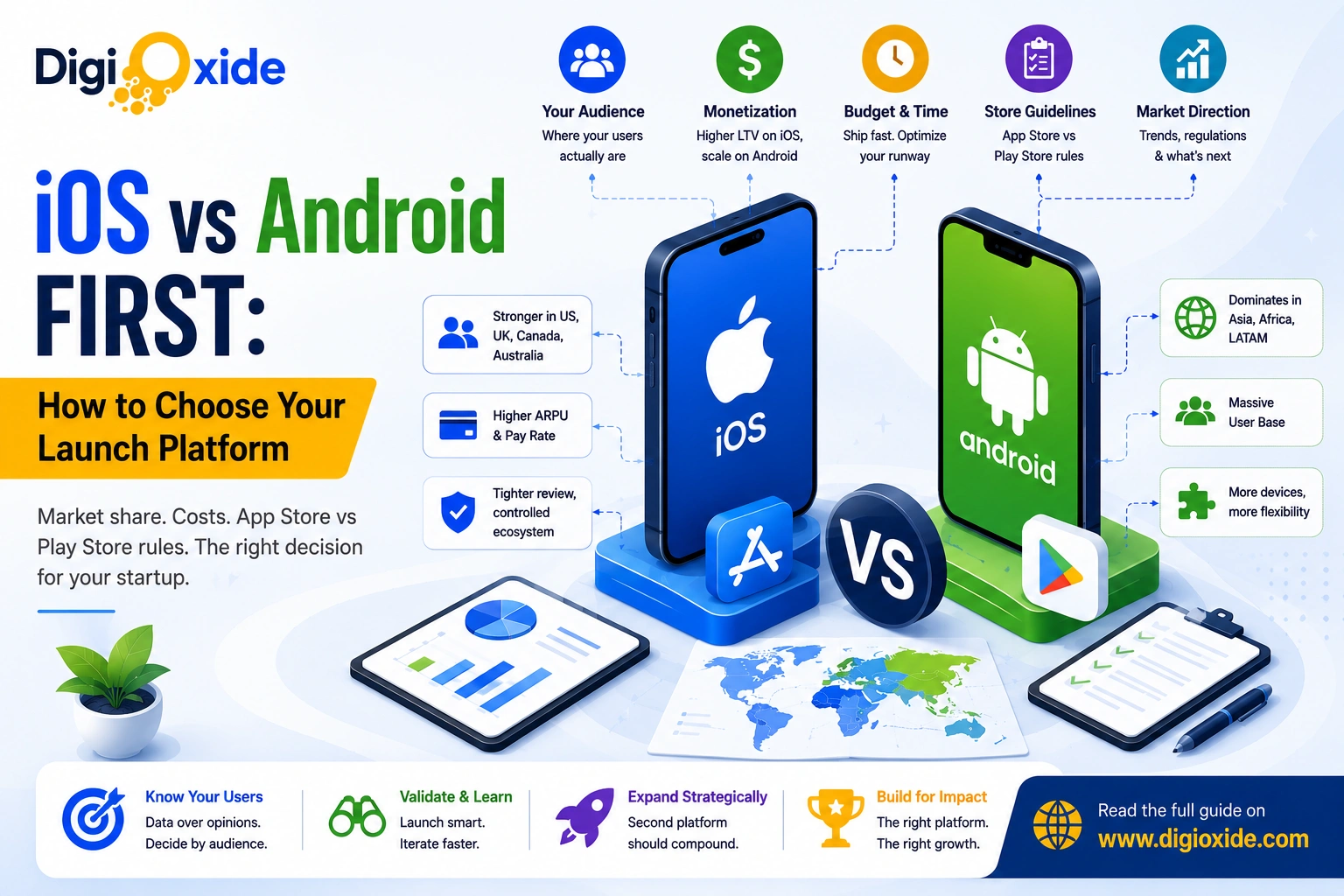
iOS vs Android First: How to Choose Your Launch Platform

The iOS vs Android launch decision is often reduced to a binary market-share argument, and that framing loses money. The right decision is a match between your audience, monetization model, budget, and time-to-market pressure, made against the actual differences in App Store and Play Store review guidelines, development cost by platform, and user demographics by OS. This guide from Digioxide Technologies Private Limited walks through the real trade-offs, gives you the platform market share by region that matters for your users, explains how the EU Digital Markets Act is quietly reshaping iOS launch strategy, and offers a decision framework you can defend to investors, board members, or your own future self.
Every founder building a mobile product runs into the same fork. Ship iOS first. Ship Android first. Or ship both, and possibly ship neither well. The wrong choice at this fork rarely kills a product outright, but it consistently makes the first year harder than it needed to be: slower feedback, higher burn, feature debt on the second platform, and a growth curve that looks flat when it should have been climbing.
The decision looks binary, but in practice it turns on five inputs: where your users actually live, how you plan to make money, your budget and speed constraints, the technical realities of each platform’s review process, and where the market itself is heading. Digioxide Technologies Private Limited builds mobile app development services for startups and enterprises across US, European, and emerging markets, and the framework below is the one we walk clients through before writing a line of code.
Why This Decision Matters More Than the Old Debate Suggests
“iOS first” and “Android first” have both become slogans, and slogans stop being useful the moment they replace analysis. The real cost of picking wrong is not that you cannot recover; it is that you spend six months building for the wrong audience, then rebuild for the right one with less runway.
Three practical consequences flow from the choice:
- Feedback velocity: The platform you ship first is where your first thousand users, your first paying customers, and your first product iterations live. Choosing the platform where your target user actually spends time changes how fast you learn.
- Cost of the second build: Once your first platform stabilizes, expanding to the second is meaningfully cheaper than starting both at once, and much cheaper than rebuilding a poorly received first launch.
- Distribution economics: App Store and Play Store have different review timelines, different discovery mechanics, and different revenue-share treatment for specific business models. Your monetization strategy influences which store’s rules help or hurt you.
The rest of this guide walks through those five inputs in order, then converts them into a decision framework you can act on.
Platform Market Share by Region
Global market share tells you almost nothing about which platform your users are on. The number that matters is the share in the specific country or region where you plan to acquire your first ten thousand users.
Broad picture (rounded shares, treat as directional):
| Region | iOS share | Android share | Notable characteristic |
|---|---|---|---|
| United States | Roughly 55 to 60 percent | Roughly 40 to 45 percent | Higher iOS skew among 18 to 34 and higher-income segments |
| Canada, Australia, UK | 50 to 60 percent iOS | 40 to 50 percent Android | Similar consumer patterns to the US |
| Western Europe (aggregate) | 30 to 40 percent iOS | 60 to 70 percent Android | Wide country-level variation |
| Nordic countries, Netherlands | 45 to 55 percent iOS | 45 to 55 percent Android | Close to parity, iOS often edging ahead |
| Germany, France, Italy, Spain | 25 to 35 percent iOS | 65 to 75 percent Android | Android-dominant on aggregate |
| Latin America | 10 to 20 percent iOS | 80 to 90 percent Android | Strong Android skew, price-sensitive |
| India | 3 to 6 percent iOS | 94 to 97 percent Android | Overwhelming Android dominance |
| Southeast Asia (aggregate) | 15 to 25 percent iOS | 75 to 85 percent Android | Android-first in most markets |
| MENA, Africa | 10 to 20 percent iOS | 80 to 90 percent Android | Android-dominant, some Gulf exceptions |
| China | Approximately 20 to 25 percent iOS | Approximately 75 to 80 percent Android | Distinct app-store landscape, Google Play absent |
Practical implications:
- A US B2C consumer product should look at iOS first for concentrated affluent users and higher willingness to pay, but should not ignore Android if the target segment skews older or price-conscious.
- A B2B product for US and Western European enterprises faces a lopsided reality: employees on iPhones dominate management ranks in many US organizations, while frontline and field workforces in the same organizations often use Android.
- An emerging-markets product should almost always launch Android first, because iOS market share is small enough that iOS-only means invisible.
- A UK, Canadian, or Australian product can reasonably start with iOS given the market skew, but Android should be on the near-term roadmap.
- A regional or global product should map platform choice country by country, not by continent, because within-region variation is often larger than between-region variation.
None of these shares are static. Recheck the numbers for your specific markets before finalizing scope, and give more weight to user surveys of your specific target segment than to national averages.
The Context: What Changed and Why It Matters
Three shifts in 2024 to 2026 have changed the calculus for platform choice, and every serious launch plan should account for them.
The EU Digital Markets Act: Since 2024, the DMA has forced Apple to permit alternative app stores and, in the EU, third-party payment mechanisms with reduced Apple commissions on specific transaction types. The practical effect for founders: EU iOS launches have new distribution and monetization options, and the operational complexity of taking advantage of them is nontrivial. Products with high in-app-purchase revenue and a European audience should model both the App Store commission scenario and the alternative-payment scenario before choosing platforms.
AI-driven review timelines: Both Apple and Google have accelerated automated review pipelines, and typical initial reviews now complete in hours to a few days for most straightforward apps. The old “iOS review takes weeks” heuristic is stale; the new question is whether your specific business model triggers manual review, which can still take several days to weeks.
Foldables and form-factor diversification: Android’s foldable and large-screen device categories are meaningfully larger than they were three years ago, and the tablet market has quietly matured. Any app whose user experience benefits from screen real estate now has more Android surface area to design for than in the past.
iOS 18 and Android 15 baseline expectations: Both platforms now assume features (interactive widgets, deeper AI integration, richer notifications, redesigned control surfaces) that materially affect what a first-launch product should support. Building against the current-minus-one OS baseline is the practical target for both platforms.
The takeaway: platform choice is not the same decision it was in 2020. Any advice you read that ignores the DMA, current review timelines, or contemporary form factors is planning against a market that no longer exists.
Which Platform Should a Startup Launch On First?
Here is the honest answer no vendor blog will write plainly: for most US and Western-European B2C startups building consumer products with monetization ambitions, iOS first is the defensible default. For most emerging-markets products, and for products serving frontline workforces, Android first is the defensible default. Anything else is a judgment call best made with real numbers about your specific users.
The five variables that actually determine the choice:
1. Where your users live: Not where you live, and not where you think your users live. Where the specific segment you plan to acquire actually spends time. If you have a waitlist, look at its geographic distribution. If you have a competing product to study, check where its user base skews.
2. How you plan to make money: iOS users have historically converted to paid apps and in-app purchases at higher rates than Android users, especially in Western markets. If your revenue depends on consumer spending inside the app, this weights the decision toward iOS in those markets. If you monetize through ads or a subscription tied to a broader service, the platform mix matters less.
3. Your target user profile: Age, income, region, and profession all correlate with platform. Products for early-career professionals in US metros skew iOS. Products for global remittance, mobile-first payments, or emerging-market services skew Android. Products for enterprise field workers often skew Android because of device management economics.
4. Your budget and speed: A single-platform launch takes less capital and reaches users faster than a dual launch, and finishing one strong launch beats delivering two mediocre ones. If your runway supports only one polished MVP, that is the constraint that decides the platform.
5. Your competitive context: If your direct competitors are all on one platform and starving on the other, that gap is either an opportunity or a warning. Check which side by talking to users, not by guessing.
For teams evaluating mobile app development services for startups choosing a platform against a hard runway constraint, our default guidance is: launch one platform well, ship on a real timeline, learn from real users, then expand to the second platform with the confidence of a working product and paying customers. The counterintuitive point is that the platform you launch second usually gets a better product than the platform you launch first, because you have already learned what to build.
Is It Cheaper to Build an iOS App or an Android App First?
For most modern first launches, iOS is marginally faster and slightly cheaper to build than Android, though the gap is smaller than the internet claims and reverses on specific project types. Here is the honest breakdown.
Why iOS is often faster and cheaper: Teams offering focused iOS app development services usually work against a narrower matrix than their Android counterparts. A tighter range of devices and screen sizes means less UI adaptation work. A more current operating system on the median user’s device means fewer version-compatibility branches. A more homogeneous chipset landscape means less performance-tuning across low-end and high-end hardware. Xcode and Swift together produce a fairly consistent developer experience.
Why Android sometimes evens the score: Serious Android app development work still involves real fragmentation costs, but modern tooling has closed most of the historical gap. Device and screen fragmentation still add QA hours, even with modern layout systems. Longer OS support tails mean more version compatibility work. Google Play Store’s review process is typically faster, which shortens iteration cycles. And Android’s flexibility can accelerate specific features (background processing, deep OS integrations, hardware access) that are more restricted on iOS.
What that means in dollars: Ranges we quote for a first-launch MVP built by a mid-market engineering team:
| Scope | Native iOS MVP | Native Android MVP | Cross-platform MVP (Flutter or React Native) |
|---|---|---|---|
| Focused MVP (single core workflow) | $45,000 to $90,000 | $50,000 to $100,000 | $55,000 to $110,000 |
| Standard MVP (auth, backend, three to five core screens) | $80,000 to $160,000 | $90,000 to $180,000 | $100,000 to $190,000 |
| Feature-rich MVP (offline, real-time, integrations) | $150,000 to $300,000 | $160,000 to $320,000 | $170,000 to $320,000 |
Practical notes on those numbers:
- The Android premium averages 10 to 15 percent for a comparable native build, driven mainly by device diversity and QA. It is not the 40 to 50 percent gap sometimes claimed.
- Cross-platform is not automatically cheaper than one native platform; it is roughly cheaper than building both native platforms, but slightly more expensive than either single platform on its own for the first release.
- Hidden costs hit both platforms: Apple Developer Program and Google Play Console fees are minor; App Store Optimization work, localization, and post-launch iteration are not.
- The delivery-model lever remains the biggest number. US onshore rates of $120 to $200 per hour versus experienced offshore teams at $25 to $50 per hour deliver the same scope for 40 to 60 percent less, which is the model Digioxide operates.
For a founder trying to answer “cost difference between iOS and Android app development” in one sentence: budget the same either way, choose the platform your users are on, and put any savings into design, testing, and post-launch iteration rather than into building a second platform prematurely.
App Store Review Guidelines vs. Play Store Rules: What Actually Differs
The old “Apple is strict, Google is lax” framing of the app store review guidelines is out of date. Both platforms now enforce material rules, and both regularly reject apps for reasons founders find surprising if they did not check the guidelines up front.
Where the App Store is stricter today:
- Payments outside Apple’s system. Consumer digital-goods and subscription apps generally must use Apple’s in-app purchase system for the paid content, with narrow exceptions carved out by regulation (notably the EU DMA) and by specific business models like “reader” apps.
- UI and design consistency. Apple’s Human Interface Guidelines are enforced more actively; visually inconsistent or poorly polished apps get rejected or held for revision.
- Privacy declarations. App Privacy labels and required tracking disclosures are non-negotiable, and misdeclarations lead to takedowns.
- Kids category and age gating. Anything targeting or accessible to children triggers additional review scrutiny and required parental gating.
Where Google Play has tightened significantly:
- Data safety declarations. Similar to Apple’s privacy labels, with enforcement following.
- Personal loan, health, and financial apps. Category-specific policies with documentation requirements.
- Background access to sensitive permissions. Location, SMS, and call log access all face restrictions and require justified use.
- Play Integrity requirements. Apps operating in higher-risk categories must implement platform integrity checks to maintain distribution.
Review timeline realities:
- Straightforward apps typically clear initial review on both platforms within 24 to 72 hours.
- Apps triggering manual review (payments, health, kids, crypto, gambling-adjacent categories) can take several days to a few weeks on either platform.
- Rejections and resubmissions are the biggest actual timeline risk. Plan for one to three review cycles on either platform for a first launch, not for “instant approval.”
Practical takeaway: read the current guidelines for the specific store and the specific category before you build, not before you submit. Retrofitting an app to satisfy a policy you missed is a common and expensive avoidable delay.
User Demographics by OS: What the Data Says
Beyond broad market share, three demographic patterns repeatedly show up in US and Western European data, and they matter for product decisions.
Income and spending: iOS users consistently show higher average incomes and higher app spending per capita in Western markets. This gap is real but often overstated; the actionable version is that iOS is a better first platform for products monetizing through in-app purchases of premium content, while ad-supported or subscription-service products care less.
Age: iOS skews younger among US teens and young adults, and skews older among affluent 50-plus segments. Android has broader midlife penetration in the US and dominates most global age brackets outside affluent Western markets.
Occupation and device management: Enterprise environments still show a bifurcation: knowledge-worker and management layers skew iOS, especially in the US, while frontline, field, retail, and industrial workforces skew Android partly because Android’s device management economics fit the fleet-deployment model better.
Loyalty and switching: Both platforms retain users at high rates; the mythical “Android users are about to switch to iOS” or vice versa is not a large enough population to plan a product around. The users you can reach on the platform you launch on are largely the users who will still be on that platform two years later.
Use these patterns as inputs, not as commandments. A well-run user survey of your specific target segment beats aggregate demographics for every material decision.
Can I Launch on Both iOS and Android at the Same Time?
Yes, but only under specific conditions, and doing it badly is more expensive than doing one platform well and adding the second later.
When simultaneous launch actually works:
- You have the budget for either two well-resourced native teams or a cross-platform team with the seniority to handle the complexity that cross-platform introduces at scale.
- Your product’s core is not platform-specific. Standard consumer app patterns (auth, list-detail flows, forms, messaging, media) translate cleanly. Anything depending heavily on OS-specific integrations (advanced sensors, deep OS extensions, platform-native design idioms) resists cross-platform expression.
- Your audience is split roughly evenly across platforms, so a single-platform launch actually leaves half the market unreached in a way that matters commercially.
- You have the operational bandwidth to support two platforms from day one: separate app store listings, separate review cycles, dual QA, dual crash monitoring, dual analytics, dual customer support paths.
When simultaneous launch is the wrong call:
- Your runway is tight: A dual launch delays real user feedback by weeks or months compared with a focused single-platform launch, and time to feedback is often the scarcest resource for a startup.
- Your product’s core value depends on high-quality execution: A polished single-platform launch beats two mediocre launches in almost every case.
- You do not have a validated audience yet: Building for two platforms before you know which one your users actually prefer is spending capital to buy false optionality.
Three real paths to a two-platform product:
- Native single-platform first, native second later: The lowest-risk path when the first platform is clearly the priority audience and the product’s user experience benefits from platform-native polish.
- Cross-platform from day one: Modern frameworks like Flutter and React Native can produce a genuinely production-quality dual-platform app with one codebase, at the cost of some platform-native affordances. Whether this is right for your product depends on the specific user-experience bar you need to hit, and our guide to native versus cross-platform mobile app development breaks down the tradeoffs in detail.
- Native for one platform, cross-platform for the other: Less common but occasionally optimal: build native for the platform where your differentiation matters most, and use cross-platform to reach the second audience with acceptable rather than exceptional experience.
For most startups asking “should I launch my app on iOS or Android first,” the practical answer is single-platform first, and the platform is whichever fits variables one through five above. For enterprises with committed users on both platforms and the budget to serve both properly, simultaneous launch through cross-platform tooling is increasingly the pragmatic choice.
Time-to-Market Considerations
Time to market is one of the underweighted variables in this decision. Four factors move it:
Team composition and availability: Experienced iOS developers, experienced Android developers, and experienced cross-platform developers have different labor markets, and the platform where you can staff quickly beats the platform that theoretically fits your product better if the staffing gap is months.
Design and QA overhead: Android device diversity adds QA time, and Apple’s design bar adds design iteration time. Both are real, but the trade is roughly even in absolute terms for a well-run project.
Store review realities: Both stores are faster than they were, but Apple’s manual reviews for specific categories still add unpredictable delay. Plan for two full review cycles rather than one, and build the resubmission buffer into your launch date.
Post-launch iteration: The platform you launch first is the platform on which you learn fastest. The faster your review cycle, the faster you iterate; Google Play’s typically faster review supports higher-cadence iteration for products where that matters.
For time-to-market considerations in a first launch, and for practical time to market considerations across the full build cycle, the rule of thumb: single platform beats dual platform by four to eight weeks on median, and native beats cross-platform by two to four weeks on median. Both gaps compress on well-run projects with the right team.
A Decision Framework by App Category
Here is a compressed framework matching common app categories to the platform choice we see work most consistently:
| App type or context | Recommended first launch | Why |
|---|---|---|
| Consumer premium content, IAPs, subscriptions in US and UK | iOS | Higher willingness to pay in relevant segment |
| Enterprise B2B for US knowledge workers | iOS | Executive and manager device skew |
| Fintech for US mass-market users | iOS or cross-platform | Balanced demographics, security bar suits iOS |
| Fintech or payments for Latin America, Africa, India, SE Asia | Android | Overwhelming market share |
| Field workforce, logistics, delivery apps in US | Android | Device management and cost economics |
| Global consumer product with real ambitions | Cross-platform, with native later where differentiation matters | Reach beats polish for initial validation |
| Health, fitness, wellness in US | iOS | Higher engagement and IAP conversion |
| Ad-supported content in emerging markets | Android | Volume matters more than per-user revenue |
| Gaming with heavy monetization | iOS in Western markets, Android elsewhere, cross-platform globally | Match revenue model to user spending patterns |
| Enterprise device fleets you control | Match to fleet OS | Distribution is decided for you |
The framework is a starting point, not a prescription. Every product has specific context that should override a category default.
When Native Beats Cross-Platform Later
A common miscalculation: teams launch cross-platform, hit product-market fit, and then discover they need native performance or platform-specific features they cannot execute cleanly on their existing codebase. The mature move is to plan for that transition rather than being surprised by it.
Signs your cross-platform code will hit a ceiling later:
- Your product’s core value depends on real-time performance, complex graphics, or deep hardware integration
- Your competitors on native platforms consistently ship platform-specific features you cannot match
- Your app’s crash and performance metrics on one platform meaningfully lag the other
- Your team spends unbounded time working around framework limitations rather than building product
If any of these apply, budget for a phased migration to native on one or both platforms once product-market fit is proven. This is a legitimate architecture decision, not a failure; many successful apps start cross-platform and add native code paths where they earn their weight.
How Digioxide Technologies Private Limited Approaches the Platform Decision
Digioxide Technologies Private Limited works with founders and product leaders on this custom mobile app development decision before the first line of code, because retrofitting a platform choice is the most expensive kind of fix. What that looks like in practice:
- Audience-first discovery: We ask about your specific users and market, not your assumptions about them, and we help validate those assumptions with quick user research when the data is not yet clear.
- Cost modeling both paths: We produce fixed-scope proposals for iOS-only, Android-only, cross-platform, and dual-native so the decision is made against real numbers.
- Team composition tuned to platform: Senior native engineers when the choice is single-platform native, senior cross-platform architects when the choice is Flutter or React Native, and blended teams when the roadmap will span both.
- Deliberate roadmap sequencing: We plan the second platform’s launch from the first day of the first platform, so version two of your first platform and version one of your second platform share as much as possible.
- Offshore economics with US-business-hours communication: Senior engineering at 40 to 60 percent below onshore-only totals, delivered fixed-scope after discovery, so the number you approve is the number you pay.
- A long partner relationship: We build products we expect to support for years, which changes every design and architecture decision made in month one.
The first-launch platform decision is genuinely important, and it is also recoverable. What matters more is picking with clear eyes, executing on a real timeline, and building a roadmap that treats the second platform as an intentional expansion rather than an emergency.
Choose the Platform, Then Build It Right
The right first platform is the one where your specific users spend time, where your monetization model works best, where your budget stretches furthest, and where your team can execute a polished launch. Get those four right and the iOS-versus-Android debate resolves itself; get any of them wrong and no amount of marketing or technical polish will fully recover the loss.
If you are working through this decision, start with a structured discovery conversation. Digioxide Technologies Private Limited will map your audience, model both paths, and give you a fixed-scope proposal you can defend to investors or your board. Contact our team to schedule it, and bring what you know about your users. That is where every good launch decision starts.
Frequently Asked Questions
Is it cheaper to build an iOS app or an Android app first?
Native iOS is typically 10 to 15 percent cheaper than native Android for a comparable first launch, driven mainly by less device and screen fragmentation and less version-compatibility work. The gap is real but smaller than the internet suggests, and it reverses for products with heavy background processing or deep OS integrations where Android is more flexible. Cross-platform frameworks like Flutter and React Native are more expensive than either single native platform but cheaper than building both native platforms. Delivery model (onshore versus blended offshore) moves the total more than platform choice does.
Which platform should a startup launch on first?
For most US and Western European B2C consumer startups monetizing through in-app purchases or subscriptions, iOS first is the defensible default. For emerging-markets products and for products serving frontline workforces, Android first is the defensible default. For enterprise B2B products targeting US knowledge workers, iOS first typically matches the buyer’s device. In every case, validate against your specific audience’s platform mix rather than trusting national averages.
Can I launch on both iOS and Android at the same time?
Yes, if your budget supports either two well-resourced native teams or a senior cross-platform team, your audience is split evenly enough that a single-platform launch would leave meaningful money on the table, and you have the operational bandwidth for dual app store listings, review cycles, and support paths. If your runway is tight or you have not yet validated audience preference, a focused single-platform launch typically produces better product and faster learning than a dual launch.
How much does it cost to build both iOS and Android apps?
A dual native build typically costs roughly 1.7 to 1.9 times a single native build, not double, because backend, design, and QA infrastructure are shared. Cross-platform frameworks reduce total cost to roughly 1.1 to 1.3 times a single native build, with tradeoffs on platform-native polish and access to specific OS features. Both numbers assume similar quality bars on each platform; underinvesting in either platform after launch is a common and expensive false economy.
What is the actual App Store versus Play Store review time?
Straightforward apps typically clear initial review on both platforms in 24 to 72 hours. Apps triggering manual review (payments, health, kids, crypto, gambling-adjacent) can take several days to a few weeks on either platform. The largest actual timeline risk is rejection and resubmission cycles, not initial review speed; plan for one to three review cycles for a first launch on either store.
Does the EU Digital Markets Act change how I should launch in Europe?
For products with EU users and material in-app-purchase revenue, yes. The DMA has forced Apple to permit alternative app stores and, in the EU, third-party payment mechanisms with reduced Apple commissions on specific transaction types. This creates new distribution and monetization options for EU iOS launches and adds operational complexity worth modeling before choosing platforms. It does not change the launch decision for products without meaningful in-app-purchase revenue.
Should I build native or use a cross-platform framework?
Native beats cross-platform for products whose value depends on platform-specific user experience, real-time performance, or deep OS integration. Cross-platform beats native for products where speed to market on both platforms matters more than platform-native polish, especially for early validation. Modern Flutter and React Native builds are genuinely production-quality for most consumer app patterns; the decision is a judgment call, not a technical constraint.
When should I add the second platform after launching on the first?
When product-market fit is validated on the first platform (real users, real retention, real revenue if applicable), when a meaningful share of your target audience or your specific customers are asking for the second platform, and when your team has bandwidth to support both without degrading the first. Most healthy startups add the second platform within 6 to 18 months of the first launch, with the exact timing driven by traction and capital rather than a calendar.
