
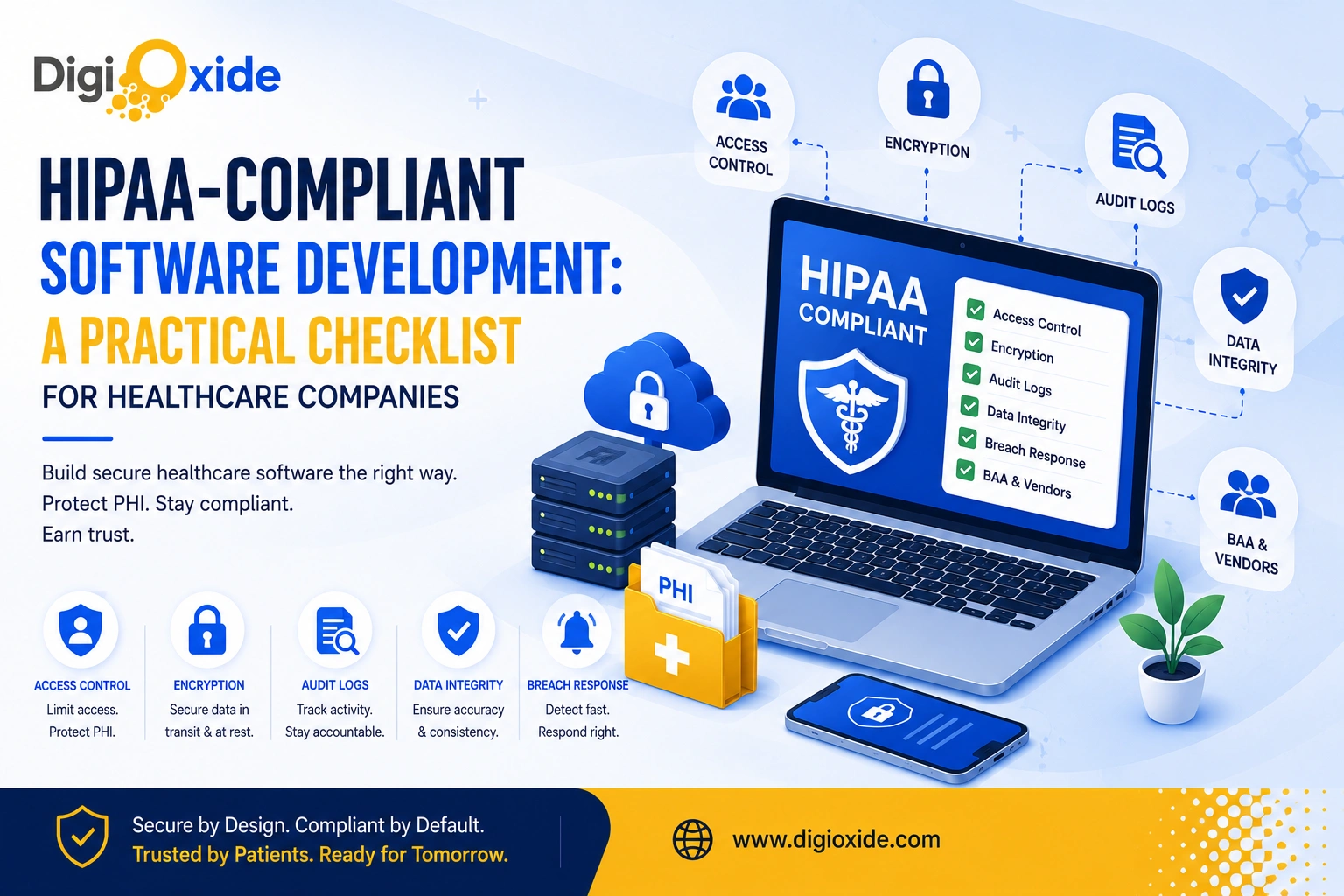
HIPAA-Compliant Software Development: A Practical Checklist for Healthcare Companies

HIPAA compliance is not a badge, a firewall, or a checkbox at the end of a sprint. It is a set of designed safeguards for protected health information (PHI) that lives inside a software product’s architecture, code, cloud configuration, vendor contracts, and daily operations. This guide from Digioxide Technologies Private Limited gives healthcare companies a practical HIPAA compliance checklist and a HIPAA compliant software development checklist: what qualifies as PHI, the technical requirements auditors actually look for, when a Business Associate Agreement is required, what happens when software fails, what the proposed 2026 Security Rule update means for your build, and realistic cost ranges for shipping software that will still be compliant a year after launch.
Every healthcare product founder eventually asks the same question: what does it actually take to be HIPAA compliant? The blog posts that dominate this search are dense with regulatory quotes, thin on engineering specifics, and often out of date. Yet the answer matters more every year. Penalty ceilings have risen, enforcement has expanded to smaller organizations, and the proposed update to the HIPAA Security Rule is set to shift several long-standing best practices into explicit requirements.
Digioxide Technologies Private Limited builds regulated healthcare software for US organizations: telehealth platforms, patient management systems, EHR-connected applications, and healthcare SaaS products. Everything below is drawn from how we scope, design, and ship those systems, and how we help clients pass the security reviews that come attached to enterprise contracts.
HIPAA Foundations Every Team Should Get Right
Before the checklist, three fundamentals worth locking down, because most of the mistakes we see stem from getting these wrong.
What HIPAA actually is: The Health Insurance Portability and Accountability Act, together with the HITECH amendments and successor rules, is the US federal framework governing protected health information. Four rules matter for software development: the Privacy Rule (permitted uses and disclosures of PHI), the Security Rule (the technical, administrative, and physical safeguards for electronic PHI), the Breach Notification Rule (what happens when PHI is exposed), and the Omnibus Rule that extended obligations to business associates and subcontractors.
Who is bound: Covered entities include health plans, healthcare clearinghouses, and healthcare providers who transmit health information electronically. Business associates are the vendors and service providers, including software companies, that create, receive, maintain, or transmit PHI on a covered entity’s behalf. If your product handles PHI for a covered entity, you are a business associate, and HIPAA applies to you directly.
What counts as PHI: Protected health information is individually identifiable health information in any form. Names, dates connected to an individual, contact details, medical record and account numbers, biometric identifiers, device identifiers, and health condition data all qualify. Data becomes non-PHI only through formal de-identification methods defined by the Privacy Rule. Wellness data that a fitness app collects for a consumer can fall outside HIPAA yet still be regulated by other state and federal laws, which is why “not covered by HIPAA” never means “not regulated.”
Healthcare data protection under HIPAA is not one control; it is a stack of them working together, and the goal of the checklist below is to make sure your secure healthcare software product has each layer in place before, not after, an audit or an enterprise security review.
Now the practical part.
What Are the Technical Requirements for HIPAA Compliant Software?
Below is the technical requirements HIPAA compliant software development checklist we build and audit against. Every item maps to specific safeguards under the Security Rule. Nothing here is optional in a serious healthcare product.
1. Access Control and Authentication
- Unique user identity for every person and every system that touches PHI (no shared accounts, no anonymous service credentials)
- Role-based access control that grants the minimum privileges necessary for each role
- Multi-factor authentication for all clinical, administrative, and privileged accounts (a proposed Security Rule requirement, and already the standard we build against)
- Automatic logoff and session timeouts on any interface that exposes PHI
- Emergency access procedures documented and technically supported for legitimate break-glass scenarios
2. Encryption Everywhere
- Data encryption standards applied in transit using current TLS across every connection that carries PHI, including internal service-to-service calls
- Data encrypted at rest in databases, object storage, backups, message queues, caches, and any staging environment (encryption is the safe-harbor control that determines whether an exposure event triggers breach notification)
- Managed key handling using a hardware security module or cloud-native key management service, with documented rotation
- No PHI in URL parameters, logs, error messages, monitoring tools, mobile push notifications, or SMS reminders
3. Audit Logs and Monitoring
- Access control and audit logs recording every read, write, export, and permission change for PHI, with actor, subject, action, and timestamp
- Tamper-evident storage of logs with retention that satisfies the six-year HIPAA documentation baseline
- Regular review of the logs, with automated anomaly detection where volume warrants
- Monitoring and alerting for security-relevant events (failed logins, permission escalations, mass data reads)
4. Data Integrity
- Technical mechanisms that detect unauthorized modification of PHI, whether from an insider, an attacker, or a bug
- Immutable or versioned records for clinical data where clinically appropriate
- Backup and disaster recovery tested against actual restore, not just checked as configured
5. Secure Data Handling and Storage
- Documented PHI data flows: where PHI enters, where it lives, where it moves, and where it is disposed
- Data minimization applied at every collection point (collect only what the workflow requires)
- Secure disposal procedures for retired records, keys, and hardware
- Production PHI never used in development, staging, or demo environments (synthetic or de-identified test data only, no exceptions)
6. Application Security
- Secure coding standards, dependency scanning, and secret management enforced in continuous integration
- Static and dynamic application security testing before every meaningful release
- Penetration testing at defined intervals and after major changes
- A documented vulnerability response process with named owners and timelines
7. Infrastructure and Cloud Configuration
- HIPAA-eligible cloud services only, with the provider’s Business Associate Agreement in place before any PHI touches the environment
- Network segmentation isolating PHI-bearing workloads from general workloads
- Least-privilege identity and access management on cloud accounts, with root access locked down
- Infrastructure as code so configuration is reviewable and reproducible, not tribal knowledge
8. Mobile and Endpoint Considerations
- No PHI stored on-device unless a specific workflow demands it, and then only encrypted with authenticated access
- Device-side session controls, biometric or PIN unlock, and remote-wipe capability for organization-managed devices
- No PHI in push notification content, screenshots, or debug logs
9. Third-Party and Integration Controls
- Business Associate Agreements executed with every subprocessor that will touch PHI, from cloud host to email provider to analytics vendor
- Scoped API credentials for every integration, with rotation and revocation procedures
- Interface logging so every PHI exchange is attributable and reviewable
10. Governance, Documentation, and Training
- Named privacy and security officers (a HIPAA administrative safeguard), with regulatory compliance software or GRC tooling that tracks controls, evidence, and reviews in one place instead of scattered spreadsheets
- A written risk analysis and risk management plan, updated at least annually and after significant changes
- Policies covering workforce training, access provisioning and deprovisioning, sanction, and incident response
- Training for every workforce member with access to PHI, documented with completion dates
Treat this as a build-time and operate-time checklist, not a launch-time one. HIPAA compliance is what the system does every day, not what it looked like on go-live morning.
Do I Need a Business Associate Agreement for My Health App?
Yes, in every case where your product creates, receives, maintains, or transmits PHI on behalf of a covered entity or another business associate. A Business Associate Agreement is not a formality; it is a HIPAA-required contract that defines how PHI may be used and safeguarded, obligates you to report incidents, and extends compliance obligations to your own subcontractors.
Practical guidance on business associate agreements:
- You sign BAAs with your customers who are covered entities, before your product touches their PHI. Enterprise buyers will not proceed without one, and you should not want to either.
- You sign BAAs with every subprocessor that touches PHI on your behalf. That includes your cloud host (AWS, Azure, and Google Cloud all offer HIPAA BAAs on eligible services), transactional email and SMS providers, error monitoring tools, analytics platforms, video infrastructure vendors, and any AI service processing PHI. The BAA chain is unbroken or the compliance chain is broken.
- A signed BAA is necessary but not sufficient. The paper contract does not encrypt anything or configure your cloud correctly; the safeguards elsewhere in this checklist do that.
- Some vendors refuse BAAs. If a critical vendor will not sign one, that vendor cannot be in the PHI path, and rearchitecting to remove them is cheaper than a breach.
- Direct-to-consumer wellness apps that do not serve a covered entity may sit outside HIPAA and therefore outside the BAA regime. They are increasingly regulated by state consumer health privacy laws, the FTC Health Breach Notification Rule, and app store policies, so the safeguards in this checklist are still the right floor.
Digioxide Technologies Private Limited executes a BAA as a standard part of onboarding for every engagement where we will handle client PHI, and we design integration architectures with BAA-covered subprocessors from the first diagram.
What Happens If Healthcare Software Isn’t HIPAA Compliant?
The consequences fall into five categories, and any one of them can end a healthcare software business.
Civil monetary penalties: The HIPAA penalty structure has four tiers, from unknowing violations to willful neglect. Under HITECH and subsequent inflation adjustments, penalties climb into six figures per violation category with annual maximums in the millions. A single incident often triggers penalties across multiple categories simultaneously.
Criminal penalties: Knowing violations, and especially violations for personal gain or malicious harm, can bring criminal charges, fines up to $250,000, and imprisonment.
Breach notification obligations: A breach of unsecured PHI triggers notice to affected individuals, the Department of Health and Human Services, and, for breaches affecting 500 or more individuals in a state or jurisdiction, prominent media outlets. HHS publishes larger breaches on a public list that stays online. Encryption of the exposed data is the safe-harbor control that determines whether an event even counts as a reportable breach.
State laws and other federal frameworks: State attorneys general can enforce HIPAA and separate state privacy laws. The FTC has taken enforcement action against health-adjacent products for privacy misrepresentations and breaches, including under its Health Breach Notification Rule. Several states now have consumer health data statutes that reach beyond HIPAA-covered entities.
Contract, market, and reputational damage: Enterprise customers will terminate contracts, indemnification clauses will trigger, procurement will blacklist future business, security review will become a moving target on every new deal, and the incident stays public long after the technical fixes are done. For startups, this is often the most consequential category: a preventable compliance failure ends the sales pipeline before penalties are even calculated.
How costly, in blunt terms: Direct penalties, forensic investigation, breach notification, credit monitoring, legal defense, and remediation for a moderate breach routinely add up to seven figures. Building the safeguards in from the start costs a modest share of the initial build. The math is not close.
Cost of HIPAA Compliant App Development
Compliance is not a separate line item you can strike; it is a way the whole product is built. That said, here are the ranges we quote for HIPAA compliant app development in the 2026 US market, and the incremental effect compliance adds to comparable non-regulated builds.
| Scope | Typical investment | Typical timeline |
|---|---|---|
| Focused single-workflow HIPAA app or module | $50,000 to $120,000 | 3 to 5 months |
| HIPAA-compliant MVP (patient app, telehealth, or PHI-handling SaaS) | $100,000 to $220,000 | 4 to 7 months |
| Full HIPAA-compliant product with one or two integrations | $200,000 to $400,000 | 6 to 10 months |
| Enterprise or multi-tenant regulated healthcare platform | $400,000 to $800,000 and up | 9 to 18 months |
The compliance-specific work inside those ranges typically covers:
- Risk analysis, threat modeling, and safeguard design during architecture
- Encryption and key management setup on HIPAA-eligible infrastructure
- Access control, audit logging, and monitoring implementation
- Business Associate Agreement execution with subprocessors
- Security testing including penetration testing
- Documentation for internal use and customer security reviews
A HIPAA compliant software development checklist for startups: Founders typically overspend by underscoping the compliance work early, then paying for rework once enterprise buyers force real safeguards. The pragmatic sequence is: front-load risk analysis and architecture, ship an MVP that is genuinely compliant even if narrow, and delay features that add compliance surface (heavy integrations, AI on PHI, native apps) until the base is stable. Our MVP development and rapid prototyping practice scopes this deliberately, so version one earns trust with buyers and auditors instead of blocking them.
Ongoing costs: Budget 15 to 20 percent of the build cost annually for security patching, dependency updates, log review, penetration testing, and adaptation to evolving rules. Compliance is a rate, not a moment.
The delivery-model lever: Onshore US rates of $120 to $200 per hour versus experienced offshore healthcare teams at $25 to $50 per hour mean a well-run blended model reduces total delivery cost by 40 to 60 percent without cutting scope. That is how Digioxide Technologies Private Limited runs healthcare engagements: senior engineers, US-business-hours overlap, and fixed-scope pricing after discovery, so the compliance work is priced honestly and does not become the surprise line on a change order.
The 2026 HIPAA Security Rule Update: What to Build For
Federal regulators have proposed the first significant update to the HIPAA Security Rule in over 20 years, and while the final rule is not settled as this is written, the direction of travel is clear enough to design against.
Signals worth building against now:
- Explicit mandates for controls that were previously “addressable.” Multi-factor authentication, encryption for PHI at rest and in transit, and other controls that many organizations already treated as required are set to become explicitly so.
- Network segmentation as a stated requirement, isolating PHI-bearing systems from general environments.
- Technology asset inventories documenting the systems that create, receive, maintain, or transmit PHI, kept current rather than assembled during audits.
- Regular vulnerability scans and penetration testing with defined frequency and remediation expectations.
- Incident response and contingency planning with tested procedures, not paper policies.
- Business associate scrutiny, including annual verification that subcontractors and vendors continue to meet their obligations.
None of this is a surprise for teams already building to modern security architecture. All of it is expensive to retrofit onto systems designed around older assumptions. Building forward from where the rule is going is the practical stance, and it is the stance we apply on every regulatory healthcare software engagement.
HIPAA-Compliant AI in Healthcare
AI is now embedded in the healthcare products we build most often: ambient documentation, intake triage, denial prediction, imaging analysis, and clinical decision support among them. HIPAA does not exempt AI, and getting compliance right on AI features requires a few specific decisions:
- Model interactions are PHI events. Any AI service that receives PHI is a subprocessor and needs a Business Associate Agreement, appropriate data handling terms, and residency controls consistent with your commitments.
- Prompt and completion logs need the same audit discipline as database access. Unlogged AI calls are unauditable data flows.
- Prohibit PHI use in model training by third parties unless explicitly permitted and appropriately contracted; enterprise offerings from major AI providers now support this posture.
- Minimum necessary applies to prompts too. Send the smallest slice of PHI the task requires; strip patient identifiers where the workflow allows.
- Retention, deletion, and residency requirements flow to the AI vendor and must be enforceable, not just promised.
- Governance for model behavior. Guardrails, evaluation, and human oversight for clinical use cases, and clear intended-use statements to keep features on the intended side of the software-as-a-medical-device line where relevant.
This is why our data and AI solutions work in healthcare is scoped compliance-first: we design AI features on top of an already-compliant architecture, not the other way around.
Common Mistakes That Sink Otherwise Good Products
Six failure patterns show up in nearly every troubled HIPAA project we have inherited:
- Treating compliance as a launch task. Auditing a finished product for HIPAA gaps is expensive and demoralizing; designing the safeguards in from day one costs a small fraction of that.
- Signing a BAA with the cloud host and stopping there. The cloud provider’s BAA covers infrastructure services; it does not cover how you configure them, and it does not cover the six other subprocessors also touching PHI.
- Skipping the risk analysis. Regulators explicitly expect a documented, current risk analysis, and its absence is a finding in itself, regardless of whether you have good controls.
- Leaving audit logs unwatched. Logs that nobody reviews are exhibits waiting to be presented in an incident. Automate review or narrow the scope so review is realistic.
- Using production PHI in staging or demo environments. This is a common finding in security audits and a fast route to a breach. Use synthetic or properly de-identified data or use nothing.
- Assuming HIPAA is your whole compliance map. For products serving specific populations or crossing state lines, add applicable state laws, FDA where clinical decision-making features cross into device territory, and SOC 2 for B2B credibility.
The through-line: HIPAA-compliant software development is the ordinary practice of building software carefully, with a specific set of controls and a habit of documenting what you did and why. Treat it that way and the audits and enterprise reviews become manageable events instead of crises.
What to Ask a HIPAA-Compliant Software Development Partner
Some vendors treat HIPAA as marketing; others build to it. These questions separate the two quickly.
- Show me a data flow diagram from a past project. Real compliance work leaves diagrams behind. Absence is diagnostic.
- How do you handle PHI in non-production environments? The right answer is “we do not, and here is how our synthetic data workflow works.” A vague answer disqualifies.
- Who has signed BAAs downstream from you on past healthcare projects? Named vendors, executed agreements, and rotation of credentials speak louder than a general assurance.
- How do you handle secrets and credentials in code and CI? Basic hygiene here predicts everything else.
- Walk me through an incident response you led. Every seasoned team has one. Vague answers are not seasoning; they are silence.
- What is your posture on the proposed Security Rule update? Ability to describe the direction of travel and how their default architecture already addresses it is a strong signal.
- Will you sign a BAA and provide documentation my compliance officer can use? The answer is either “yes, on standard terms” or you are talking to the wrong partner.
Why Healthcare Companies Choose Digioxide Technologies Private Limited
Digioxide Technologies Private Limited builds regulated healthcare software as a first-class discipline, not as a side offering. Clients who choose us get:
- Compliance engineered in from the first diagram. HIPAA safeguards, audit-ready logging, encrypted-by-default data handling, and BAA-covered subprocessors as the architecture, not as retrofits.
- A complete team under one roof, delivered through our custom software development services: discovery, UI/UX, engineering, quality assurance, security testing, and long-term support without the seams that create risk.
- US healthcare fluency. Real experience against Epic and Oracle Health sandboxes, HL7 and FHIR standards, e-prescribing networks, HIPAA-eligible cloud services, and the security reviews enterprise buyers run.
- Delivery economics that widen your runway. Senior engineering at offshore rates with US-business-hours overlap, typically 40 to 60 percent below onshore-only totals, priced fixed after discovery.
- Documentation your auditors will actually use. Risk analyses, policies, control matrices, and evidence artifacts prepared in formats compliance teams and enterprise procurement expect.
- A partner’s incentives, not a vendor’s. We build systems we expect to support for years, which changes every decision in month one.
Whether the deliverable is a patient app, a telehealth platform, an EHR-integrated workflow tool, or a healthcare SaaS product ready for its first enterprise security review, the standard is the same: engineered for compliance, priced honestly, and delivered by a team that has done it before.
Frequently Asked Questions
What are the technical requirements for HIPAA compliant software?
At minimum: unique user identities with role-based access control and multi-factor authentication for privileged and clinical accounts, automatic session timeouts, current-standard encryption for PHI in transit and at rest, tamper-evident audit logging of every PHI access with actor and timestamp, integrity controls that detect unauthorized modification, secure disposal of retired data and hardware, backup and disaster recovery tested against actual restore, application security testing and dependency scanning in CI, HIPAA-eligible cloud services with executed Business Associate Agreements, network segmentation, and documented policies and workforce training. Each maps to a specific Security Rule safeguard, and each is expected to be operational, not just designed.
What happens if healthcare software isn’t HIPAA compliant?
Civil monetary penalties across four violation tiers, with annual maximums in the millions; potential criminal penalties for knowing violations; breach notification obligations to affected individuals, HHS, and, above a size threshold, the media, with the incident listed publicly; state law enforcement actions and, for consumer-facing products, FTC enforcement including under the Health Breach Notification Rule; and the contract, procurement, and reputational damage that typically outweighs the direct penalties, especially for startups.
Do I need a Business Associate Agreement for my health app?
Yes, whenever your app handles PHI on behalf of a covered entity or another business associate. You sign BAAs with your covered-entity customers, and you sign BAAs with every subprocessor that touches PHI on your behalf, including cloud host, email and SMS providers, monitoring and analytics tools, video infrastructure, and AI services. Direct-to-consumer wellness apps that do not serve a covered entity may sit outside HIPAA but are increasingly regulated by state privacy laws and the FTC Health Breach Notification Rule, so the checklist here is still the right floor.
What makes an app HIPAA compliant?
The combination of designed technical safeguards (access control, encryption, audit logging, integrity controls, secure infrastructure configuration), executed contracts (BAAs across the vendor chain), governance practices (risk analysis, policies, training, incident response), and daily operational discipline (patching, log review, testing, deprovisioning). No single control makes an app compliant, and no product is “certified” HIPAA compliant; compliance is demonstrated through operating controls and documentation, evaluated in context.
How much does HIPAA compliant app development cost?
A focused single-workflow HIPAA app or module typically runs $50,000 to $120,000. A HIPAA-compliant MVP for a patient app, telehealth product, or PHI-handling SaaS runs $100,000 to $220,000 over four to seven months. A full HIPAA-compliant product with one or two integrations runs $200,000 to $400,000, and enterprise or multi-tenant regulated platforms range from $400,000 to $800,000 or more. Budget 15 to 20 percent of the build cost annually for ongoing security and compliance work, and expect blended offshore delivery to reduce totals by 40 to 60 percent versus onshore-only rates.
How long does HIPAA compliant software take to build?
A focused module ships in three to five months. A HIPAA-compliant MVP typically takes four to seven months. Full products with integrations run six to ten months, and enterprise platforms 9 to 18 months. A defensible risk analysis and architecture at the start is what keeps these timelines honest, because compliance issues discovered mid-build are more expensive to fix than compliance issues designed away.
Are all healthcare apps required to be HIPAA compliant?
Not all. HIPAA applies where covered entities or their business associates create, receive, maintain, or transmit PHI. Direct-to-consumer wellness and fitness apps that do not act on behalf of a covered entity may sit outside HIPAA, but they typically fall under other frameworks: the FTC Health Breach Notification Rule, state consumer health privacy laws, and app store policies. If your app touches personal health data, treat the safeguards in this checklist as the baseline regardless of which specific rule technically applies.
Is HIPAA compliance a one-time achievement?
No. Compliance is a continuous state: patched systems, current risk analyses, active log review, tested backups, refreshed training, ongoing subprocessor oversight, and updates when rules change. The proposed 2026 Security Rule update is a reminder that yesterday’s baseline is not tomorrow’s, and building forward from where the rule is going costs less than remediating later.
Compliance Is a Design Choice
The healthcare products that win in 2026 will not be the ones with the loudest HIPAA claims; they will be the ones whose safeguards are so ordinary and well-documented that security reviews stop being obstacles and become steps. Every item in this checklist is achievable on any project that treats compliance as an architecture decision rather than a launch task.
If HIPAA-compliant software development is on your roadmap, start with a structured discovery conversation, not a proposal request. Digioxide Technologies Private Limited will map your PHI flows, define the safeguards your product actually requires, name the vendors and BAAs involved, and give you a fixed-scope proposal you can defend to your board, your compliance officer, and your enterprise buyers. Contact our team to schedule it.
